


The industrious Peter Hyams began as a screenwriter, graduated to directing and soon took charge of the camera as well. He had his hand in a number of successful films. His most ill-advised step was to both write and direct a follow-up to Kubrick’s 2001: A Space Odyssey. Yet what he came up with was as good as an unwanted sequel could be. His surprise hit was Capricorn One, a show that helped promote the notion of faked space missions. For our money we still recommend a tiny Hyams film from 1974, the compelling Our Time. It’s about a ‘dated’ issue from the 1950s, that is surely making a tragic comeback.
One of Peter Hyams’ biggest and most promising films surely looked like a can’t-lose project on paper — a science-fiction action epic taking place entirely off-world, just like the previous mega-hit Alien. Instead of alien monsters, Hyams’ Outland imagines a workplace corruption situation in a futuristic space colony. The stakes are high but the focus remains narrow, on a lone lawman who insists on upholding the law. The unfolding of the film’s Philip K. Dick-like world is excellent, even if the second half of the story plays as a familiar western standoff, staged in a futuristic setting.

The film’s ace in the hole is its star Sean Connery, who brings credibility and worth to every role he takes on. Hyams sets up a fairly stock mystery situation, but Connery brings it to life. At 50 yeears of age, he’s still at the top of his game physically, something that this role requires.
The Con Amalgamate Corporation has established a chain of titanium mining operations on Jupiter’s moon Io. Miners sign on for long tours, living away from their families in an enclosed environment that can be psychologically punishing. The Con Am 27 plant is one of their most productive installations. The new Federal Marshal Bill O’Neil (Sean Connery) has just arrived, when he’s beset by a family problem. Discouraged by the equally confining lifestyle, Bill’s wife Carol (Kika Markham) leaves him, taking his son Paul (Nicholas Barnes). Thus Bill is even more isolated when he takes it upon himself to investigate a pattern of suspicious deaths among the plant workers. Bill knows that he can’t trust his own deputies. His Sgt. Montone (James B. Sikking) monitors his activities a little too carefully.

A conspiracy is in place to increase productivity, using a drug that puts the miners in danger — some become psychotic and kill themselves. Installation supervisor Sheppard (Peter Boyle) rushes the bodies away with no autopsies, but Bill manages to get a blood sample to the camp’s doctor, the rather cranky loner Dr. Marian Lazarus (Frances Sternhagen).
Bill has nobody to fall back on for support, as the corruption is already well established. Sheppard wants him to compromise, promising a kickback reward. When Bill holds out for doing the right thing, we know exactly what will happen. Sheppard brings in three ‘specialists’ to take care of Con Am 27’s uncooperative Marshal.

We love the environment created for Outland — it’s a convincing off-world mining operation. Elevators reach into the interior of the Jupiterian moon. On the surface is an enormous processor, a giant web of pre-fab towers and catwalks. The colony’s work & living spaces are more than credible. The work is all done in convincing pressure suits, that look suitably futuristic but also nuts-and-bolts practical. The idle talk among the miners takes the Union grumbling of the Alien spacemen a bit further … everybody hates Sheppard, but they like the bonuses they are earning from working extra-long shifts.
But we’re presented with an unacceptable situation — the miners OD on Sheppard’s illicit drug, that makes them feel good and work longer. When they crack up, they go nuts and expose themselves to the zero-pressure Ionian atmosphere, which causes their bodies to all but explode. Sheppard has managed to suppress the fact that the fairly frequent freak-out deaths are a predictable pattern.

The clarity of the script and direction couldn’t be improved. The dialogues are excellent, not loaded down with lame exposition. Peter Boyle’s one-track ‘company man’ reminds us of too many bosses that fudge work conditions, hoping that his workers don’t catch on. Before he meets Sheppard in person, Bill must listen to a speech in which Sheppard all but invites him to compromise his function as the plant’s security officer.
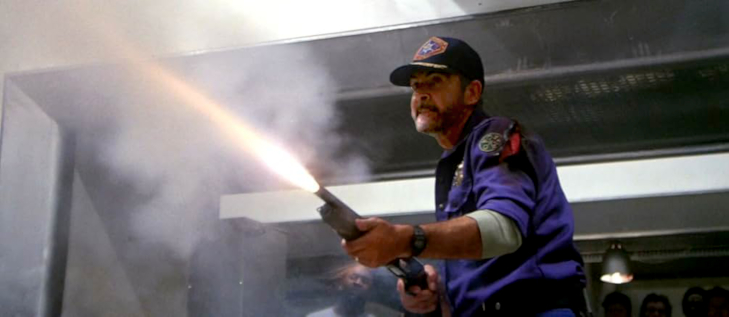
Writer-director Hyams concentrates on believable details. We accept the illusion that these men live, eat, sleep and shower in these metal rooms. The characterizations are clear as well. Con Am 27 is a mostly all-male environment, a rough place where the R&R breaks are for getting drunk and visiting the company prostitutes. Violent situations are not unknown: the Marshal and his deputies carry sawed-off shotguns. We guess that the shot they fire is unlikely to punch holes in the walls, which would compromise the pressurized living areas.
But the film isn’t quite as engaging as it wants to be. The pattern of mysterious deaths is revealed very early on, leaving us with Marshal Bill becoming a problem for the (well-played) corporate crooks. Outland is often described as High Noon in space. When trouble comes Bill makes the rounds to ask for help, and mostly gets cold turn-downs. He’s left to face Killer Diller Miller to face Con Am’s hit men on his own.
The producers must have hoped that Outland would take audiences where no space film had gone before — one of filmdom’s biggest stars must do battle in a fantastic futuristic environment. Peter Hyams’ surprise was the debut of John Eppolito’s Introvision, a special effects process to facilitate the compositing of full-sized live-action and other film material — painted backgrounds, miniatures, etc. — using cleverly manipulated front-projection techniques. Introvision had an advantage over complex ILM-type optical work: the composite images came together in the camera, for a faster production turn-around.

The third-act three-way gundown finale of Outland is actually more like McCabe and Mrs. Miller than High Noon. Instead of being tracked in the snow, Marshal Bill is stalked in the plant’s giant industrial interiors, and then outside, on the prefab metal towers. Introvision allows for excellent views of the space-suited combatants climbing in environments much larger than anything that could be built, with convincing stars and Ionian mountains in the background.
What nobody may have counted on is how slowly the combatants move in their space suits. Not underwater Thunderball slowly, but not brisk, either. The ‘fights’ also lack personality. The combatants are limited in their movement, and we can’t really see if it’s Sean Connery in the space suit.

Not helping the big Introvision finale is that the metal towers of the plant exterior are not all that visually dynamic. You see one prefab structure, you’ve seen them all. Things also get a bit repetitive — the deaths are all mostly caused by rapid depressurization. The two suicides we see are gruesome, the standard image being a view of a man’s head ballooning inside his space helmet. Once the men are outside on the structure, director Hyams must make sure that they surprise each other at close quarters. Any shotgun hit at any distance would rip a hole in an opponent’s space suit.
Hyams doesn’t hype his action with patently impossible stunts, which is good for credibility. But it’s not super-exciting either. The audience was probably expecting bigger surprises, or a new thrill like the fanciful light sabers in George Lucas’s endlessly profitable space franchise.

Breaking through the underplayed dramatics are Bill O’Neil’s scenes with Dr. Lazarus. Frances Sternhagen is given good wise-cracking dialogue, and she and Connery’s cop build a good relationship during their investigation. Also to be commended is their characters’ mutual realization that simply uncovering the conspiracy gets them nowhere — Sheppard and his minions surely have a plan in case the new Marshal refuses to play ball with their crooked game.
Peter Hyams puts all of the effort into making the story play out in a believable way. The killers that Bill must face aren’t given much in the way of personalities. Dr. Lazarus does break her own non-intervention rule to come to Bill’s aid, which gives us at least one personality factor to applaud. But Peter Boyle and Jim Sikking do the best they can with thinly written parts. We’re kept aloft by Connery’s masterful ‘inhabiting’ of his role. Even then, Peter Hyams keeps downplaying the drama. He doesn’t share Marshal Bill’s big emotional payoff with the audience. The happy reconciliation at the end takes place off-screen. *


Search as I might, including Arrow’s US site, I can’t find a “parallel Blu-ray package” anywhere.
Arrow isn’t releasing this on Blu-ray.
Dang. The review says they are.
It still does the stupid thing with helmets with lights inside them. You wouldn’t be able to see out. That always takes me out of a film. Tom Cruise does it all the time in his movies. When you have the lights on indoors can you see out the window at night? Thought not. It’s still a good movie though
I saw this in theater and always enjoyed it. It felt like it lived in the same world as Alien.
This movie has a good look visually, but the story is rather “meh”. Frances Sternhagen is insufferable in this.