


We’re admittedly partial to movies about aviation here at CineSavant.
The Pentagon was noted for lobbying Hollywood to make message films to boost enlistment and promote defense spending. It wasn’t just us, as major English film companies could find themselves tasked with patriotic service public relations duties as well. A big example were film promotions for 1951’s massive Festival of Britain, a national trade show to sell the country’s economic recovery to the rest of the world. In addition to some 3-D films, the fancy Technicolor movie The Magic Box was commissioned to commemorate film pioneer William Friese-Greene. It starred Robert Donat and dozens of stars, and implied that motion pictures were a British invention.
One tentpole for the British economic recovery was its aviation industry, which was forging ahead with progressive designs for jets. Commercial movies about aviation tended to focus on disasters, emphasizing the risks involved in passenger flight as well as testing: The Sound Barrier, No Highway in the Sky. Severin Films released an excellent disc last year of Charles Frend’s Cone of Silence, a fine picture that made passenger flying look hazardous at best … we really need to review that one.

In 1954 England was heavily invested in an enormous new aerodrome to be called Heathrow, but there was still bad press afoot linking airplane disasters to government cover-ups. The Rank Organization was leaned on to produce a bouquet to air travel. Rank controlled the smaller, highly-regarded Ealing Studios, and gave them the job of fabricating a 90-minute fluff picture. Producer Michael Relph started work with John Eldridge, a talented director of documentaries. But Eldridge fell ill, and Relph’s partner Basil Dearden had no choice but to step in and direct the movie himself.
Out of the Clouds charts 24 hours of activity at a glamorous new airport, showing how passengers are treated (with kid gloves) and stressing that the airline professionals put safety ahead of every concern. Airport supervisor Nick Millbourne (Robert Beatty of 2001: A Space Odyssey) does everything but emptly the wastebaskets, running from his office to the flight line to the control tower. He caters to nervous fliers and personally handles concerns from aircraft readiness to a pair of parrots stuck in quarantine in the baggage room. When fog forces a flight delay, Nick personally gives the order to unload perishable cargo until the weather lets up. Nick is polite and professional at all times; he presides over a staff as close-knit as the bar patrons in the old TV show Cheers.

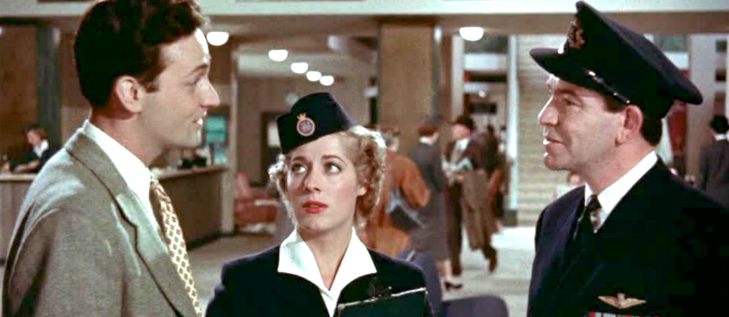
Out of the Clouds was a project that director Basil Dearden didn’t want, but it apparently was quite successful. We’re told that the screenplay was adapted from a book with subplots about airline competition, hazardous flights and corrupt personnel. It was all dropped. We’re instead given a lively, well-orchestrated Business As Usual selection of side stories, with added human touches that serve as light comedy. The dashing pilot Gus Randall (Anthony Steele) woos the gorgeous stewardess Penny Henson (Eunice Gayson of Dr. No ↑ ), who is also interested in the more stable Nick. Gus agrees to bring a package back from Cairo for the seductive Eleanor (Jill Melford), not fully realizing that she’s the agent of an Egyptian smuggler. Nick is having a career non-crisis. He’s been grounded for health reasons, and really wants to get back up in the air. But we have to admit that his social skills are exemplary, playing nursemaid and matchmaker at the same time.

James Robertson Justice is the authoritative Captain Brent, the top pilot who keeps rejecting aircraft because he doesn’t like the way the engines sound. → His judgment proves correct when he prudently aborts a flight to New York, and returns to Heathrow. Lives are never in danger. We are also shown how radar allows Captain Brent to land on instruments, when the airport is socked in with fog.
The main drama is a sweet but very flat romantic pair-up seemingly engineered to make Out of the Clouds serve a checklist of Public Relations issues. Did some government minister ask that a pro-Israel message be inserted into the show? We’re given the good-looking couple played by David Knight and Margo Lorenz. He’s Bill, an idealistic American engineer en route to the new nation to make the desert bloom. She’s Leah, a Holocaust survivor who lost her entire family, and she’s bound for New York to marry an older man she doesn’t love because she craves security. Although many DPs (displaced persons) remained ‘unresolved’ years after war’s end, Leah looks to be in fine condition and must repeatedly tell us that she’s anxious. *
A flight delay gives the pair some time to fall in love, something they realize as soon as they part going in opposite directions. But Leah’s aborted flight returns to London. Given ‘spiritual guidance’ from a fellow passenger, amusing Indian (Abraham Sofaer), Bill takes it upon himself to double back from Rome.

↑ The made-for-each-other couple ends up in a madcap tour of London, aided by an incredibily hospitable cabdriver (Gordon Harker) and a sweet landlady (Megs Jenkins) who serves them a fine meal. She talks of the wonder of London’s parish bells and the ‘charming’ noises from the docks. It’s travelogue nonsense, served up very handsomely.
We admire the way the pro cast makes this all so pleasant. Director Basil Dearden embraces the lightweight non-storyline, punctuated by guest bits. A nervous rich woman (Marie Lohr) takes pills so she’ll sleep on the plane; when said plane is delayed she’s left snoring away in the airport. Sidney James is in for a moment as a gambler trying to take out a big insurance policy on his wife. Nicholas Phipps is a caricature of an officer from the Foreign Office, trying to figure out what to do with two ‘stateless’ parrots.
Charming but more serious is Bernard Lee, a customs cop who lays a trap for Gus, on the hunch that the pilot will be carrying contraband from Cairo. The main customer liaison Jean Osmond (Melissa Stribling) deals with a numerous petty passenger problems. When a flight is delayed overnight, the airline puts all the passengers up overnight at a hotel. Jean personally accompanies the bus to the hotel and all but tucks everyone in to sleep. Gee, what airlines do that now? **

Responsible, caring people are in charge. I want to live on THAT planet.
In these days when nothing seems secure or even rational, the ‘everything’s under control’ vibe of Out of the Clouds is very reassuring. Extensive filming took place at a real airport with impressive 1955-era passenger aircraft, all prop planes of course. Every department is fully staffed and everything seems to be well in hand. Heathrow is really a complex of terminals, but the modern facilities we see (based on plans for a terminal then under construction) remind us more of a local airport than an international hub. To suggest that England is still a major force connecting all corners of the world, the casting people populate one scene with every kind of ‘foreigner’ they can think of.
We can’t help it — when we see so many faces familiar from English genre classics, we want to make inappropriate connections. It looks as if sweet old Katie Johnson is no longer receiving crooks at her boarding house, and has decided to become a World Traveler. Did Eunice Gayson become a flight attendant because her attempt to do social work in the charity hospital of Dr. Frank went so poorly? We’re happy to see that both William Franklyn and Sidney James survived being brutally machine-gunned in the industrial New Town of Winnerden Flats. And we’re course delighted to see that Melissa Stribling divorced drippy Arthur Holmwood and took up the life of a modern independent woman. Was she inspired by her sex fling with that dashing nobleman from Carpathia?

