
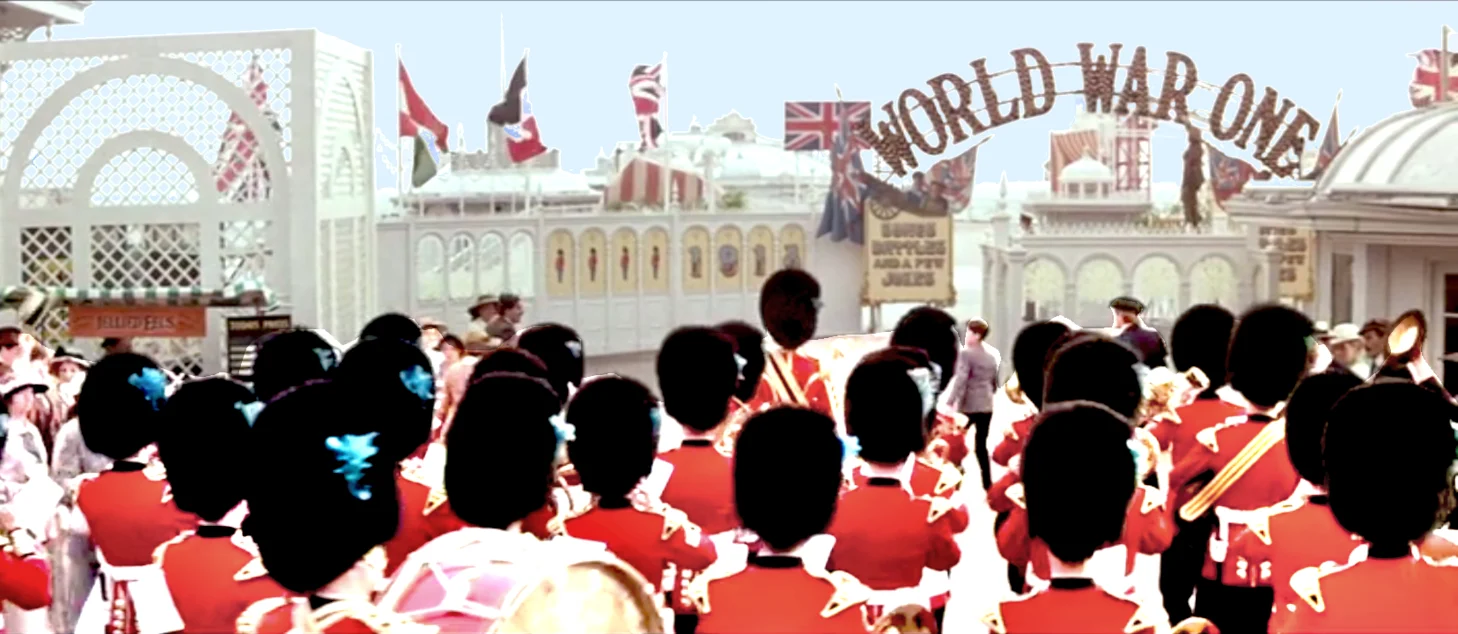


If the waging of war in 2026 may seem like a circus of murderous lies, rest assured that the First World War of 1914 was even more insane, more cruel. Richard Attenborough so admired the anti-war theme of Joan Littlewood’s 1963 Theater Workshop musical revue that he chose to adapt it for his directing debut. Sir Richard got his epic-sized ‘experimental’ musical launched as a class act,. and lining up Paramount Pictures to distribute.
Oh! What a Lovely War is the story of World War One told through songs. Numerous famous personages are depicted, but the ensemble cast includes as continuing characters only the Smith Family, a happy working-class clan that gets caught up in the patriotic excitement, and eventually loses all of its men-folk to the conflict in France.
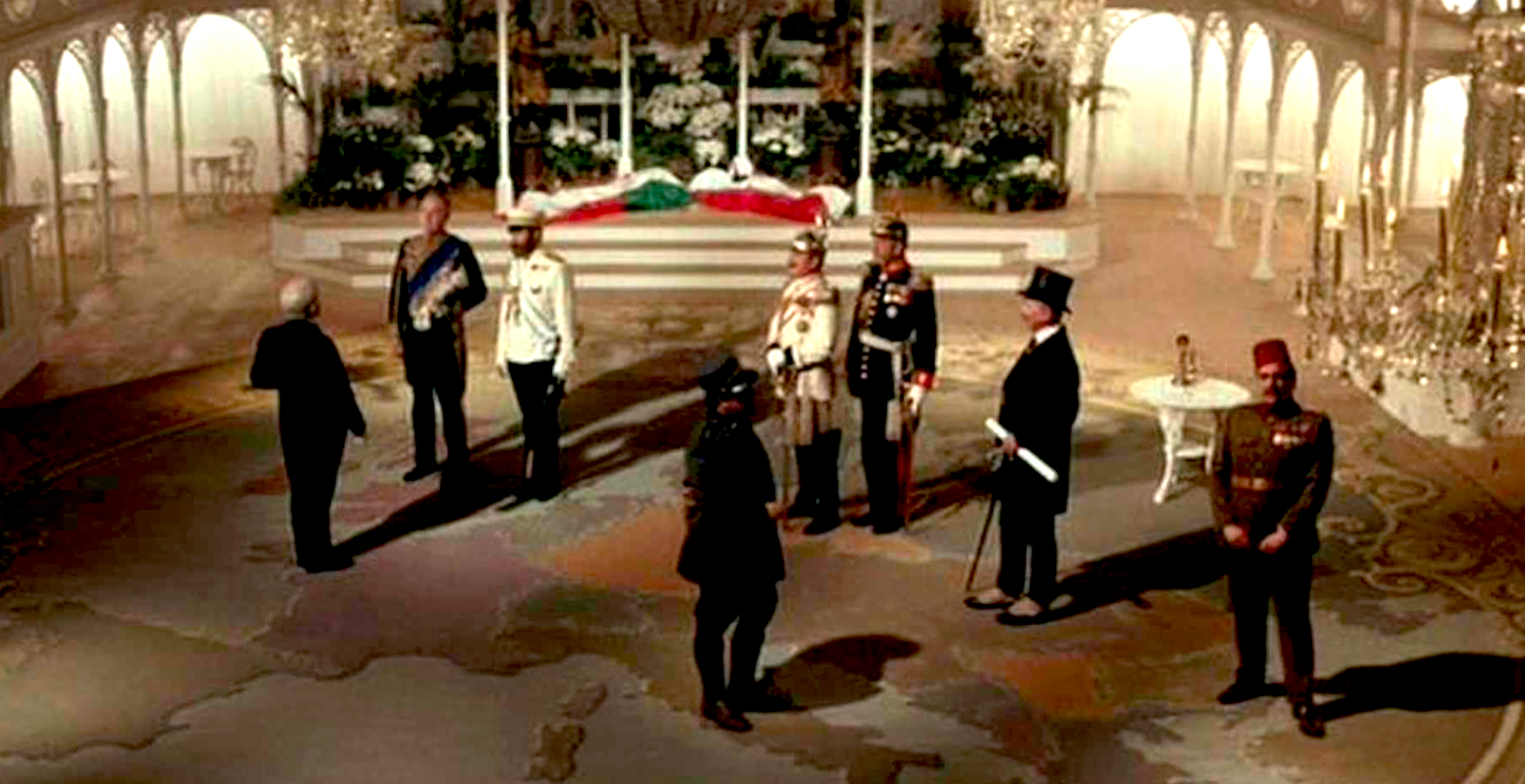
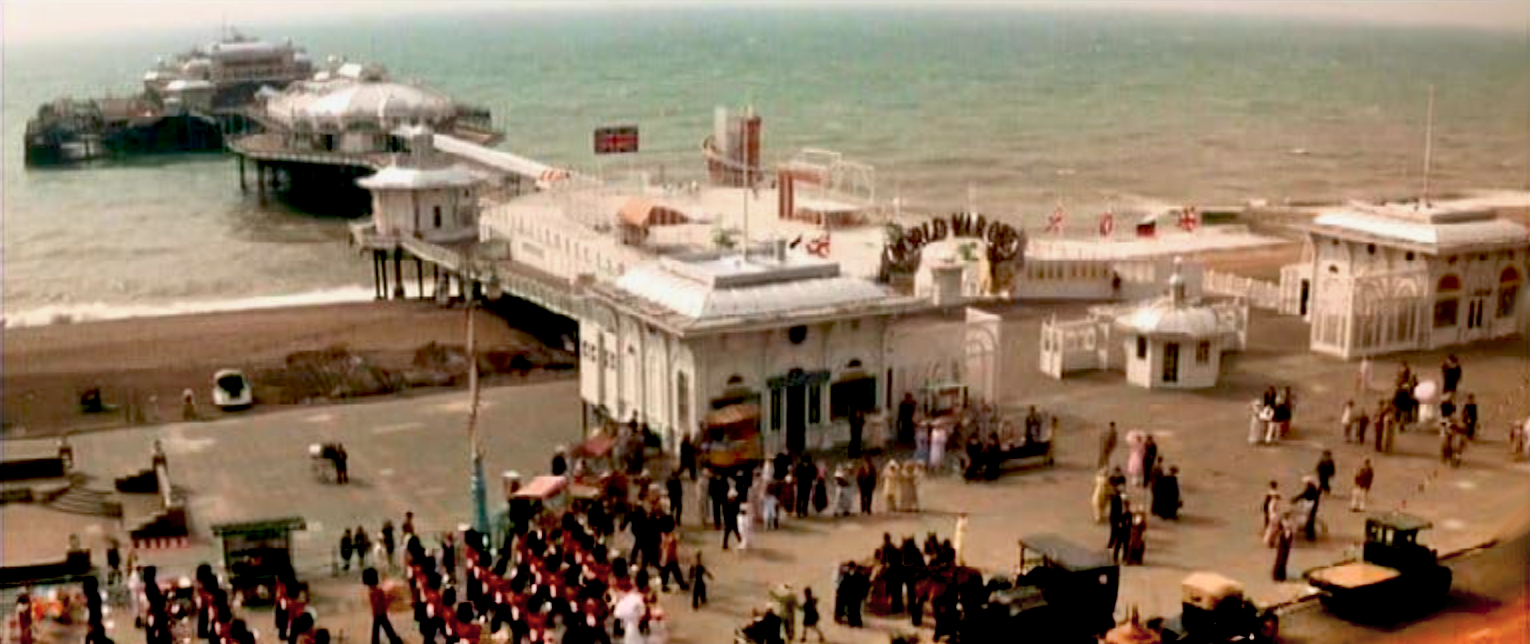
The film takes the form of a stylized, part-theatrical fantasy. Realistic depictions of life in the muddy trenches is punctuated by moments of symbolic surrealism. Meanwhile, Europe’s monarchs pose like waxwork statues in an Olympian dream palace, away from the mortal commoners that they rule. The English military establishment — for which the film has nothing but contempt — conduct the war as an amusement for the masses. ‘World War One’ is a bright-white funfair pier at Brighton, decorated with electric signage.
The picture is arranged around a group of 1917-era songs to which soldiers gave new lyrics, converting melodies of hope and faith into morbidly funny, sardonic expressions of frustration and hopelessness. The millions that died were mostly conscripts fed through a military machine that threw their lives away on a daily basis, and lied about everything to maintain public support. Staggering defeats were publicized as sterling victories. The incompetent high command insisted on fighting with the ‘honor’ rules of the previous century, ordering soldiers to face machine guns and chemical weapons.
Ms. Greenwood hated everything that was military — the uniforms, the conformity, the jingoistic culture. She initially resisted the idea, but her partner Gerry Raffles, finding a treasure trove of Wartime music in a 1917 book called Tommy’s Tunes, which recorded the substitute lyrics being sung in the trenches. He suggested that Greenwood generate an anti-war statement by juxtaposing the songs against grim statistics from the war. To get away from khaki uniforms, Greenwood chose to use pierrot costumes and helmets throughout her revue.
Those authentic songs from the past are the whole show. Some are novelty trifles and others beautiful melodies of an innocent age. All expressed the horror felt by those in the trenches, soldiers with no official way to protest, or even just to say, ‘why are you killing us for nothing?’
The Ever-Popular War Games, with Songs, Battles and a few Jokes
All of the songs are from the war era, even the very satirical title tune. The altered lyrics to pop tunes and hymns express the soldiers’ honest reactions to being in the trenches, helpless in the middle of all the carnage. Attenborough’s film ‘opens up’ Littlewood’s show to epic proportions but maintains her tone of horrified irony. Like the play, the movie has no conventional storyline. It instead ‘restages’ the war starting with the assassination of the Archduke, and ends with the Armistice of November 1918. The fortunes of the ‘generic’ Smith family are observed between musical numbers, from the recruitment song “I’ll Make a Man of You” to the airmen’s anthem “The Bells of Hell Go Ting-a-ling-a-ling.”
The import disc from Eureka! / Masters of Cinema is a Region B disc. We’ll take any opportunity to promote it, even if only to encourage a domestic disc company to bring it out here.
Oh! What a Lovely War garnered great reviews but didn’t convince Paramount that it could find an audience in the states. The lack of confidence showed when the movie was given the same kind support afforded to Sergio Leone’s Once Upon a Time in the West . . . practically none. I doubt that many filmgoers outside of a few major cities ever heard of this movie. *
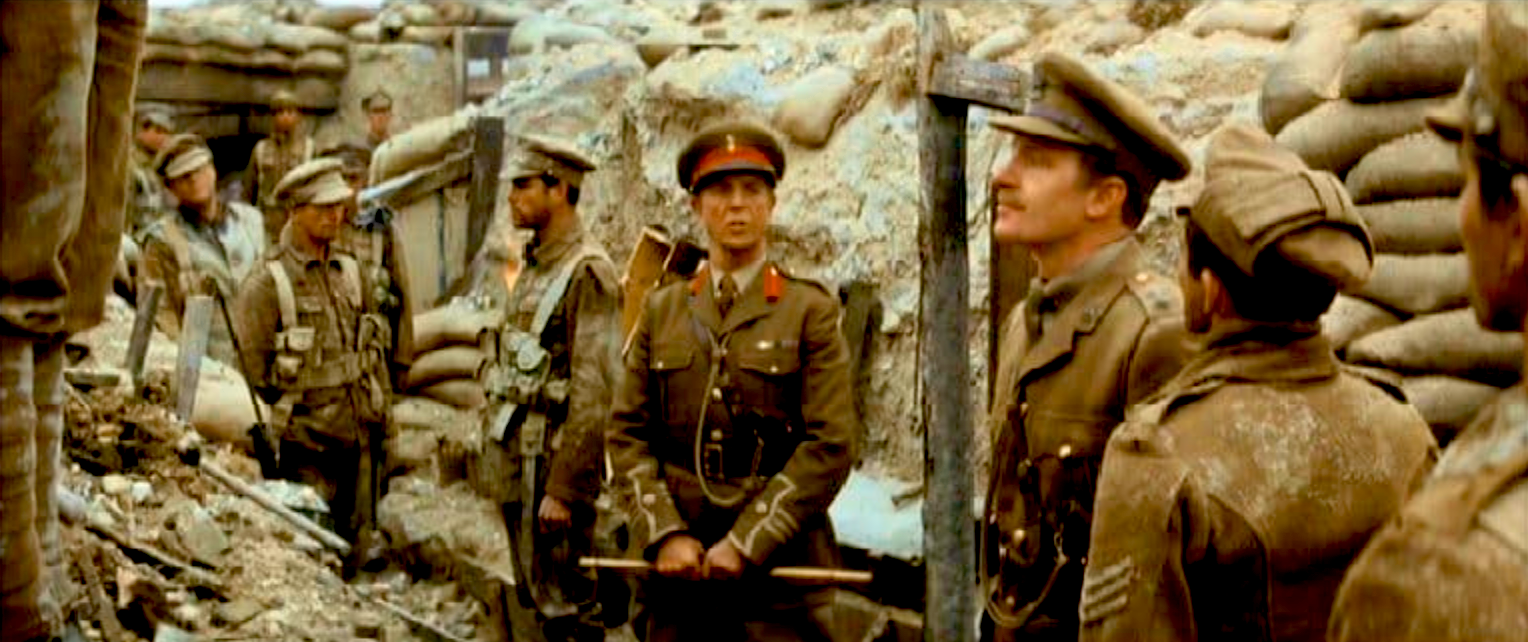
The movie is not for everyone — the fascination is in the nifty period songs, sung with the lyrics made up by the soldiers themselves. Many tunes are improved by the irony and sarcasm. Jerome Kern’s haunting melody “They Wouldn’t Believe Me” is given entirely new lyrics, that express how impossible it was to make propaganda-soaked folks back home understand how horrible things were in the trenches:
And when they ask us / How dangerous it was
Oh we’ll never tell them / No we’ll never tell them
We spent our pay in some café / And fought wild women night and day
T’was the cushiest job we ever had.
And when they ask us / And they’re certainly going to ask us
The reason why we didn’t win the Croix de Guerre
Oh we’ll never tell them / No we’ll never tell them
There was a front / But damned if we knew where.
The show presents at least 25 songs full of life and wit and heartbreak, with varying degrees of moral outrage. Although he did not take credit, the film adaptation is said to have been done by novelist Len Deighton (The Ipcress File). Ingenious stylization ties the tunes together: for the English public, World War One begins as a major attraction, a get-dressed-up, flag-waving patriotic carnival on the Brighton Amusement Pier. The four years of the War to End All Wars are compressed into a heavily stylized pageant. First-time director Attenborough may have felt that the fun-fair setting was fitting: his own breakthrough acting role had been as a murderous hoodlum in the 1947 Graham Greene classic Brighton Rock.
Oh! What a Lovely War is a lot of things. It’s a snapshot of a relatively innocent England about to be disillusioned by the horrors of war. It’s a record of the way things were — styles, class attitudes and music. And every brightly lit image is a scream of protest against the unfathomable waste and destruction.
The principal weapon is unsubtle, heavy-duty irony.
The farce of homefront euphoria contrasts obscenely with life and death in the trenches. A rousing patriotic campaign in England assures widespread enlistment, promising a quick victory over the Huns. The conscription-age males in the Smith Family are swept up in the glory. In keeping with the surreal musical fantasia, all slip into uniform and march (or take fun-ride cars) to the end of the pier. They disappear into another dimension, to be magically transported to the front. Because he has been commissioned as an officer, Bertie Smith is given a jaunty farewell in musical number on the funfair’s train ride:
“As the train moved out he said / ‘Remember me to all the birds!’
Then he wagged his paw and went a way to war / crying out these prophetic words…”
A simple cut takes us from the light frivolity back to reality, where Bertie’s forlorn mother Mrs. Smith gives the empty horizon one last look. It is not long before a constant flow of maimed young men returns to the pier from across the sea.
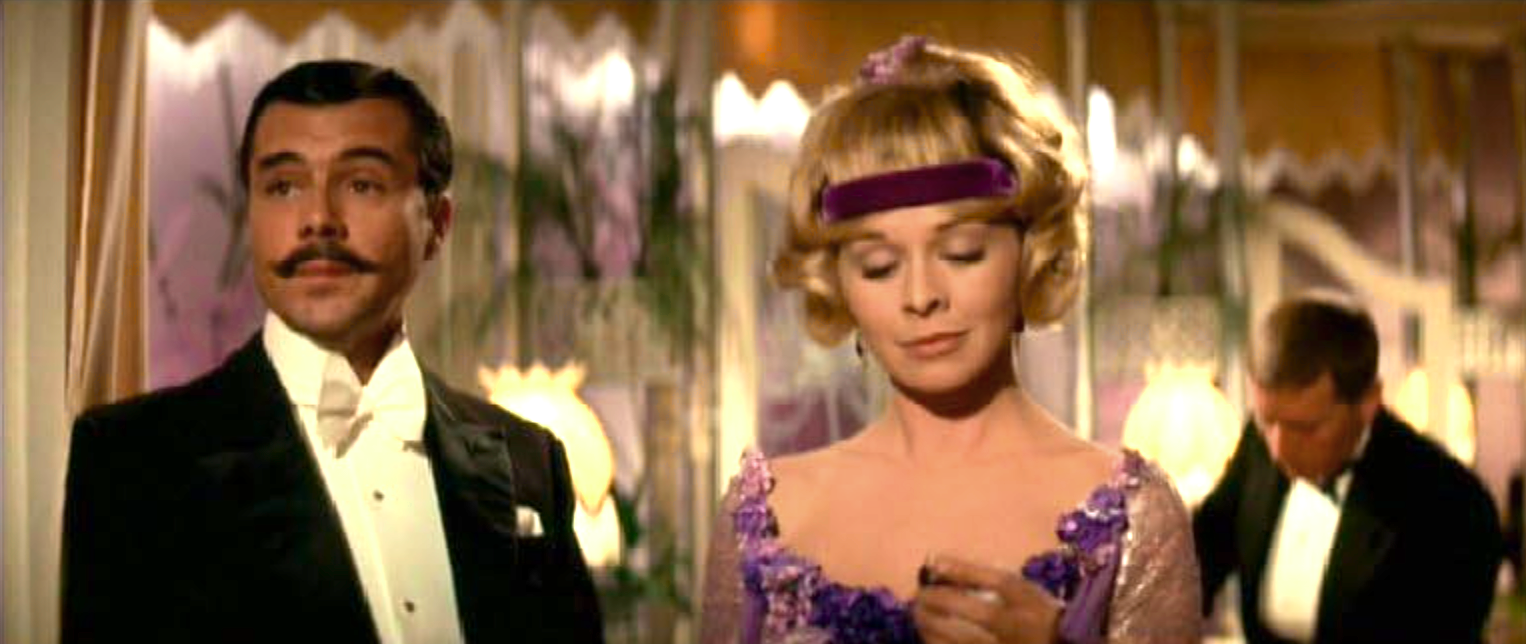
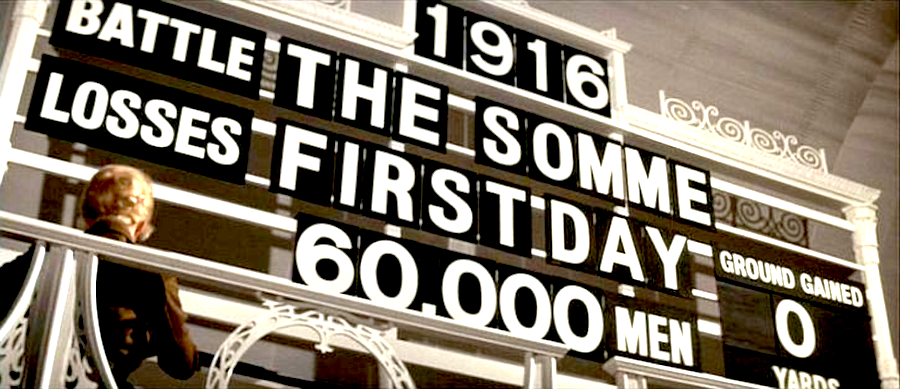
Surreal transitions are a recurring cinematic device. On a tower high above the pier arcades, the incompetent Field Marshal Sir Douglas Haig (John Mills) peers at the French coast through a spyglass, and then descends by sliding down a circular funfair chute. In the ballroom below is a scoreboard with the name of a battlefield followed by the obscene daily tallies: “60,000 killed today. Ground Gained, Zero.” The upper classes ignore the awful statistics. They drink champagne in the pier’s dance palace where the military high command carry on their full-dress social charade, with petty rivalries for status and promotions.
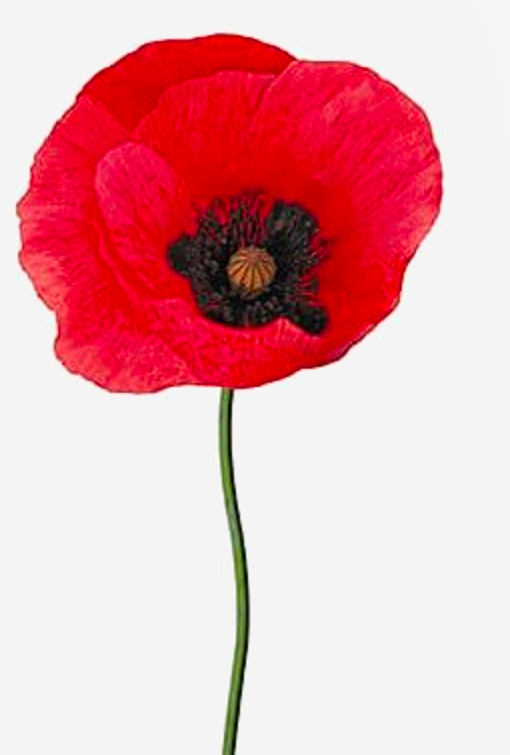
The Symbolic Red Poppies
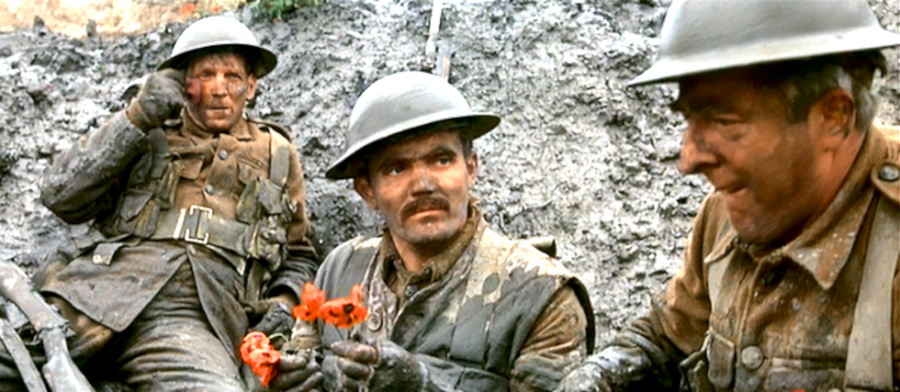
The movie begins with a weird stylized pageant. The assembled crowned heads of Europe stand on a giant map. The words they speak are historic quotes; every statesman declares that war is impossible. A recurring emcee-like character (Joe Melia) produces a pair of red flowers for the Archduke and his wife to hold. Poof goes the photographer’s flash, and they’re dead. Senile Emperor Franz Josef is tricked into signing a declaration of war. Everybody mobilizes. The motif of red flowers returns time and again to represent death, both individually and in big baskets of blooms.
Richard Attenborough did find some conservative resistance to his film. Although he used only direct quotes for the dialogue spoken by the high officers, the family of Field-Marshal Sir John French (Laurence Olivier) tried to get the film banned. Attenborough was on firm legal ground, yet avoided controversy. After reading unbelievably appalling newer accounts of the behavior of the English officer corps in The Great War, we admire Attenborough’s self control. A decade earlier, Kirk Douglas directly accuses WWI generals and politicians of being degenerate mass murderers in Stanley Kubrick’s movie. No problem for the English military establishment there … the army being criticized was French.
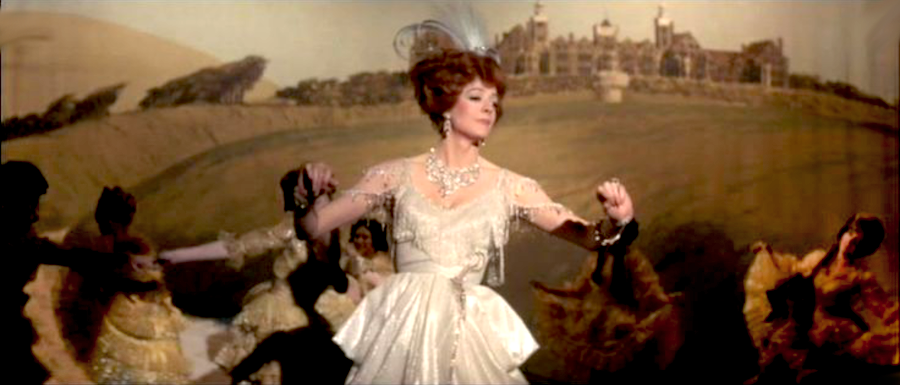
The famous personages are played by movie stars but the Smith Family is is a group of sympathetic, less familiar faces: Wendy Alnutt, Colin Farrell, Malcolm McFee, John Rae, Corin Redgrave, Maurice Roëves, Paul Shelley, Kim Smith, Angela Thorne, Mary Wimbush. We must watch as the Smiths are decimated by their own patriotic decency. Swayed by patriotic peer pressure in the grand Music Hall show that serves as a recruiting tool, the Smith women do not protest. The film’s most memorable performance is by the great Maggie Smith. Her teasing enlistment song lures sons, husbands and sweethearts onto the stage, where they are instantaneously converted into soldiers.
” … But on Saturday I’m willing /
If you’ll only take the shilling /
To Make a Man of any one of You!”
Meanwhile, the ancient, doddering high commanders use the troops as cannon fodder, while grousing about petty personal inconveniences. “We need only one more big offensive and the enemy will collapse,” the generals keep repeating . . . the 1915 version of ‘Peace with honor,’ and ‘Stay the course.’
Lively songs tend to be undercut by the horror of the fighting. Jean-Pierre Cassel’s jaunty French number, a dance on a carousel atop a Belgian hill, depicts the destruction of fancy 19th century style cavalry in the new mechanized warfare. Most of the pop songs and converted hymns express the misery and dreams of the soldiers in the trenches. Many are given a macabre twist: “Hush! Here comes a whiz-bang . . . and it’s headed straight for you!”
An obscene drinking song or two are thrown in for good measure. A group of Australians sings “One Staff Officer Jumped Right Over Another Staff Officer’s Back”, lampooning the pompous commissioned bureaucrats that never go near the front. At the opposite emotional pole, “Silent Night” sung in German is used for the historical Christmas Miracle, a true occurrence in which soldiers from both sides left their trenches for a few hours to fraternize in no man’s land. The high command threatened them with execution for treason.
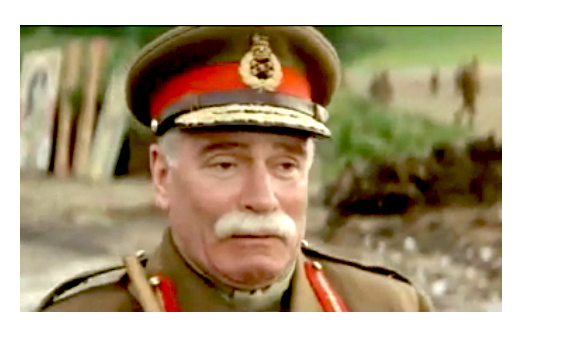
In his commentary Attenborough explains that he signed up all those stars by first winning Laurence Olivier over to his meaningful anti-war statement. Once Olivier was on board the entire theatrical establishment turned out to play a gloriously long list of cameos. In addition to those already mentioned, they include big stars Dirk Bogarde, Phyllis Calvert, John Clements, John Gielgud, Kenneth More, Michael Redgrave, Vanessa Redgrave, Ralph Richardson, and Susannah York.
The list of noted supporting players is even more fun, as many later became stars: Robert Flemyng, Ian Holm, David Lodge, Juliet Mills, Nanette Newman, Cecil Parker, Gerald Sim, Thorley Walters, Michael Bates, Edward Fox, Angus Lennie, Harry Locke, Norman Bird and Sheila Cox. Not easy to spot among the chorus girls are Carole Gray, Christine Noonan and Jane Seymour. Pippa Steel mans the grim scoreboard bearing the battlefield Death Statistics.
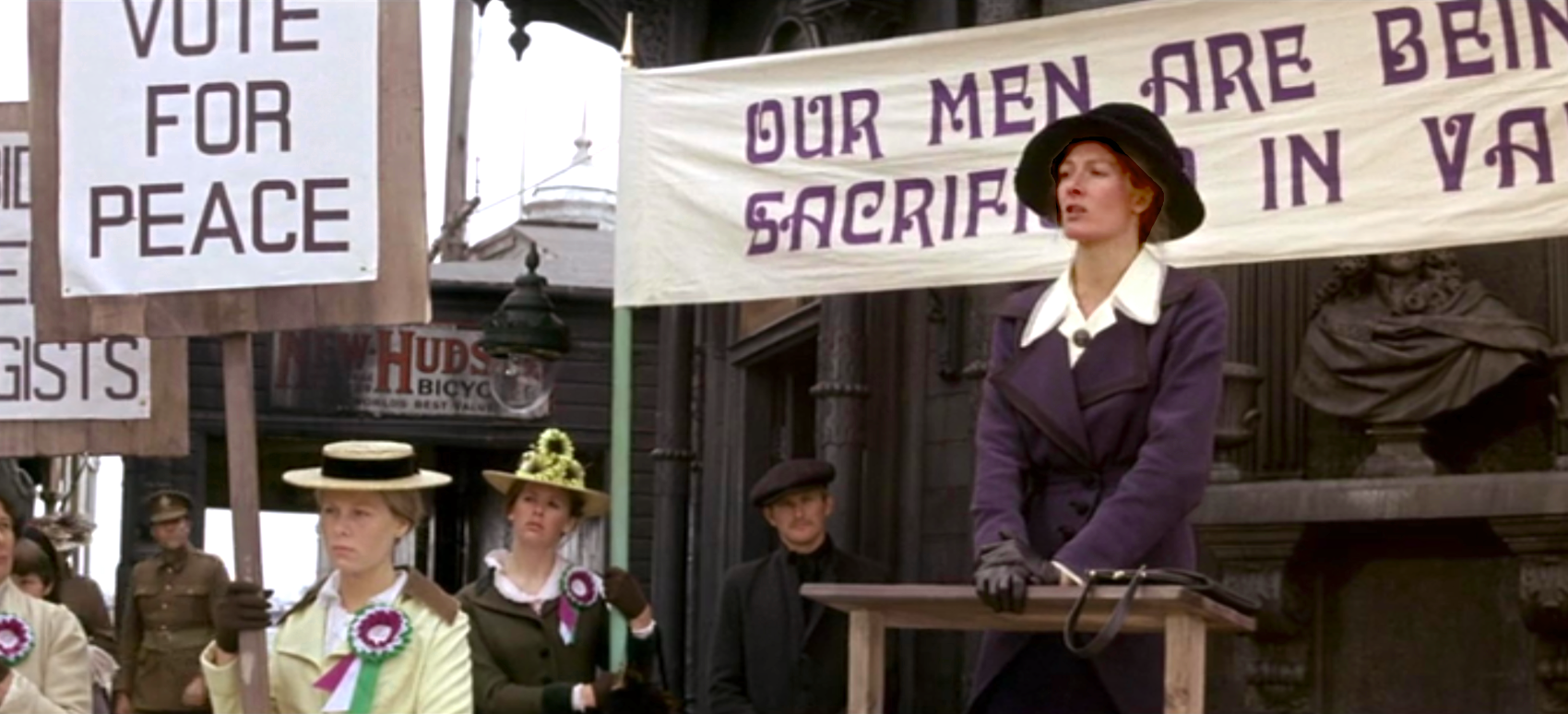
Late in the film Vanessa Redgrave appears as Sylvia Pankhurst, the historical firebrand and anti-war speechmaker. Her harangue against war profiteering and a government that doesn’t care about killing an entire generation of men is angrily shouted down. The average citizen is desperate to believe that the sacrifice of so many is contributing to something meaningful. Meanwhile, Field Marshal. Haig prays that the war will be over before the Americans arrive. Think of the face he’ll lose.
The music and comedy become melancholy as more of the Smith boys fall, from the young pups to the stuffy cousin Bert. Those symbolic red flowers become less and less welcome. Attenborough finds heartbreaking ways to reveal them, often enlisting the Panavision lens’s ability to radically rack focus.
Oh! What a Lovely War shapes up as a lavish feature film that condemns the exploitation of patriotism. Depending on the public mood, it could be considered in bad taste, or defeatist. Joan Littlewood went on record against the film, as it depicts the war experience as a photogenic spectacle. We don’t think it ever loses focus from the songs, and their funny-traumatic lyrics. The role of the church is not spared, when sermons do the usual thing of declaring that God is On Our Side. The soldiers are more likely to conclude that God wants them dead. A devout hymn is suddenly hijacked by a beautiful tenor voice. “What a Friend we Have in Jesus” becomes, “When this lousy war is o-ver, no more soldiering for me . . .”
Being unlike any other musical, Attenborough’s somewhat abstract show is probably too long to make commercial sense. It’s obvious that Paramount thought it too slow, but we also wouldn’t want to see a single thing cut out. The fact that it wasn’t chopped down indicates that Sir Richard likely had a contractual clause that gave him Final Cut.
Who is the Unknown Soldier? You are.
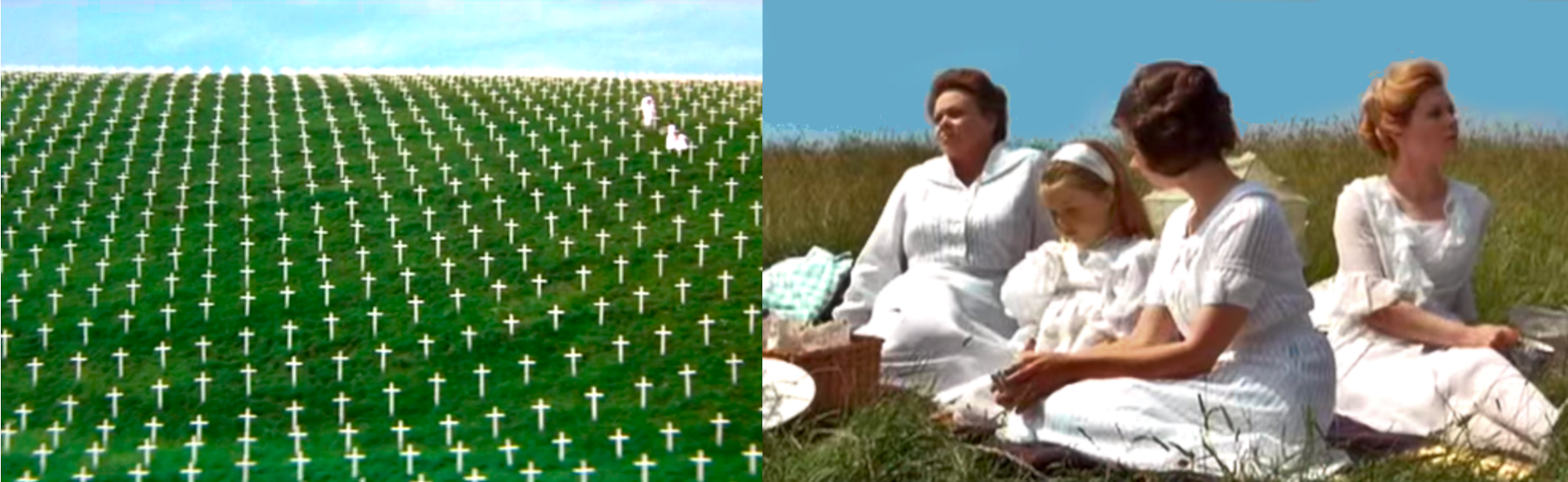
The final reel is a chiller. The symbolic fate of the last soldier to die becomes a ghostly dream. With the sound of a gunshot, he disappears behind the blur of a red flower, to emerge from a mist to follow a red ribbon leading from the trenches, through no-man’s land, to the ballroom where the armistice is being signed. Eternity is found in a sunny place where he can relax. The Smith women are having a picnic a few yards away. His mother seems to sense his nearness.
The last shot is a jaw dropper on a big Panavision screen, backed by the famous Jerome Kern song “They Didn’t Believe Me.” A live-action aerial shot gives us a sense of scale — of the real scope of suffering and death — in a way that a CGI graphic never could. The image is a humbling expression of the numbing reality of millions of wasted lives.
Some confusion here – is it Greenwood or Littlewood? Both appear in the first few paragraphs…
Thank you Garett. The fix should register in a couple of hours.
Would be a good double bill with ‘How I Won The War’ (1967). The ad campaigns are oddly similar.
I bet that a lot of people were surprised to see a Beatle in a non-Beatles movie.
Let’s not forget how the Versailles Negotiations set the stage for WWII. They also set the stage for the Vietnam War, as a young Ho Chi Minh appealed to Woodrow Wilson, but the rabidly racist Wilson refused to listen.
The circular funfair chute in the film is the famous Helter Skelter.
Pardon my ignorance. Is that specific Helter Skelter reference a funfair wide or something from a playground?