
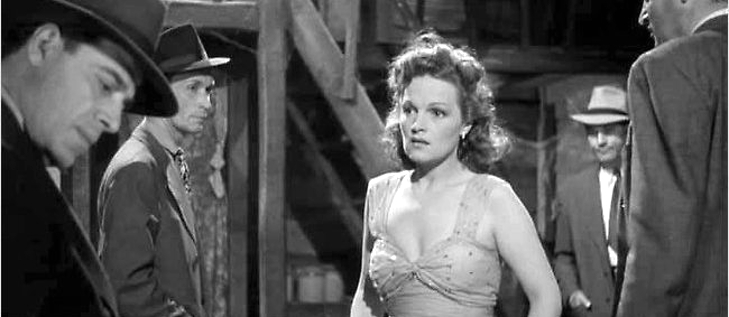


This freakish Brit imitation of American gangster fare is no longer an obscure item; Kino Lorber released a good-looking Blu-ray a little more than a year ago. I return to it now because the extras on this Powerhouse Indicator disc are so illuminating.
The once-notorious No Orchids for Miss Blandish is one of the weirdest crime films of the 1940s; it caused a (profitable, we’re told) uproar upon its release in London. The Hardy Encyclopedia of the Crime Film noted that it was condemned in the House of Commons, yet was ‘seen by over 100,000 people in its first three weeks at London’s Plaza Cinema.’ The censors got their knuckles rapped for dereliction of duty, and issued an apology!
A full decade before the arrival of the violent and gory Hammer horror films, English censors were outraged by a wave of similarly deplored film fare, a rash of postwar crime films dragging the country into a new era of sex and violence. England couldn’t halt the flood of cinematic punks that contradicted the country’s official self-image. Graham Greene’s novel Brighton Rock became a red-hot thriller about a razor-wielding scar-faced thug; it launched the starring career of the young Richard Attenborough. The descent of a juvenile (Diana Dors) into sexual degradation is the sordid subject of Good Time Girl. The morally murky It Always Rains on Sunday deals with small-time crime and sexual betrayal in a Jewish district. Efforts were made to ban some of these films outright, as with the later Cosh Boy, said to glorify razor-slashing delinquents. But sharp producers followed the American example and exploited the outrage for added publicity value.

No Orchids for Miss Blandish is difficult to accurately describe. The independently produced film was written and directed by one St. John Legh Clowes. Its source is a stage play from a popular book by James Hadley Chase, which is markedly similar to the notorious 1933 American pre-Code shocker The Story of Temple Drake, an adaptation of Sanctuary by William Faulkner. Temple Drake is one of the key films that precipitated the enforcement of the Production Code. In both stories, after an heiress is seduced (or raped) by a kidnapper, she falls in love with him and turns her back on her family and upbringing. Heightening the connection is the fact that minor leading man Jack La Rue plays the rapacious male lead in both films, spaced fifteen years apart.
Original reaction to the English movie was unqualified outrage. An Archbishop spoke against it from his pulpit. The Observer said that
“It has all the morals of an alley cat and the sweetness of a sewer.”
The once-conservative Monthly Film Bulletin called it
“…the most sickening exhibition of brutality, perversion, sex and sadism ever to be shown on a cinema screen.”
The movie was a rave success when released in London, yet has reportedly never been shown on English television.
No Orchids wastes no time before wading into salacious waters. The beautiful but frigid socialite Miss Blandish (Linden Travers from The Lady Vanishes) isn’t happy about her engagement to a worthless man from a father-approved good family. Punk crooks intercept the couple on the way to a ‘hot’ road house. They only have simple theft in mind, but the unstable Riley (Richard Nielson) loses control and murders the fiancé. More killings follow. Crook Ted Bailey (Leslie Bradley, later of Attack of the Crab Monsters) drags Blandish to an isolated shack, but before he can rape the terrified woman, the more powerful Grisson Gang moves in. Enigmatic leader Slim Grisson (Jack La Rue) has seen and admired Blandish in his Black Dice nightclub, and has even sent her orchids. He murders Bailey and takes the distraught heiress back to his nightclub and imprisons her in an upstairs room. Against all expectations, she responds by falling madly in love with him. The feeling is mutual. Slim’s cohorts are angered when he returns Blandish’s diamonds to her father, along with her handwritten note saying that she’s run away of her own free will.
The police close the case, but Bailey’s stripper girlfriend Anna (Frances Marsden) suspects foul play. Grisson henchman Eddie (Walter Crisham) cozies up to Anna to keep her quiet, while conspiring with the rest of the gang to force Slim to demand a ransom. That’s the cue for the two-fisted reporter Dave Fenner (Hugh McDermott of Devil Girl from Mars) to step in: he connects the Grissons to the original kidnapping and sets out to prove that Miss Blandish is indeed a prisoner. Now behaving like star-crossed lovers, Blandish and Slim can’t keep the rest of the gang from rebelling.
Some films date badly because of changing dramatic conventions — line readings and basic situations seem awkward or foolish. No Orchids for Miss Blandish may take the prize for a well-made picture that gets most everything dead wrong from the get-go. Yet it is a delight to watch. Time has transformed its once-shocking subject matter into an Airplane!- like parody of gangster and noir clichés. The surface action revels in tawdry cheap thrills: death is dished out by blackjack, broken glass, guns, a machine gun and even a hand grenade. The forbidden romance is preposterous. Miss Blandish (she isn’t given a first name) speaks in posh tones and swoons in shock at the prospect of rape by any of a half-dozen slimy gangsters. Not much later she’s sharing long, passionate kisses with Slim:
“I know you’ve killed people. You’re cold, you’re hard, you’re ruthless — but …”
Ain’t love grand? They talk like that through the whole picture.

Made in London and starring a mostly English cast, No Orchids inhabits an alternate gangland universe. It’s fully overwhelmed by misconceptions about a fantasy gangland USA. It just didn’t play for American audiences at all. The overcooked American slang comes from twenty years of gangster parodies: “You crazy rat you croaked him!” Few of the characters seem to belong in the same movie. Walter Crisham’s loathsome Eddie (just above) sneers at all times, as if he were the gangster father of our childhood pal Eddie Haskell.
Accents are all over the place. The New Jersey hillbilly (?) Barney (Michael Balfour) speaks with a cockney accent. The sneering hood Riley does a spot-on imitation of a Dead End Kid. A mob doctor (MacDonald Parke) manages a cross between John McGiver and Elmer Fudd. He struggles with high-toned dialogue that replaces words like ‘walk’ with ‘perambulate.’ The slimy Eddie takes orders from the unpleasant Ma Grisson (Lily Molnar), a tough-talking Ma Barker clone. Ebullient headwaiter-chef Louis (Charles Goldner) delights in serving French delicacies to Slim and Blandish, even when Slim shouts that he just wants a ham on rye.
American actor Jack La Rue was a regular Hollywood villain in the pre-Code days, often portrayed as an oily degenerate. His close-ups in Michael Curtiz’s Three on a Match establish him as a one-of-a-kind sadistic pervert. Fifteen years later La Rue is trying to relaunch himself as a romantic figure, playing Slim somewhere between George Raft and Humphrey Bogart. Slim’s signature habit is very ‘Raftian’ — he constantly rolls a sinister pair of black dice. La Rue commands a killer dead-eye stare yet has little charisma, and generates zero chemistry with the swanky, bloodless Linden Travers. She seems to be addressing her refined dialogue to some other Prince Charming just out of camera view. Miss Blandish is supposedly transported into ecstasies of erotic abandon, but Travers never gets her hair mussed.
The film’s skewed view of America is that all personal interaction is transaction, about money or power. All is hostility: even Blandish’s father and the police representative motivate each other with threats. Numerous discussions end with somebody being slapped around, as if author Clowes’ only reference to America was James Cagney movies. Fenner knocks Eddie unconscious with just a slap on the cheek! The sight of the tubby Ma Grisson repeatedly slapping someone she has just met is ridiculous.
The film’s take on Hollywood-style gunplay is equally funny: Slim repeatedly out-draws assailants that plainly have the drop on him. The gun-toting Dave Fenner behaves more like a happy-go-lucky James Bond than an investigative reporter. Fenner climbs into the window of the Grisson Club’s lead singer Margo (Zoé Gail) when she’s undressing for bed, and holds a gun on her. Margo is apparently excited by this bullying seduction: he whips the drawstring from her pajamas, forcing her to hold her pants up for the rest of the scene. A subsequent murder scene in a tiny shack is patently absurd. Slim rakes Fenner with machine gun bullets and then has his henchman finish him off with a hand grenade — you know, just like what those American gangsters do. A minute or two later, we learn that Fenner has escaped unscathed.

Writer-director St. John Legh Clowes never finds a believable tone, especially in his love scenes. He does make good use of a moving camera, although Gerald Gibbs’ cinematography mostly has a high-key, MGM look. A showdown in Barney’s shack shows Slim tossing his signature black dice, his body neatly framing the gangland action behind him. George Melachrino’s music score favors wince-inducing stings (Ba Da Da DUMMMM!) and contributes a lush romantic theme for the two crazy lovers, adding to the general tone of giddy awkwardness. Not helping is the over-populated cast, with actors that look and dress roughly the same. For half the picture I thought that Anna and the club singer Margo were the same character. Why did her hairstyle kept changing? Then both women showed up in the same scene, and I knew I’d have to watch the whole show again.
Orchids becomes irresistible Camp because Clowes fails to make any of these elements cohere: the film bounces from absurd violence to mawkish melodrama to lengthy musical numbers. Even then it goes too far — a sleek floor show song is about getting rid of an unwanted sweetheart. With the wildly uneven screenplay and direction, and the bizarre accents and goofy characterizations, No Orchids for Miss Blandish comes off as preposterous, yet exciting and funny. Something outrageous is happening every minute.
Keener eyes for Brit talent will recognize Danny Green (The Ladykillers) as the Grisson’s main thug. Working un-billed as the club doorman is future Bond baddie Walter Gotell. In a much larger un-billed role, Sidney James suffers as a bartender dealt a traumatic eye injury by the vicious Riley.
Twenty-five years later, Robert Aldrich directed a version of the same story in The Grissom Gang, with more of a rural ‘Ma Barker’ spin. The plotline is almost identical, with the same strange romance in the middle of a kidnap scheme, framed by a string of callous killings. Some reviewers think highly of it. I can imagine both versions being PC poison today, when the notion of a kidnap / rape victim falling in love with her rapist would likely inspire an extremely unpleasant media reaction.
