
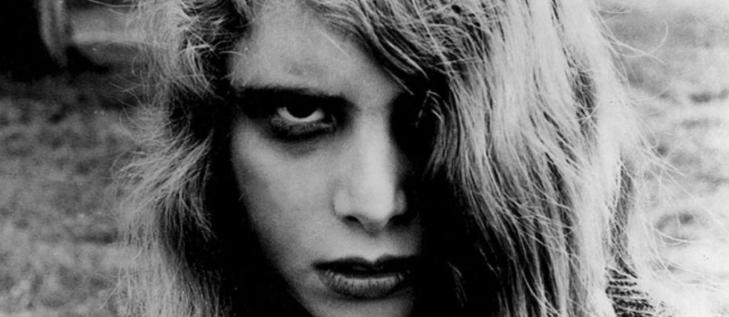


Fifty years later, George Romero’s thriller still impresses as a shock to the system, a sharp left turn to terror. Many of today’s popular horror movies can be traced directly to the breakthrough success of 1968’s Night of the Living Dead, an attempt by regional Pittsburgers to ‘make a really scary film.’ They succeeded all right, in that their eerie B&W zombie siege haunted midnight shows for at least twenty years. The average micro-budgeted independent horror of the 1960s was like a picture puzzle with a chunk of pieces missing. Acting skills were more often than not inessential, but a show with a good story and exciting direction was a rarity. Night of the Living Dead’s sometimes weak performances are completely outdistanced by its storytelling skill.

I was present at a 1970 midnight screening attended by supposedly jaded Westwood film fans. We had responded to crude photocopied handouts distributed around UCLA: Midnight Horror Show, Plaza Theater, One Dollar. One could feel the dread in the audience. Working with little but his own imagination, ex- industrial film director George Romero trapped us in a house under attack by an army of ghouls, without a chance of escape. The seemingly obsolete music soundtrack only added to the feeling of unease. It’s one of the few instances when I’ve felt the grip of fear seizing an entire audience.
A crazed, stumbling man attacks Barbra and her brother (Judith O’Dea & Russell Streiner) in a rural cemetery. Barbra alone escapes and takes refuge in a farmhouse. She’s joined by Ben (Duane Jones), who realizes that she’s in psychic shock when she cannot speak. Ben barricades the house. More shuffling killers arrive; the radio and TV report that ‘the recently dead are coming back to life and eating the flesh of the living.’ The cellar door opens, revealing several equally frightened refugees hiding below. Argumentative Harry Cooper (Karl Hardman) clashes with Ben on the issue of leadership and strategy: Cooper wants to hole up in the cellar and Ben wants to fight it out upstairs. Harry’s wife Helen (Marilyn Eastman) is concerned about their daughter Karen (Kyra Schon), who has been bitten by a ghoul and is not doing well. Young Tom and Judy (Keith Wayne & Judith Ridley) decide to make a dash for the truck in the farmyard. Alas and alack, the group disunity inside is as problematic as the zombie threat outside.

Night of the Living Dead is the creative expression of a group of industrial filmmakers excited to be making a movie, and led by a singularly inspired director. For a film made by relative amateurs, the settings, makeup and effects are excellent. The lighting is professional and the zombies are felled by bullet hits as good or better than those seen in Hollywood movies. The experience must have been something akin to a neighborhood Halloween haunted house project, the kind that gets out of hand because it’s too scary for kids.
The story takes itself entirely seriously; free from the edicts of studio filmmaking, Romero made something not seen before. He cleverly limits our perspective to what the human defenders personally experience. Nervous radio and TV news reports make the crisis seem immediate and authentic. The media’s sketchy facts remind us of the anxiety factor of real disasters, when useful information is difficult to come by. The film transfers all of this tension directly to the viewer. I remember the midnight audience in 1970 looking for any excuse to laugh — at weak performances, klunker dialogue — so as to relieve the tension. But that defense fell away when the movie followed through on its gruesome premise. The hungry ghouls break through by the dozens, feasting on human flesh. The survivors’ courage and optimism largely come to nothing as the zombie horde mobs the house.
John Russo’s script stays on task. That he never allows the tension to subside says a lot for a homegrown production. But George Romero’s directing sensibility carries the day. His handheld, unstable camera draws attention to itself only infrequently, as in a cut to a low angle of Barbra running that tells us she’s going to fall right in front of the camera. Romero’s montages of ghouls on the march are genuinely disturbing. Brief close-ups give us glimpses of post-mortuary wounds; longer shots show groups of shambling figures slowly converging on the house and its tasty human contents.

Romero finds an effective visual wrinkle for the ‘ghoul feast’ scene in the farmhouse yard. The sequence is processed with a different film stock to obtain a grainy, high contrast texture. It may have been done to obscure images of entrails, etc, but the effect is chilling. The low, rumbling electronic tone heard in the scene hits us almost on a subconscious level, contrasting with the cleverly edited stock music cues that comprise the rest of the film’s score. Several scenes use abstracted sound effects with excellent results. The repeated stabbing of Helen is accompanied by strange stylized shrieks reminiscent of the grating violin strokes in Psycho. The garden trowel weapon is laughing at her.
The analytic autopsy of Night of the Living Dead began as soon as it became a mini-phenomenon. Most of the theories see it as an allegory for an America under outside threat, but weakened by forces from within. The film has also been examined as a critique of race issues in America, with Duane Jones’ no-nonsense black survivor doing battle with the obnoxious Alpha Male Harry Cooper for dominance of the farmhouse. Is Cooper’s plan to barricade in the cellar a wise one, or is he running away from a fight? Does Ben refuse to share his leadership role because he’s right, or because he’s resentful and stubborn? What’s the significance of little sick Karen Cooper, a potential zombie infiltrator taking a horrible advantage of mother love? We can imagine Charles Manson seeing that scene before pronouncing his chilling curse on America’s parents: ‘Your children will come after you with knives.’
If not for a couple of odd developments Night of the Living Dead might have remained a tasty obscurity. Catching a Chicago matinee, young film reviewer Roger Ebert observed unaccompanied small children in the theater, crying in traumatized panic. He wrote a special article on this depressing phenomenon, saying it was a bad development that parents were using theaters as a cheap babysitter, and that exhibitors weren’t using more discretion. The article was reprinted in the conservative Reader’s Digest and thus read by half the homes in the nation. At age sixteen, I read that article too. I don’t remember being concerned for the children of America — but I definitely wondered just how horrifying this ‘Night of the Living Dead’ movie could possibly be.

If You Film It, They Will Steal it From You.
As noted by Criterion’s extras, the film’s first 1968 release from Walter Reade didn’t set the world on fire. But a second release, mostly as a Midnight Movie attraction, took off like a rocket. In 1970 someone noticed that the copyright notice had been left off of Image Ten’s prints, and film pirates smelled ‘Public Domain’ blood in the water. They wasted no time smuggling dupe prints out of the labs, and Romero’s picture was soon showing everywhere, particularly around college campuses — like the one I caught at UCLA. The effect was double-edged. On the one hand, the movie saturated the public consciousness, becoming one of the first Cult Midnight Movies and an instant classic. George Romero became a potential hot director, and was able to begin an interesting film career. But the filmmakers benefited little from the millions Night of the Living Dead was reaping at the box office. They made industry news, but were elbowed out of the profit stream.
The ripoff continued right through the 1970s, just because exhibitors could screen a ‘free’ feature that would draw an audience. Sherman Torgan of Los Angeles’ New Beverly Cinema stored a good 16mm print in the corner of his projection booth, ready and waiting if he could line up no suitable attraction for his Friday and Saturday midnight slots. Night always drew a respectable audience.
Night of the Living Dead isn’t going to die; its graphic horrors are just as effective now as when it made midnight audiences scream in unison back in my college days. It’s a great memory, waiting in line in a chilling wind with Randall William Cook and other UCLA dorm denizens. A great many horror films have followed in its bloody footsteps, but none has captured its simple power to chill us to the bone.
