

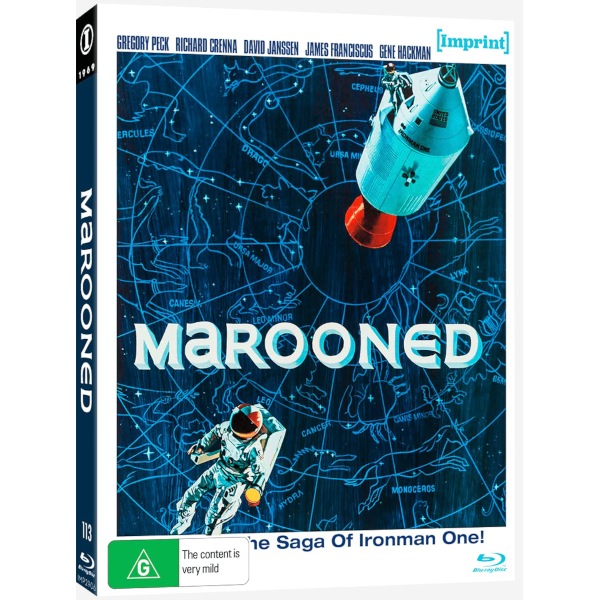
![Viavision [Imprint] 113](https://cinesavant.com/wp-content/uploads/2020/08/6350viavision0820.png)
A couple of studios hopped on the ‘race to the moon’ band wagon of the 1960s, even though the always-advancing Space Program was a riskier movie proposition than the Vietnam war. By the time a show could be finished the subject could become last week’s news. 1969’s Marooned arrived just four months after the actual Apollo 11 moon landing, and four months before the nearly-disastrous Apollo 13 mission, which bears points of comparison with this movie’s fictional premise.
One of those projects that bounces around for years until it falls behind current events, Marooned began as a 1964 Martin Caidin novel imagining a space disaster in the Mercury and Gemini programs. For a World’s Fair, Frank Capra had produced a hybrid live-action / film presentation about capsules docking in orbit. Hoping to re-energize his stalled directing career, he and his son optioned the book for the screen. When Hollywood rejected Capra and his (reportedly) over-hyped screenplay the project was taken over by Mike Frankovich, the ex- Columbia executive who was now producing independently.
Marooned assembled a professional crew for the high-profile subject. Director John Sturges was a good bet even if his track record since The Great Escape had not been the best. None of the casting was newsworthy. By this time the older star Gregory Peck was taking most any role offered. Two of the actors hired to play astronauts were still most strongly associated with TV roles. Only Gene Hackman was a hot name, and he was likely fulfilling a Columbia contract he had signed before his breakout film Bonnie & Clyde.
Author Caidin’s now-obsolete Mercury spacecraft were upgraded to newer Apollo hardware. Producer Frankovich almost had to cancel the film after a 1967 launch pad fire killed three Apollo astronauts. The script’s original technical mishap was also a space capsule fire, so a new emergency was written into the screenplay. By this time the (reported) romantic excesses of the Capra script had been dropped. Director John Sturges changed the film even more, making it drier and less melodramatic.

Going out of its way to stick to technical feasibility, the finished Marooned sets up a space emergency that becomes a mostly static waiting game. After completing a mission in a new Spacelab-like experimental space station, astronauts Jim Pruett (Richard Crenna), Buzz Lloyd (Gene Hackman) and Stoney Stone (James Franciscus) find themselves stuck in orbit. The main engine of ‘Ironman One’ Apollo capsule won’t ignite to initiate re-entry. They haven’t enough fuel even to re-dock with the space lab. What to do? The word from Mission Control is to just ‘sit tight,’ but the astronauts have only 42 hours of oxygen on board.
Action-wise, Marooned is mostly inert. Experts, executives and politicians talk on phones or the radio, while the three brave astronauts must sit still elbow-to-elbow in a tiny capsule, taking care not to do anything that might increase their oxygen consumption. NASA administrator Charles Keith (Gregory Peck) vetoes a long-shot rescue plan proposed by top astronaut Ted Dougherty (David Janssen), but The President (John Forsythe) orders a go-ahead because the public won’t accept ‘doing nothing.’ The tension rises as the impossible rescue mission becomes possible, mainly because Keith signs off on skipping dozens of safety procedures and double-checks. A rescue rocket is hastily assembled on the launch pad, using an experimental ‘lifting body’ capsule that is only partially tested.
Will the men survive? Their wives Celia Pruett (Lee Grant), Teresa Stone (Nancy Kovack) and Betty Lloyd (Mariette Hartley) can only watch and fret, helplessly.

I remember being excited to see Marooned and feeling somewhat perplexed when it didn’t satisfy. Yes, it was talky and slow and static, but that’s not always a bad thing in Sci-fi: the talky Andromeda Strain and Colossus The Forbin Project generate terrific suspense. Some of Marooned’s problems are obvious but others only became easy to see much later, after we saw newer movies that fared better with similar material.
The Waiting Game.
Many 1960s NASA launches were given full network coverage. Watching space stuff on TV meant a lot of waiting through delays and cancellations. Even when he had flight director Chris Kraft as a consultant, the network host might have to vamp for hours, on live TV. Since we could see no actual visuals from space, experts played with models to demonstrate unseen procedures happening in orbit. Marooned is mostly one long wait session. John Sturges’ opted to fill Mission Control with a surfeit of Mission Control tech chatter and commications jargon, which only added to the boredom: TV audiences had long become weary of it.
It didn’t seem credible or responsible for the rescue mission to squeeze down the prep & test process for an untried rocket-capsule combo to just 40 hours. When Charles Keith jettisons pages of safeguard steps, we now think of the 1986 Challenger disaster. President ‘Fosythe’ orders the reckless rescue mission for the sake of appearances, exactly the way President Reagan ordered NASA to launch Challenger on its original schedule despite the freezing temperatures at the Cape. Reagan wanted the PR boost of chatting with teacher-astronaut Christa McAuliffe during his State of the Union speech, so the NASA experts warning against the ill-judged launch were ignored.
We wonder what the ‘romantic excesses’ of Frank Capra’s screenplay had amounted to. What was Capra going to do, dissolve to flashbacks of the astronauts with their wives? Frankovich and Sturges removed the soap opera complications, but after two hours of excitement-challenged waiting, they then finish with a stack of noble he-man clichés. It’s interesting getting the Soviets involved, but having the astronauts push each other out of the way to volunteer for altruistic suicides is a bit much.

Our biggest gripe are the scripted personalities and behaviors of the astronauts. Many early astronauts were military men and combat fliers that related to danger via a special non-emotional code. They’d say it’s just training but we still admire their cold-nerved fixation on mission goals. Test pilots stayed calm even when they knew they were going to crash — their blood pressure didn’t even go up. They were conditioned to ‘maintain an even strain’: nobody groused about bad luck or stupid instructions during a mission — psychological monitoring and the peer pressure weeded out men not 100% supportive of the program, no matter what happens.
Marooned’s Ironman One is crewed by whiney malcontents. They groan and bitch and simmer with resentment, like fussy kids stuck in the back seat of a station wagon. Buzz and Jim give Stoney grief for acting like a true-blue Mister Rogers. The screenplay tries to explain that the astronauts are suffering from a (fictional) space malady in which they become somewhat uncoordinated, lose their judgment, make mistakes, etc. It can’t account for Gene Hackman’s Buzz acting like a complete jerk.

What Part of ‘They Were Expendable’ Don’t You Understand?
I saw Marooned with an audience of airmen at Norton Air Force base. Right from the beginning they rejected the way ‘business’ was conducted in the NASA decision room. When David Janssen’s head astronaut Dougherty doesn’t get his way he throws the equivalent of a tantrum. Dougherty’s undisciplined outbursts just don’t make it. He yells the loudest, so he must be right? In 1969 it seemed that David Janssen was using this role to take back the tough-guy cred he lost playing a lame peacenik journalist patronized by John Wayne in The Green Berets.
My audience of active airmen regarded what happens in the capsule — the bickering, the grousing, the bad blood — as hilarious, as if the show were The Three Stooges in Orbit. Those three big men are really packed in there, even after director Sturges had the art directors enlarge the set to give the actors and the camera more space. In reality, they’d quietly do what they’re told and take their sleeping pills, not start fighting like teenagers. When things come to a boil in Ironman One, I now imagine hearing the soundtrack of “Triplets” from the musical The Band Wagon.

We’re stuck in mission control and the capsule for 90% of the show, listening to people explaining what’s happening in (excellent) exposition. The astronaut’s wives must sit like idiots on the other side of a glass wall as the men try to manage an impossible situation. For the three actresses it’s a truly thankless job. Lee Grant is given all the good lines, while poor Nancy Kovack and Mariette Hartley are wasted. Ms. Hartley must speak words that the average Stepford Wife would reject:
“Teresa, Celia and I have been in this business ten years and we’ve learned that the best thing is for us girls to keep our feelings to ourselves and let the men get on with their jobs. Right, Celia?”
Director Sturges is good with male relationships, but with little action to distinguish the characters, he can’t bring much to the movie. Like several directors who earned their stripes while navigating the crumbling studio system of the 1950s, Sturges found his authority reduced in Hollywood’s new star-centric power structure. Frank Sinatra could insist that the film set run his way. The careerist troublemaker Steve McQueen never took direction well, and wouldn’t cooperate with Sturges on The Great Escape until the focus was changed to favor his role.
After the huge disaster of The Hallelujah Trail and the disappointment of his superlative Hour of the Gun, Sturges apparently became disenchanted with the business in toto. As a director for hire on Marooned he was granted the proper authority, but the movie meant little to him personally. The screenplay has little room for improvisation — and must invent reasons to get out of the cramped interiors. We welcome the occasional bits of action at a real NASA launch pad. At one point Gregory Peck’s NASA boss is stopped on the road by some cops, just so that something happens away from the mission control set. Even that scene ends up being more talk, with Keith confabbing with The President over a police radio. Question: do you think The President is going to tell Keith to risk lives for his political convenience, on an unsecured call?
Look, look — a matte line!
Thanks to Stanley Kubrick’s 2001: A Space Odyssey, back in 1969 all of us movie fans interested in the space program fancied ourselves instant special effects ‘experts.’ (I plead guilty, your honor.) We were unduly harsh on the Marooned space visuals. Everything in space is surrounded by traveling matte lines — of very high quality for 1969. The space scenes are of course all multi-generation opticals, so we see more grain and occasional density fluctuation. But film stocks and compositing techniques had improved greatly since the trial-and-error days of Conquest of Space.

The space illusions hold up better than 1967’s You Only Live Twice but aren’t quite as good as 1969’s Journey to the Far Side of the Sun, the live-action movie made by the Andersons of Thunderbirds fame. Spoiled by the wonders of Kubrick’s epic, we turned up our noses at these standard Hollywood techniques. The lighting in space was all wrong. Some of the optical composites look like klunky cut-outs, and the spacemen are obviously hanging by wires. Today I only grouse at some easily avoidable goofs. The same star background is used for different angles cut together — when a shot of a solitary space man cuts to another angle of a spacecraft, the stars behind both stay exactly the same. It looks like a jump cut.
Otherwise it’s unfair to slam Marooned’s special effects — even Douglas Trumbull couldn’t quite reach the Kubrick benchmark, three years later in Silent Running.
The Shows that Got It Right.
Two excellent movies made years later throw more shade on the status of Marooned. Philip Kaufmann’s The Right Stuff nails the sense of the astronauts’ total dedication, their ‘functional fearlessness’ in the face of danger. Kaufmann’s astronauts also demand and win the right to be treated as spacecraft pilots, not specimens in a capsule. All the way through Marooned, Mission Control treats the Ironman One astronauts like children that can’t handle the truth. Charles Keith keeps them in the dark and instructs his official communicators to distract them with EGBOK mantras. No wonder we don’t respect the astronauts, nobody in NASA does either.
Ron Howard’s great Apollo 13 dramatizes the inspiring professionalism of real astronauts facing possible obliteration. Tom Hanks and his cohorts not only get to be pro-active, they help to improvise work-arounds to sidestep the worst equipment failures. They navigate their re-entry almost by eye … skirting almost certain doom. By contrast, the Ironmen are cautioned to behave like good hamsters, do nothing and wait for Mission Control’s Hail-Mary rescue rocket. In general we agree that Marooned is a decent undemanding techno-suspense thriller, a perfectly adequate popcorn-muncher. If its astronauts hadn’t been given a lot of unlikely show-off actions to perform at the finish, they wouldn’t have very much to do at all.

