
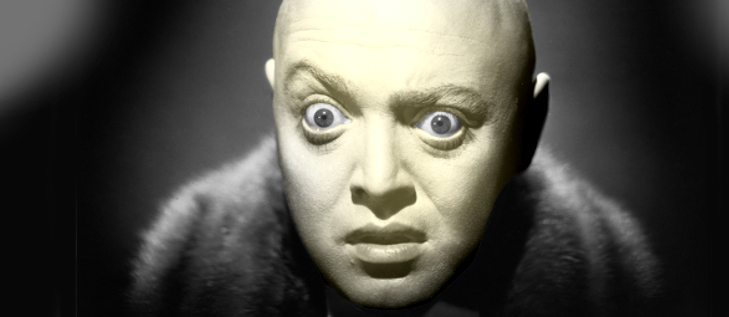
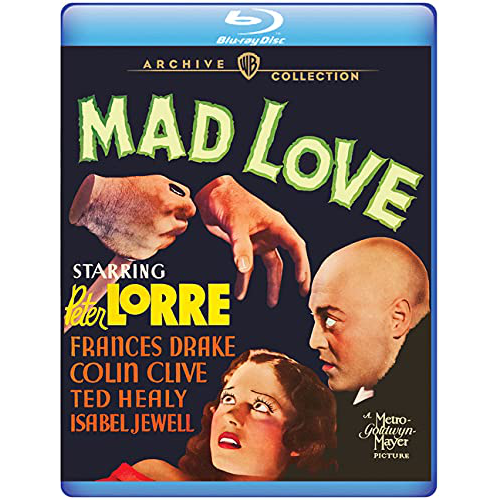

Mad Love is legendary stuff, a horror original despite being a direct adaptation of a story filmed as a silent movie. The screenplay filters everything through the notion of Grand Guignol and wrong-headed obsessive love. Peter Lorre’s bald genius is the definition of the dangerous egghead: Dr. Gogol’s name points to Lorre’s googly eyes, and his genius is matched by an emotional unstability expressed in profoundly melancholy statements.
Lorre arrived here heralded as a performing genius but Hollywood was strapped to figure out what to do with him. U.S. audiences had heard of Peter Lorre but likely weren’t ready for such a creepy characterization; perhaps he should have held out for a different kind of movie for his first Hollywood effort. Serious horror was seriously outré in 1935, for Mad Love bombed and promptly disappeared into the vault. Since that time, was it not screened much, or shown on TV? I didn’t catch up with it until the 1980s, and then only in a few film clips integrated into John Huston’s Under the Volcano. Despite a lack of enthusiasm by fans seeking more outrageous monsters, it’s an amazingly rewarding horror show, one of the best ever.
It’s a delirious macabre love story. In his first American film Peter Lorre puts everything he has into the twisted Dr. Gogol. Was Lorre not yet 100% fluent in English? If so, it adds to his creepy line deliveries. The bad rap given cameraman-turned director Karl Freund — even by encyclopedian Phil Hardy — is mystifying. This is actually an inspired job of direction. To my mind this chiller and Freund’s moody and slow-paced The Mummy conjure up genuine uncanny chills. Freund retreated to camera work, which is a terrible shame.

Weird tragedy strikes the famous and talented couple. Grand Guignol star Yvonne Orlac (Frances Drake) quits the stage to be with her husband, concert pianist Stephen Orlac (Colin Clive). This upsets her most faithful fan, surgeon Dr. Gogol (Peter Lorre), a social misfit who tends to repel people. As weak compensation, Gogol purchases the theater’s wax effigy of Yvonne. When Stephen’s hands are mangled in a train wreck Yvonne begs Gogol to save them. Gogol does this by substituting the hands of Rollo the Knife Thrower (Edward Brophy), a murderer who has just been guillotined. All goes well until Stephen discovers that his unfamiliar new hands are useless on a piano … but unusually adept at handling cutlery. As the despondent Orlac grows bitter and resentful, Gogol becomes deranged by his renewed contact with Yvonne. He pursues a diabolical scheme to have her for his own. Gogol’s deception is so horribly cruel, it drives him into fits of giddy delirium.
The screenplay for this highly eccentric shocker is a catalog of Germanic silent horror themes. It revels in the kind of expressionistic angst that in American horror is often limited to window dressing. The eccentric pattern is established from the first, when a fist smashes the last of the main titles, written on a frosty windowpane. The story’s mix of theater and reality begins with a recreation of the famed Le Théâtre du Grand-Guignol of Paris. Playing a woman tortured for love, the actress Yvonne screams on stage. In the shadows of his box seat, all but hiding behind a curtain, her celebrity fan Gogol nearly faints with excitement… tortures and guillotine executions arouse him.
1930s horror is overpopulated with shrinking violets waiting to be carried off by the monster, a ‘given’ that makes wisecracking reporters like Glenda Farrell a refreshing break from the norm. Frances Drake’s Yvonne Orlac is strong and independent; she refuses to be a passive love object. She openly admits that she has traded on Doctor Gogol’s obsession to save her husband’s hands. Gogol is adrift in his own erotic (erotic-sadistic?) fantasies, so it’s no wonder that he misinterprets her gratitude. When he eventually declares his love loudly and directly, Yvonne doesn’t faint but instead slaps his face. It’s Gogol’s worst nightmare: “I have conquered science. Why can I not conquer love?!”

How many classic horror actresses found themselves being used like décor, just to scream or to breathe heavily in cutaways? Ms. Drake and Karl Freund one-up Michael Curtiz in The Mystery of the Wax Museum: in addition to playing Yvonne, she ‘stands in’ for the wax statue of herself, without betraying a single flinch or eye-blink.
Peter Lorre leaps into this bizarre character, transforming himself into a spider-like ghoul just by shaving his head and finding ways to accentuate his bulging eyes. Dr. Gogol’s most outrageous outbursts come across as sincere and profound. Lorre makes oddball quotes and forced classical illusions entirely believable: “One always kills the thing one loves.” “Galatea! I am Pygmalion!”
Was Gogol driven mad by amorous rejection, or was he crazy from the get-go? Gogol’s surgical brilliance has made him a celebrity arbiter of life and death. Yet he seems genuinely warped. His schizophrenic nature is expressed in his gentle care for a child with a spinal injury — until thoughts of Yvonne intrude, and he becomes oblvious to anything else.
It’s curious how likeable is Colin Clive’s Stephen Orlac. Clive’s thoughtless Henry Frankenstein gets off too easy at the climax, what with his criminal neglect for his creation. Clive’s Orlac is given a warm off-screen introduction on the radio (“Cough – cough.”). He’s grateful for having his hands saved; when things go bad we stay on his side.
Orlac’s intuition that his new hands are alien objects feels ‘proto-Cronenbergian,’ as expressionist Body Horror. That hands have muscle memory is very true; how often do we find that our fingers remember how to perform some little articulate task independently of our conscious thought? That Orlac has inherited Rollo’s knife-throwing skills is fantastic, yet it carries a strange logical credibility. Of such things are superstitions born.
Colin Clive had big hands to begin with and clever makeup scars and other exaggerations give them the appearance of a gross mismatch. We think of Karloff’s spliced-on hands in Frankenstein, and Donald Sutherland’s clumsy oversized hands in The Day of the Locust. Mad Love brings in other weird psychological interpretations, such as the Freudian “Orlac and Son” sign over Stephen’s father’s antiques store, with “Et Fils” crossed off.
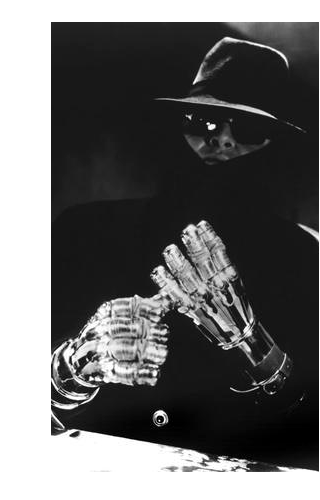
Detractors of Hitchcock’s Vertigo often complain that ‘nobody would set out to murder somebody that way.’ Gogol’s plan to ‘win’ Yvonne for himself is pure delirium: he thinks that when she’s a penniless widow, she’ll be compelled to fall in love with him. The film’s most uncanny set piece is Stephen Orlac’s interview with a hissing, caped man who identifies himself as one of Gogol’s grafting experiments. → This surgical construction has metal hands, and a thick brace where his head has been reattached to his body. The grotesque half-metal man pushes Stephen over the edge, so to speak; he’s already obsessed with his own transplanted hands. Dr. Gogol can restore a severed head, and he’s apparently invented robotic limbs, too. (Question: were those chrome hands and forearms re-used for some other fantasy, perhaps a Republic serial?)
After many viewings, the other scene in Mad Love that still feels fresh and affecting is Rollo’s march to the guillotine. ↓ This brief performance is especially touching because we already love Edward Brophy as a wisecracking comedian. With the pale morning light on his face, the condemned Rollo is humbled but not demoralized: “Everybody gets it in the neck sooner or later.” Ted Healey’s friendly “see ya later” patter with Rollo is all the more poignant. Brophy’s death walk is more affecting and a lot less complicated than Charlie Chaplin’s final moments in Monsieur Verdoux.

Some fans that don’t like Mad Love fault Ted Healy’s wisecracking reporter Reagan, an obnoxious Yank in Paris mostly tolerated or ignored by the locals. I have no problem with Reagan, who is perhaps patterned after Lee Tracy in Doctor X. Reagan doesn’t distract us too much from the macabre events around him. He also plays several funny scenes with Françoise, Gogol’s batty housekeeper (May Beatty). Their banter confuses a corpse with a wax figure, serving nicely to keep the mystery particulars in suspense. Healy’s Reagan clearly knows what a pain in the tail he is. His sincerity peeks through when he talks to poor Rollo, dropping the newshound patter.
The film wears its expressionism is on the surface. The story progression is as jarring and confrontational as that of Charles Laughton’s The Night of the Hunter. The sets are lit for psychological impact, from Dr. Gogo’s prep room with its accusing mirrors, to the fist-in-the-window title, to the weird shadows. Several excellent, well-designed montages are included in the mix, with semi-abstract superimpositions.
And what about Dr. Gogol’s cockatoo housepet? The white bird begs to be a symbol of something — Gogol’s madness? A score of shots frame the bird flitting around Gogol’s salon, contrasting with the static wax statue of Yvonne, the one that the dotty Françoise believes can come to life. When it perches on her shoulder we may be reminded of imagery in Franju’s Eyes Without a Face. Did Orson Welles source Citizen Kane’s screeching cockatoo punctuation-transition from this film? Could Welles have seen Mad Love while reviewing the work of Gregg Toland, as Pauline Kael suggested?
Several motifs converge at the wonderfully precise climax, stacking one clever surprise atop another. The screenwriters make a joke of parallel cutting — just as Yvonne’s murder seems imminent, the police chief instructs his driver to slow down. Instead of collapsing in self-pity Stephen Orlac reasserts his status as the good-guy hero. The finish is a whirlpool of doppelgängers, haunted organ-playing, manic death pacts and crazed cockatiels. Stephen’s murderous new hands turn out to be a blessing in disguise.
We’re told that Mad Love couldn’t get arrested when it was new. Perhaps audiences of 1935 were far removed from the joke about the Man of a Thousand Faces: “Don’t step on it, it might be Lon Chaney!” Having had little prior exposure to Peter Lorre, they may have looked at his Dr. Gogol and thought him pale and disgusting, like something found under a rock. Happily, Lorre found steady work as supporting eccentrics and in ethnic roles. He made his mark in film noir and in later horror, often in a comic mode. Mad Love’s bona fide weirdness is apparently still not for all tastes.
Here’s Rick Baker on Mad Love:
