

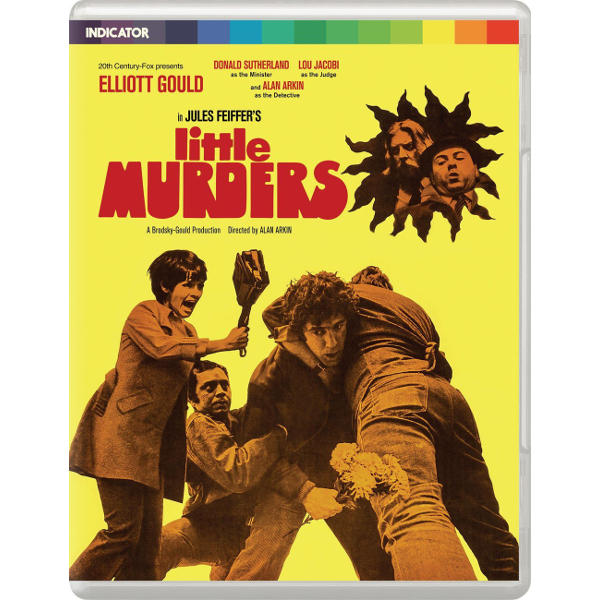

Little Murders was one of the first new films I saw in college; I believe I went on its opening weekend in Westwood with Clark Dugger, another ambitious film student. The audience was abuzz. I knew about Jules Feiffer through his cartoons, but being a California boy had no exposure to New York angst beyond things like Midnight Cowboy. By this time we knew Elliott Gould well; the only things I’d seen Alan Arkin in were Inspector Clouseau (forgettable), Popi (wonderful) and Catch-22 (funny but traumatic). Advance reviews praised Little Murders as a blacker-than-black comedy, but that was the blanket description given half the movies of 1971. We were of course looking for ha-ha M*A*S*H comedy, not I-think-I’m-going-to-be-sick Catch-22 comedy.
What we got was even blacker, and probably more than I could handle at the time. The upscale West L.A. audience probably couldn’t get beyond the important function of dogsh— in the drama, and few were ready for such an undiluted dose of The Truth about the trend toward meaningless violence in America. PBS viewers loved Theater of the Absurd pieces, but really only when the productions kept the gloves on.

Like Catch-22, Feiffer and Arkin’s film is really a social horror movie, the kind that the audience is not yet ready to accept. Feiffer states clearly that his play was a direct reaction to the Kennedy assassinations, and the revelation that the American illusion of ‘wonderfulness’ was Over. After seven years of riots, assassinations, criminal war and mass murders, America was still in denial. But for complacent viewers that saw the national sickness as just a bad phase, a disturbing artwork like Little Murders looked like part of the problem.
Now it seems eerily prophetic, a hyper-pessimistic cousin to Chayefsky’s Network. Feiffer’s characters no longer play as absurd exaggerations. The central thesis that society has become psychotic, now feels all too true.
To ward off the daily trauma of living in New York photographer Alfred Chamberlain (Elliott Gould) has become an ‘apathist’ determined to let nothing get him upset. He neither resists nor complains about the bullies that beat him up each day. Disillusioned by the meaningless consumer images he was hired to produce, he now takes pictures of dog excrement he finds in the street. Interior designer Patsy Newquist (Marcia Rodd) is a defiant optimist; when she meets Alfred she immediately determines to make him care about things, to get involved, to become a fighter. She has to force Alfred to do most everything, but he does admit that he enjoys her company. Meeting The Parents is an exercise in insanity, as both Mr. and Mrs. Newquist (Vincent Gardenia & Elizabeth Wilson) have adapted to the horror of living by becoming neurotics-in-denial. Their oldest son was murdered, and they avoid dealing with the pain by praising the detective they think is still trying to solve the case, Lt. Practice (Alan Arkin). Patsy’s brother Kenny (Jon Korkes) is a hyper-tense closeted gay who continually acts out hatred for his family.
The Newquists play transparent, grotesque denial games to avoid dealing with reality. And reality is terrible. Patsy is plagued by constant obscene phone calls. They come home one evening to find her apartment literally destroyed, item by item. Mr. Newquist wails about how he just hopes he can get through the day and not be shot, stabbed or mugged, and that when he comes home from work he won’t find his entire family dead. Lt. Practice visits, and we see that he has had a nervous breakdown over the hundreds of unsolved cases for which he has no clues and no motives. Random snipers are killing people every day.

Patsy finally talks Alfred into getting married, so she can continue to redeem him. They get their marriage license from a psychotic judge (Lou Jacobi) who can only shout out noble stories of The Old Days when people were poor but decent. They are united in an ‘alternative ceremony’ by Rev. Dupas (Donald Sutherland), who horrifies the Newquists with his philosophy that nothing has permanent value, least of all marriage. Alfred moves in with Patsy; to find the cause of his social misalignment she sends him to Chicago to ask questions of his parents (John Randolph and Doris Roberts). Patsy scores a breakthrough when Alfred finally responds to her pleas to re-engage with the struggle. He says he’ll try to work with her to become a caring, loving person willing to fight for positive values. Then the worst happens.
When in doubt we retreat to what we know, and I admit that I retreat to science fiction. I was deeply affected by the nihilism of Joseph Losey’s These Are the Damned, in which a character says that nuclear annihilation is inevitable, and calmly states that in England, “the age of senseless violence has caught up with us as well.” Then in François Truffaut’s Fahrenheit 451 we see passengers on a train acting out little psychotic nervous tics, because they’re all severely alienated from their own lives. A housewife is addicted to idiotic fake reality shows on TV, believing that the characters are really talking to her. Well, I heard a description of just such a proposed show just a few weeks back.

Plenty of 1960s and ’70s New York satires made New York seem like an absurd battlefield; even the comedy The Out-Of-Towners is an ordeal of traumatic outrages that stop being funny almost immediately. Little Murders is sometimes described as politically subversive satire, but I think it’s really social science fiction, extrapolating present day (1967) trends. In his excellent interview piece Jules Feiffer points out that the most absurd elements of his play have come true. The equivalent of photos of dogs___ now wins awards in art shows. Society is so sick that violence, especially gun violence, has become a daily means of self-expression.
Is it true that people ‘go crazy’ as a coping mechanism for an intolerable reality? Feiffer goes beyond his little neurotic cartoons to make the frighteningly true connection that traumatized, demoralized people will go to any lengths to regain a feeling of security and power, a sense of control over their lives. In 1971 I resisted and resented Feiffer’s premise simply because of its undiluted negativity. Pernicious pessimism can be contagious. It made us uncomfortable to recognize the truth of the absurdities exhibited in Little Murders, but we didn’t accept the leap of logic in the last scene, where the inoffensive Alfred rallies the Newquist men to reassert their territorial imperative through random violence. The paternal structure reasserts itself. Father is no longer an impotent fool, and the solidarity of common purpose reunites the family unit under his authority. Back in 1971 the premise just seemed too antisocial, too misanthropic, too extreme. Little Murders quickly disappeared off screens, to remain largely absent for 47 years. Now it plays like a documentary explaining our societal decline.

Alan Arkin said that the French director Jean Renoir praised the film, but I wonder what Luis Buñuel would have thought about it. Only Buñuel had created acid comedies as coldly logical as Feiffer and Arkin’s. If the show were all intolerable suffering, it would be easier to discount or forget. But Marcia Rodd’s Patsy is a positive character with a hopeful goal. Her campaign to reach Alfred succeeds, and is a major victory over the bleakness we’ve been suffering. It’s an island of romantic promise that shows that the filmmakers haven’t themselves become hopeless misanthropes. Something precious is found and lost, and we’re affected to the core.
In terms of literature Little Murders somehow reminds me of George Bernard Shaw’s Major Barbara. People often fool themselves into thinking they’ve been transformed by political enlightenment. Patsy qualifies as a heroine, but her efforts are nullified by a breakdown of civilization around her; glorious personal revelations can’t come when bullets are flying. The business with dog excrement somehow cued a memory of the story ‘Clay’ in James Joyce’s Dubliners, where a woman looking for human warmth is rewarded with a handful of mud. Sad subtext has become overt despair — Alfred is documenting his own disillusion.
We’re told that actor Elliott Gould starred in the first failed attempt to stage Little Murders, and that Alan Arkin directed a later successful run off-Broadway. Gould’s recent film successes allowed him to produce the picture, although he didn’t take credit. Between Gould and Arkin the ace cast was assembled. Elliott Gould’s apathetic, passive attitude is priceless. Patsy hammers at him, trying to find a core of feeling, but he’s just one big marshmallow. When working out his problem relating to other people, Gould tells a very long story about confronting an FBI surveillance agent, that’s a classic of its kind, definitely an extended Feiffer monologue. I imagine that Alfred’s passivity had to be an influence on Gould and Robert Altman’s The Long Goodbye.

Arkin and Gould pulled their cast from New York’s best. It was fortuitous that Gould couldn’t work up the nerve to ask Jane Fonda to play Patsy because Marcia Rodd couldn’t be bettered. The more frustrated and shrill Patsy becomes, the more we like her. The Newquists are deep, rich characters thanks to the fine performances of Elizabeth Wilson (Patterns,The Graduate) and Vincent Gardenia (Little Shop of Horrors, Moonstruck). In their hands the parents never become cartoons. It’s more than the skit humor of, say, the excellent William Daniels and Joan Delaney as the Quantrills in Theodore J. Flicker’s The President’s Analyst.
The impressively quirked-out Jon Korkes, we learn, was an acting student that Alan Arkin decided was perfect to play Danny. Added for the movie were Alfred’s parents, played by the stage greats John Randolph and Doris Roberts. Ms. Roberts has big, fairly recent TV credits, but it’s great seeing her pop up way back in 1961’s Something Wild.

Both Donald Sutherland and Alan Arkin contribute career-best turns in one-scene appearances. Sutherland is maddening as the new age guru who seems to have founded a church on the premise of believing in nothing, with an opportunistic slant. Bribed by Mr. Newquist to mention ‘the deity’ in the ceremony, Sutherland’s Reverend gleefully announces that he won’t do it, but that he’s keeping the money. Arkin’s detective has such a bad case of nerves that he can’t sputter out a sentence without stammering. The way Arkin stumbles in his speech is technically amazing — it feels like he’s going to choke.
What can you say about a movie in which such appalling things happen (I’ve tried not to spoil anything) but that you can’t turn away from because it all seems so appallingly true? Most of us don’t put up steel shutters over our windows, but in our city security companies extort enough money to give all the thieves a living wage. Alan Arkin’s film could be dismissed as cynical negativity when new, but not today. Most of us could set aside Feiffer’s reprehensible characters in Mike Nichols’ Carnal Knowledge because we felt that not everybody was like that, that he was dealing with twisted individuals. But in 2018 we know that a tiny minority of fearful malcontents can make America run red with blood. Gun violence is family therapy in Little Murders, a means of self-expression for those that feel cheated or abandoned: ‘I can’t do anything positive and my whole life has turned to dirt, but the ability to control who lives and who dies makes me powerful.’
