

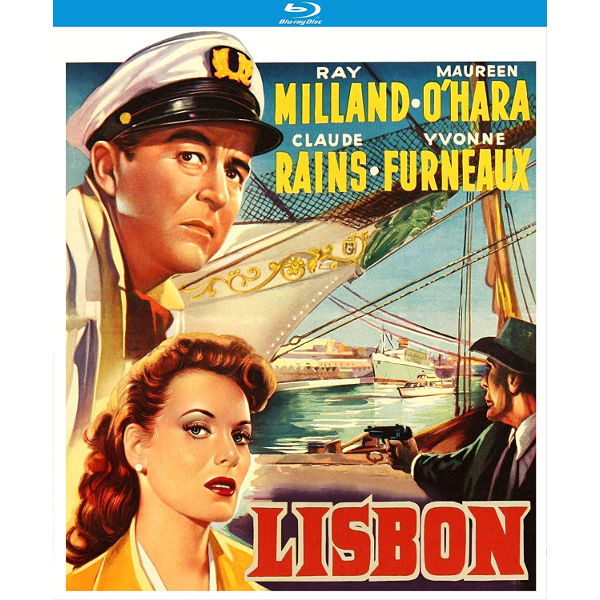

Lisbon is one of those movies that draws me like honey — it carries nostalgic memories plus an air of mystery caused by a lifetime of unavailability. Around 1981 I caught only a few seconds of a virtually unwatchable pan-scanned TV print, but that was enough to showcase its famous music theme, which I then wrongly assumed was written for the movie. The Lisboa Antigua song was ubiquitous in the middle 1950s and one of my mother’s favorites, whether heard on the radio or on The Lawrence Welk Show. I suppose it would now top a list of bland easy listening favorites, but it always got me.
But there IS a film attached to this song. It it worthwhile? It was for me, despite being yet another artistically compromised Republic Picture from that studio’s downgrade years. It’s one of their more expensive productions, but still has problems. Toby Roan’s entertaining commentary reports at length on the film’s production travails, but the rough spots are easily spotted in this excellent-quality disc. Fans of Ray Milland, Maureen O’Hara and Claude Rains will want to see it; I was also charmed to enjoy an early-career look at the incredible French beauty Yvonne Furneaux.

Filmed in Portugal, the film is no cheapie. John Tucker Battle’s screenplay is from a story by Martin Rackin. Lisbon’s top cop Fonseca (Jay Novello) is trying to sort out a mix of criminal activity among foreign guests in his beautiful city. Rich American Sylvia Merrill (Maureen O’Hara) has come to recover her much older husband, industrialist millionaire Lloyd Merrill (Percy Marmont) from Red Communist captors. She doesn’t believe C.I.A. agent Norworth (Harold Jamieson), who promises that Merrill will be released soon; she has instead come to Lisbon to see the unscrupulous, wealthy criminal Aristides Mavros (Claude Rains), who claims he can get Merrill out through other means. Mavros houses several female ‘secretaries’ on his lavish hilltop estate, and is attended by a devoted servant, Selwyn (Edward Chapman) and the sinister retainer Seraphim (Francis Lederer), a utility henchman ready to kill on command.
Into the harbor comes the gentleman smuggler Robert John Evans (Ray Milland), who uses his converted torpedo patrol boat Orca to sneak his contraband past Fonseca’s police. For $10,000 dollars, Evans agrees to transport the freed prisoner Lloyd Merrill back to Lisbon. Mavros has Evans reconnoiter with Sylvia. She sends mixed signals but the adventurer resists the temptation to get closer to a married woman. Sylvia’s interest in Evans grows despite her determination to free her husband. Evans is instead drawn to Mavros’ favorite ‘secretary’ Maria Maddalena Masanet (Yvonne Furneaux) who quickly returns his interest. This development enrages the murderous Seraphim, who determines that Evans must die no matter what happens. And Sylvia doesn’t know how to react, when the Mephistopheles- like Mavros openly suggests that what she really wants is for her husband to die during the rescue, so she can inherit his $25 million dollars.

The rich Nelson Riddle orchestration of Lisboa Antigua adorns the opening titles, which is followed by one of the best wordless character introduction scenes in thriller filmmaking, involving Claude Rains, some bird seed, a tennis racket, and a cat. If only the rest of the show was so dramatically efficient. Filmed entirely in Portugal, Lisbon’s travelogue aspects are very pleasing. The city and its environs circa 1955 are a tourist’s dream, and are very likely much different today. The romance between Evans and the captivating Ms. Masanet plays out against various pristine tourist attractions.
The screenplay is talky but often good. Evans’ smuggling activities are nicely sketched, without getting into a lot of detail. As might be expected, Claude Rains is the best thing in the movie. He’s given a fair share of clever dialogue, but is so good that even the so-so lines play well. The expatriate Greek Aristides Mavros’ crime activities are particularly credible — he’s irresistibly suave and openly amoral. With smiling confidence, he assures his cohorts and clients that he can be trusted out of mutual interest. Francis Lederer’s creepy henchman is a little stiff, but we like that — the legendary star of Pandora’s Box, The Return of Dracula and Terror is a Man might be the template for this kind of villainy.

The story property had been floating around for several years. With a gender swap in the leading role, it had been prepared as a Joan Crawford movie, before she opted to make Johnny Guitar instead. Ray Milland had already produced and directed the Republic western A Man Alone (which has also just been released by Kino) but this show was a much bigger deal. Production problems surely taxed Milland’s well-documented patience, and although his direction is always professional, it’s also rather stiff and artless. The story and characters play well but camera angles often feel dry and perfunctory. Scene transitions have Republic’s peculiarly literal ‘now we are here but now we are here’ feeling; more than once the screen fades down and then fades up again on the same angle, apparently hours later. The editing of the ending is particularly limp, even with the stylish music keeping us ‘in the mood.’
Acting-wise, Milland is adequate but a little harsh. His performance isn’t nearly as smooth and effortless as when he’s not directing. Although the comparison may not be fair, he’s pretty slack here compared to the high polish given his Tony Wendice character in Hitchcock’s Dial M for Murder. Milland always seemed to be living and breathing his characters, with a humorous self-awareness that made them multi-dimensional. In Lisbon he often seems on edge, as if he isn’t entirely inside the Captain Evans character, and is instead evaluating the scenes as they play around him.
The gorgeous Yvonne Furneaux comes off very well. Although already a familiar face for European audiences, U.S. art film devotees would likely only have seen her in the Laurence Olivier The Beggar’s Opera. She was sensational in Antonioni’s (highly recommended) 1955 film Le amiche, but that wasn’t imported until 1962. Apparently a spoiled kept woman, Furneaux’s Masanet is a butterfly that Mavros keeps in line with threats to burn her favorite dresses. The snooty butler Selwyn is only too happy to light the furnace. Naturally, Milland’s hero decides Masanet has a heart of gold.

Claude Rains is predictably superb; all playing against him are improved. The one stumbling block is Maureen O’Hara’s compromised heroine. Her speeches are often forced, but her acting works against Sylvia’s character arc, which shifts from a faithful Penelope to something more akin to a James M. Cain femme fatale. The role asks for someone capable of playing a role in depth, and O’Hara is a one-emotion-per-movie actress. This can be seen way back in 1943’s The Fallen Sparrow, with her suspected Fascist agent. O’Hara’s Sylvia instead makes sudden gear changes that don’t feel right — nothing is subtle or insinuating. Either a multi-valent characterization is out of her range… or director Milland did not have the energy to pull a performance out of her.
Milland’s action direction isn’t all that good either. The film’s one fight is only good at the ending, with an impressive shot of a body sinking, a burning flare still glowing in its chest. Milland does manage some suspense in anticipation of the prisoner transfer, but there are no real high-seas adventure scenes wither. We’re told that the boat Milland had hired suddenly became unavailable to the production. This perhaps explains why a similar master-shot of the Orca is passed off as happening in various locales, even going to and coming back from the same rendezvous.

The very pleasing travelogue-oriented scenes properly show off the local sights. A lot of time is spent in restaurants and Mavros’ palatial home; some of these locations are fairly impressive. But it’s likely that the lack of wide-angle anamorphic Cinepanorama lenses compromised many setups and required sets big enough to accomodate a camera shooting from at least fifteen feet away. Thus, the boat interior set makes the Orca seem far too spacious. The flat, compressed look of many interiors puts too much emphasis on the walls behind the actors.
I’ll be moving on shortly to the Ray Milland- directed A Man Alone, a simple Republic western given a marvelous polish. I’ve already seen three of his other pictures where he directs himself. Milland’s The Safecracker feels slight and unfinished; Hostile Witness is undistinguished. The much more successful Panic in Year Zero! still has its awkward elements but communicates its basic story extremely well. Of all of these pictures Lisbon has the most prestigious cast and the strongest claim on mainstream respectability. Although head and shoulders above average Republic product, it still feels a bit weak and frequently mis-judged. I like it anyway — if the movie was just a bit better, the music alone would push it into classic status. For now, you can check out Nelson Riddle’s Lisboa Antigua here.


