
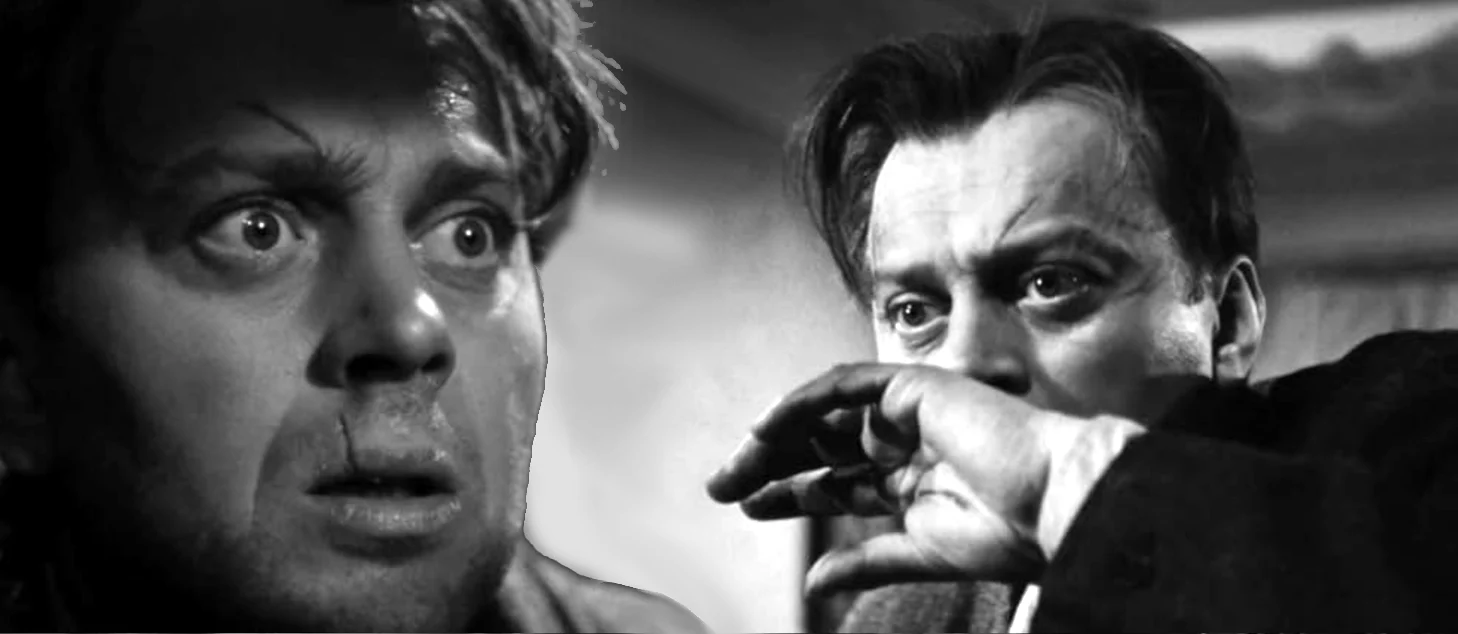

Back in 1948, the movies didn’t understand ‘the bomb’ any better than did the hysteria-driven public. Most of our favorite classic Sci-fi films stay away from politics, sticking to an allegorical remove with their technological fairy tales about radioactive monsters. The real menace was reduced to an unfocused general anxiety. Viewers of Godzilla recognized its ‘poetry of destruction,’ but viewers after more pragmatic ideas and insights had to look elsewhere.
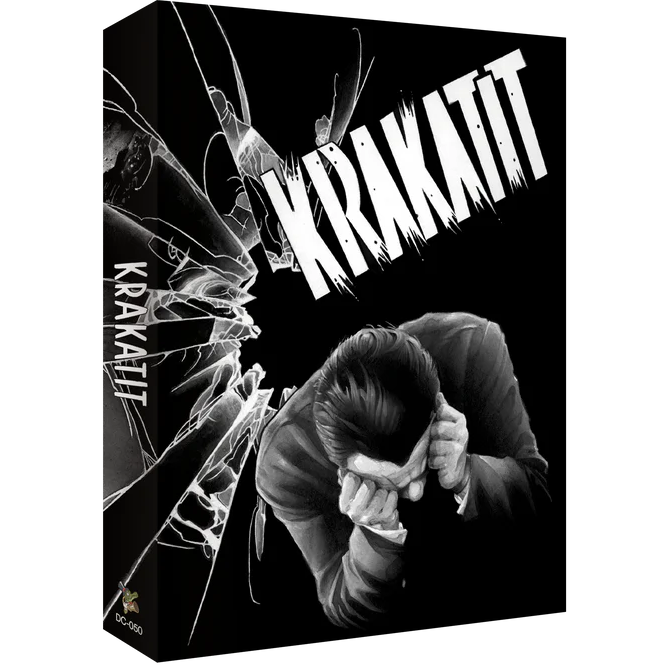
Fear not …. from out of Eastern Europe comes the obscure (to Americans) 1948 Czech movie Krakatit, which offers a humanist response in the form of a part-expressionist fever dream. We feel secure saying this because a bold title up front states right out that we’ll be watching a story ‘from within a fever dream.’ It’s an unique item — an honest attempt to make sense of the nuclear threat immediately after Hiroshima. The moral quicksand of the time is seen from the vantage point of a country enjoying a couple of years of relative political freedom; the new communist government will soon prohibit the making of movies like Krakatit.
A visionary who was both anti-fascist and anti-communist.
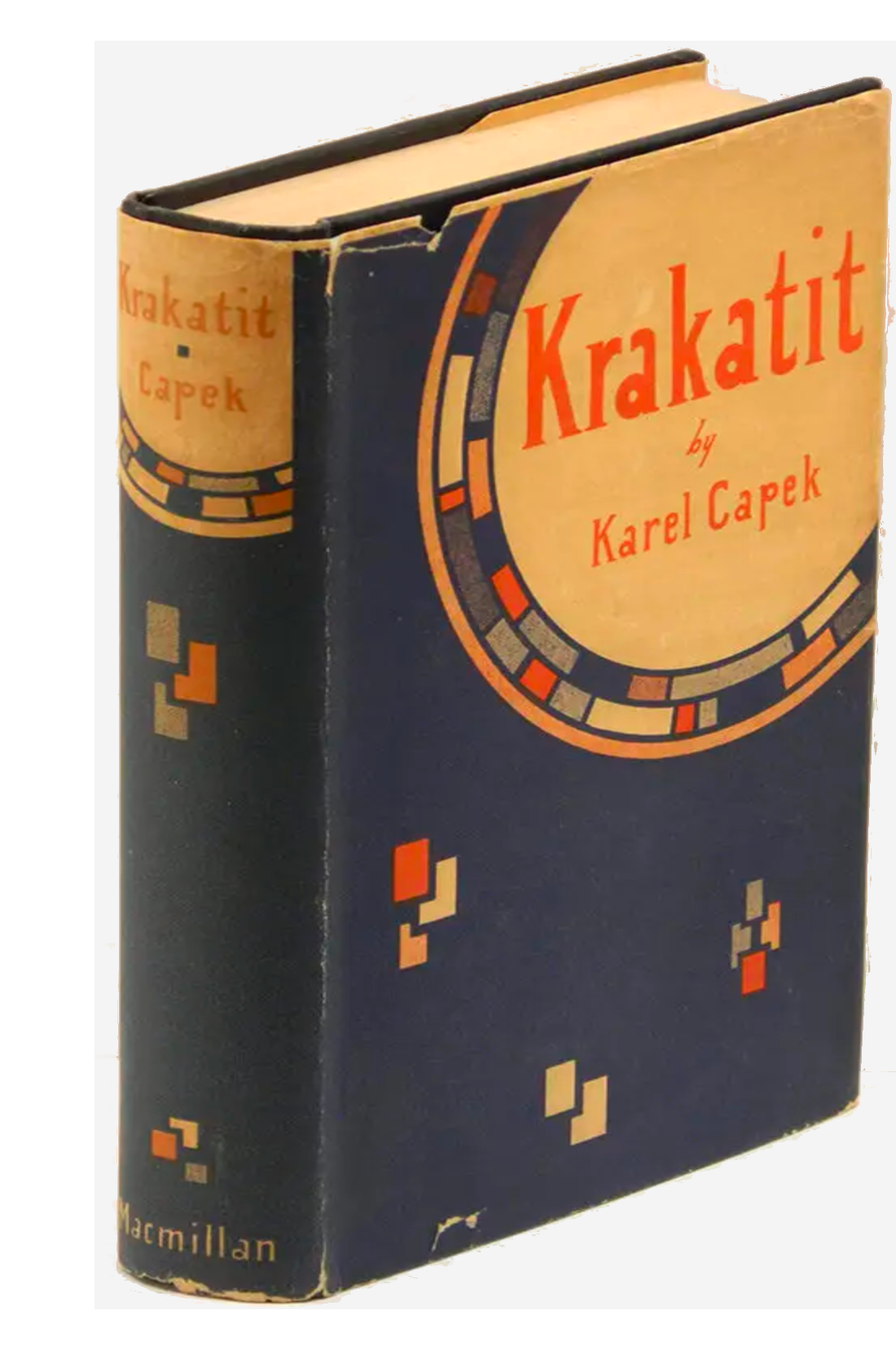
The famed author Karel Čapek coined a key word for the 21st century, ‘robot.’ The one-word title of this 1922 Čapek story didn’t catch on in the same way. It’s an excellent example of onomatopoeia — it’s a fictional explosive named after a certain world-shattering event. The book was soon translated into English. Got $500? A first edition can be yours. →
H.G. Wells had predicted nuclear weapons in his 1914 book The World Set Free, even calling them ‘atomic bombs.’ Written in 1922, Čapek’s Krakatit imagines an explosive also connected to theoretical experiments to split the atom. An inventor’s formula can unleash the atomic power in any kind of matter. It can be detonated by radio waves, from hundreds of miles away. As with his famous play R.U.R., Čapek goes beyond serial thrills to examine the social consequences of his futuristic predictions. The explosive secret so important that multiple entities vie to control its inventor. The 1948 film updates the politics to take in the chaos of Europe after the fall of Berlin.
Krakatit’s most challenging aspect is its filmic form — a part-expressionist rendering of the inventor’s fever dream. Instead of a frightening giant monster, we experience the mental disorientation of the man who holds the secret of Krakatit. While doctors try to save his life, he struggles to reconstruct his identity out of an amnesiac fog. Is what we’re seeing an absurdist dream that he cannot separate from reality? Director and co-screenwriter Otakar Vávra’s movie may be 90% hallucination.
It’s the first film ever to depict an atomic holocaust.
Doctors attend to Prokop (Karel Höger), a scientist who survived a lab explosion but was knocked senseless, with burned hands. While Prokop hallucinates, we enter his subjective reality, a mix of flashbacks and fantasies. At first Prokop cannot remember who he is or what his work was. Stumbling through a foggy night, he’s taken in by Jirí Tomes (Miroslav Homola) a friend from his college days. Jirí questions the delirious Prokop and then disappears. A mystery woman in a veil (Vlasta Fabiánová) the appears and entreats Prokop to find Jirí and give him a letter. Prokop fails at this, and ends up recuperating at the farmhouse of Jirí’s father Dr. Tomes (František Smolek).
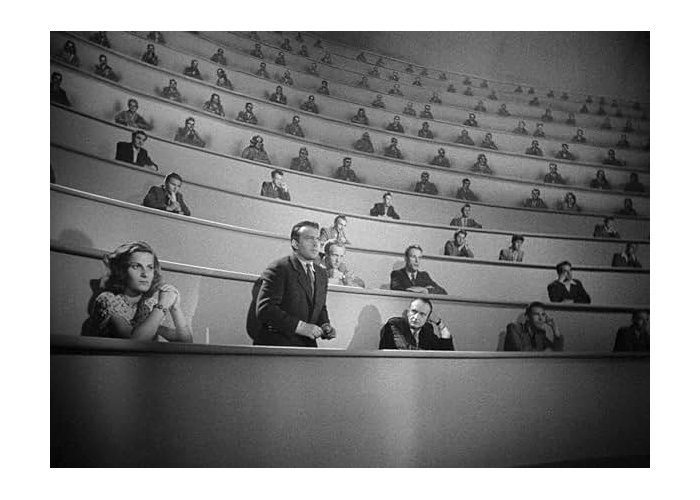
There Prokop regains his equilibrium, and becomes enamored of Jirí’s kindly sister Anci (Natasa Tanská). The anxiety returns when Prokop happens to see a personals ad in a newspaper with the word ‘Krakatit,’ and the truth comes flooding back: only he knows the exact formula for Krakatit, and Jirí Tomes may have stolen it from him.
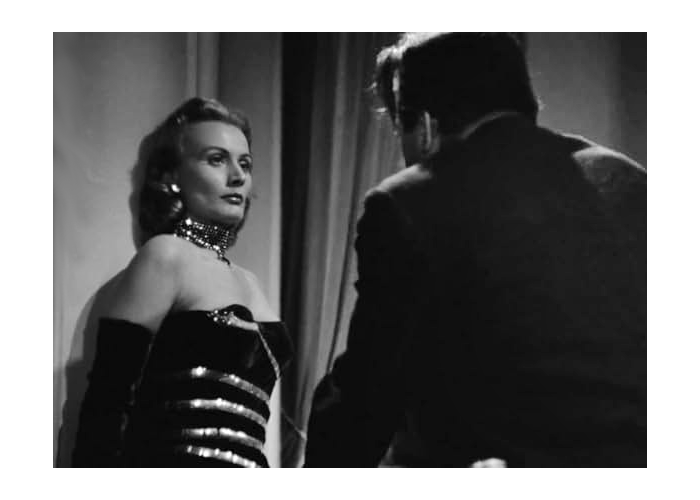
The American businessman Carson (Eduard Linkers) then enters the picture. He wants to profit from Krakatit; when Prokop refuses to sell to Uncle Sam, Carson introduces him to a secret conspiracy of monarchists and fascists that have survived the war. Still rich, they want to use Prokop’s super-weapon to re-establish a world order with them in control. Prokop meets and is seduced by the dazzlingly beautiful Princess Wilhelmina (Florence Marly), who tells him everything will be fine. He’s not to worry about the fact that he’s a pampered prisoner. She tells him that ideas and feelings are explosive too, and proves it in bed. But it’s fairly clear that she’s functioning as a fascist honey trap.
That’s only the first half of the storyline, and it doesn’t take into account director Otakar Vávra’s cavalcade of oneiric images. The visuals transform reality, yet most everything looks the same. The few outright fantastic visuals have the minimalist look of Luis Buñuel or Jean Cocteau. Prokop is haunted by visions of the ‘veiled woman.’ When he looks out a window, he sees himself climbing a hill to revisit his old lab. At one point he must try to ‘talk pacifism’ to an audience of depraved fascists, whose main speaker is a punk who models himself as a young Hitler.
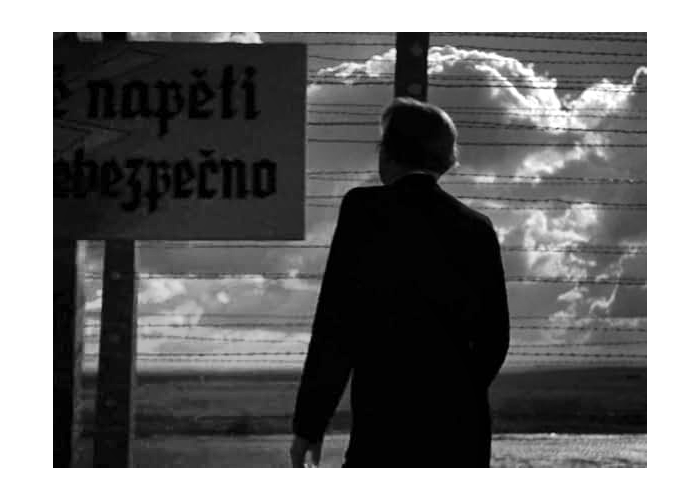
A dead dog on an electrified fence.
Prokop’s mental visions remind us of similar concepts in the stories of Luis Borges and Philip K. Dick. Every detail has a hidden meaning. Why is Princess Wilhelmina’s regal castle surrounded by the kind of security fences familiar from Nazi concentration camps? ↖ Wilhelmina is herself too much like a princess from a fairy tale, except that she uses sex to steer Prokop to her way of thinking.
Walter Chaw’s insert essay connects the ‘hallucinatory’ stylization of Krakatit to John Frankenheimer’s paranoid thriller The Manchurian Candidate, specifically the ladies’ garden party that keeps transforming back and forth into a convention of Red brainwashers. Vávra doesn’t switch realities within the same shot, but we do get the idea that the people asking ‘curious’ questions of Prokop in his ‘fever state’ are subjective impressions of more direct interrogations. If Krakatit has a weakness, it’s that average audiences are not prepared for its dream logic. It’s not an easy-to-read film, and it leaves several narrative threads unresolved. It’s more like Alice Through the Looking Glass than The Wizard of Oz … we don’t finish with a tidy identity reveal for the Scarecrow and the Tin Woodsman.
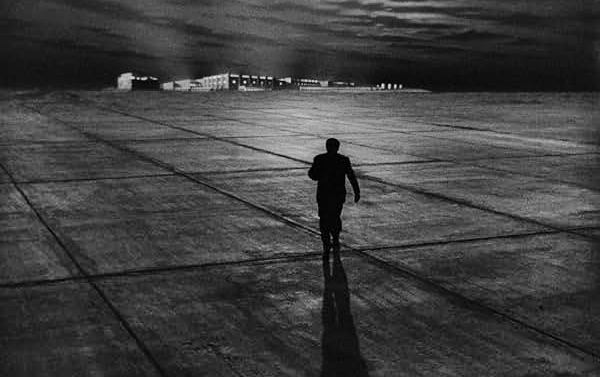
We’re impressed by Václav Hanus’s expressive B&W cinematography. With the war just finished, we’re surprised by the high technical values and the polished production. The Nazi occupiers invested heavily in the Czech state movie industry during the war, which perhaps accounts for the sophisticated Rear Projection effects on view. One setup places Prokop on a seemingly endless concrete plain. The UK TV show The Prisoner needed evocative images like these.

One essayist calls this a budget production, but we go with the other writer who says that it was much more expensive. There is a lot of matte work and rear projection, all beautifully designed. Occasional process plates look a little sub-par, but it does no harm. Numerous scenes appear to employ extremely detailed painted backdrops. Fantastic views are easy to spot, but a simple shot of a policeman on his beat at night is a real beauty — if he took five steps back he’d walk into a wall. ←
Three Women.
Does the interior logic of Prokop’s dream-reality reveal that he was previously too work-preoccupied to have a girlfriend? The story puts three in his path. ↓ We obviously side with the sweet and ethical Anci, but two less savory seductresses take charge of Prokop’s hallucinations. The veiled mystery woman functions similarly to Lucie Mannheim’s ‘woman in black’ in Alfred Hitchcock’s The 39 Steps. The imperious Princess Wilhelmina is yet another spot-on perfect casting for the legendary actress Florence Marly. We know her as, of all things, a space vampire in Curtis Harrington’s Queen of Blood. We also recommend catching up with René Clément’s superb Les maudits, in which Marly plays a horrible Nazi opportunist.
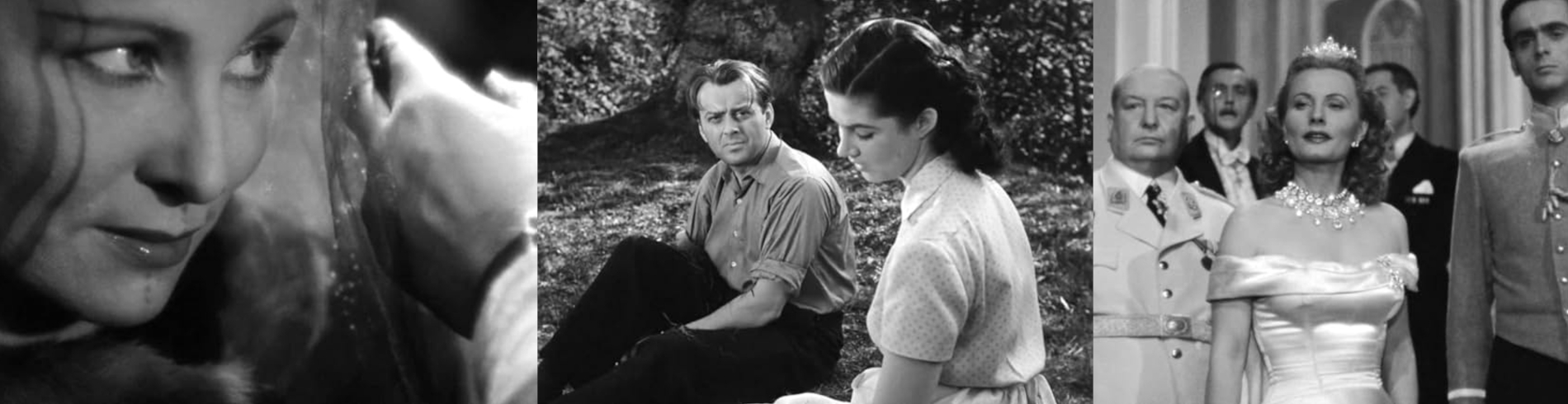
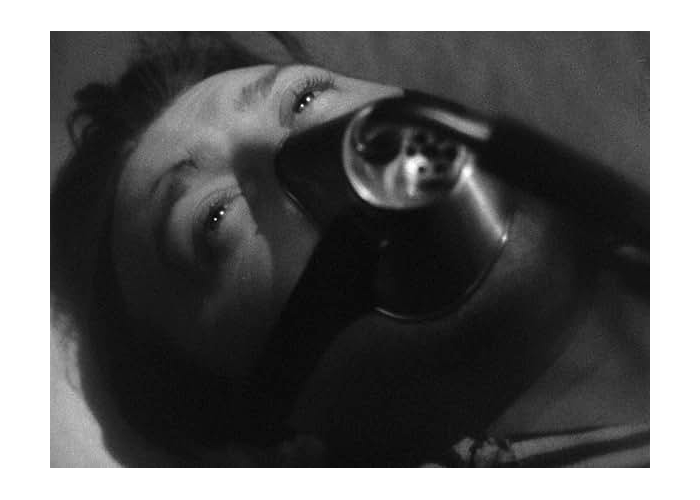
Ms. Marly is really something in the movie’s visual high point, a seduction scene that occurs at about the one hour mark. The series of choker close-ups of hands and faces generates an impressive erotic charge very much like the opening of Samuel Fuller’s Pickup On South Street. ↓ We feel the sexual electricity: Clayton Dillard’s visual essay rightly compares the effect with the visual treatment given Marlene Dietrich in von Sternberg movies.

The performances are precise and effective throughout — few contemporary reviews seem to have grasped that most secondary players are figments of Prokop’s imagination, not rounded characterizations. Prokop fixates on one of the women that tries to seduce him, only to later experience a total disillusionment — accompanied by a startling visual effect. One aristocratic conspirator all but identifies himself as a literal Demon … and tricks Prokop into being the one to set off a mass nuclear detonation. Prokop’s gone down the Rabbit Hole, folks.
The charismatic Karel Höger looks good under makeup representing wounds from his lab accident. At times his Prokop is disoriented and dizzy, like the lost idealist in Carol Reed’s Odd Man Out. In others he’s got more control, attending a fascist gathering in a tuxedo, or scaring his sponsor-captors with an explosion created from a spoonful of the Princess’s face powder. The good scientist perfected Krakatit in a kitchen lab in a shack … the big industrial labs we see are presumed to be funded by warmongers looking for new weapons.
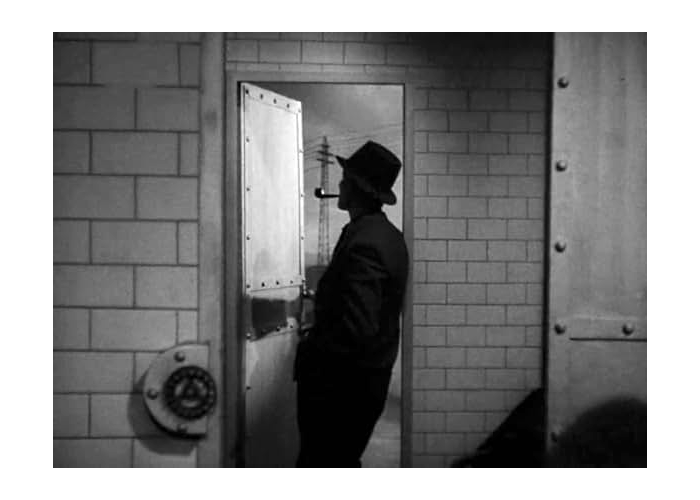
He’s a lot different from the way nuclear scientists were presented in non- Sci-fi Hollywood pictures. Generals and politicians controlled the bomb, but the physicists are blamed for its use. The archetypal guilty, suicidal scientist character was introduced in Seven Days to Noon and soon mutated into self-hating ‘defeated’ characters like that played by Paul Kelly in The High and the Mighty. Weirdly, a minor ‘security agent’ would seem to be cast and dressed to closely resemble the most famous atom physicist Robert Oppenheimer. They even gave him an ever-present tobacco pipe. →
In 1951 Krakatit saw an arthouse release at New York’s Stanley theater, apparently sourced from the Soviet Union. The Variety review identifies it as Czech but says that the spoken language was Russian, and the listed distributor was the Soviet export company Artkino. Reviewer Wear. may have lost the thread of the story along the way: he asks why the scientist is given such unreasonable things to do, and why he doesn’t choose to live happily ever after with Princess Wilhelmina. He mostly likes Otakar Vávra’s direction and praises Kiri Srnka’s weird music, which utilizes a Theremin. But the reviewer also drops words like ‘uneven,’ ‘confusing,’ and ‘heavy-handed.’ Did the Russians change the script in the dubbing stage?
In big business or politics, ‘disruptors’ that crave total control will happily throw the rest of us into utter chaos.
For our part, we want to see Krakatit again soon … to better understand what’s going on. But nothing prepares us for a nightmare vision of atomic strikes across Europe … seen from hundreds of miles away as Prokop realizes that others have been probing his secrets. The genie is out of the bottle.
The bottom line is there’s a hell of a lot to digest in Krakatit. It was made in a burst of free creativity, just before an authoritarian government seized Czechoslovakia. It is surprisingly mature and propaganda-free: Hollywood’s early responses to the atom bomb carbon-copied the Official Story Washington wanted to tell: The Beginning or the End, Above and Beyond. The few downbeat-dissenting independent pictures we made mark an American freedom of thought and expression that persisted even in a climate of Cold War.

I didn’t know Otakar was a real first name. I assumed Hergé made it up for the Tintin book King Ottokar’s Scepter.