

![Viavision [Imprint]](https://cinesavant.com/wp-content/uploads/2020/08/6350viavision0820.png)
Discounting a couple of guest bits, Ann-Margret began her life in the movies as an instant star, a talent almost too big for the medium. She possessed a new, non-demure show-biz attitude — aggressively sexual and too powerful to be stopped. George Sidney knew she’d be dynamite in Bye Bye Birdie, and added a musical star entrance prologue. Ann-Margret was filmed performing against blue to matte newspaper headlines into the background. . . but her image was so powerful they left the blue screen blank. TV’s Mad Men pegged that Birdie opening as an unsung cultural highlight of 1963, acknowledging Ann-Margret’s genuine, inimitable star quality.
By the ‘sixties Hollywood was seldom connecting actresses with proper roles, and in this case some genius decided that Ann-Margret was right for a ‘delinquent hellion’ part. She later decided that Kitten with a Whip was a career misstep, a ‘tough’ movie that damaged her wholesome image — an image that had prevailed even when gyrating with Elvis Presley in Viva Las Vegas. Ann-Margret worked non-stop in ’64 and ’65 but her first decent dramatic role was in The Cincinnati Kid, directed by Norman Jewison.
The strongest thing about Kitten with a Whip is its title, which (I rush to exclaim) suggests a lewd phrase describing a man sexually dominated by a woman. The movie resembles an exploitation piece that American-International or Allied Artists might have made four or five years before for $75,000 or so, but upgraded to Universal’s mediocre casting and on-the-lot production values. For starters, Ann-Margret’s co-star is John Forsythe, a TV actor making a play to re-enter feature work.

San Diego businessman David Stratton (John Forsythe) is being pressured by his associate Grant (Richard Anderson) to consider a congressional run. He may be reluctant because he’s at present he’s insecure about his marriage. While his wife Virginia (Audrey Dalton) and young daughter are off in San Francisco, David’s life turns upside down. A 17 year-old reformatory escapee Jody Dvorak (Ann-Margret) breaks into David’s house and surprises him in his daughter’s bed. Jody claims to be an ordinary runaway. She accepts David’s charity and promises not to cause trouble — and then returns to manipulate him with sexual blackmail.
The kind-hearted David has no defense against Jody’s lies and tricks. She comes on like a baby doll, and then veers wildly between hurt innocence and sadistic excess, relishing in her power. Jody invites her girlfriend Midge (Diane Sayer) to the house for a party, along with two dangerous hooligans. The faux-intellectual Ron (Peter Brown) and the thuggish Buck (James aka ‘Skip’ Ward) are trouble waiting to happen: their only plan is to terrorize David just for kicks.
“She’s all out for kicks . . . and every inch of her spells EXCITEMENT!”
Kitten with a Whip’s advertising certainly lays on the provocative tag lines, and writer-director Douglas Heyes does what he can to back them up. But even if Ann-Margret can tease sex content, all the Production Code will allow are a few lines of suggestive dialogue. There’s some violence — some wholesome razor slashing — but zero sex or vice. Jody’s incorrigible friends look exactly like what they are, good-looking SAG talent nearing the 30 mark. The lawless home invasion doesn’t result in anything too outrageous — no wild abandon, no drugs, no perversion. All they do is play some jazz records and drink. Ron’s sinister hipster sarcasm is bush league TV writing: too clever, too clean. The movie isn’t nearly as ‘dangerous’ as the same year’s Lady in a Cage with Olivia de Havilland and James Caan.

“Ooooh! Everything’s so creamy! Kill me quick, I never had it so good!”
Is Ann-Margret as bad in this movie as they say she is? Oh indeed yes — but who could possibly play Jody Dvorak as written? She’s just seventeen (you know what I mean) but also a total psycho. Deep down she’s a sincerely helpless, victimized child-woman, yet she’s also hell on wheels. Ann-Margret can do both extremes but seeing her switch gears every couple of minutes doesn’t work. The character bounces around like a yo-yo. She needed better coaching or better directing.
Forsythe’s David seems a total fool for not sizing up Jody in five minutes. Anybody so gullible won’t survive three weeks in politics. That’s where Kitten’s credibility goes out the window. A man of property and position, David Stratton seems decent and thoughtful; we get few if any hints about the trouble with his marriage. David repeatedly gives Jody and her criminal friends the benefit of the doubt no matter how often they prove that they’re total scum … or at least unpredictably dangerous. They threaten his life but when they’re hurt he offers first aid. The man’s a principled jellyfish.
Originally, this all may have made better sense, but in a way that couldn’t be filmed in Hollywood. In the novel, David Stratton’s ordeal is even more of a journey into Hell. According to the disc commentators, the original book’s David has sex with Jody almost the moment he meets her, with the excuse that he’s drunk and disoriented, which changes the chemistry of both David’s character and the story in general.

It’s just that in this context, with the TV show production values and abstracted, disinfected storyline, all the relationships and behavior come off as false, often laughable. The Tijuana scenes fall flat when the upscale San Diegans enter a sleazy bar. It’s inconceivable that the wives wouldn’t bolt the moment the stripper appeared on stage.
David is forced to lie a blue streak to cover up all the inconsistencies at his house. None of his excuses convince for a minute, especially with Vera in charge of the inquisition. After begging his way out of a political dinner, David then bumps into the whole dinner party across the border in Tijuana, while he’s in rough shape and carrying a bottle of liquor. He still tries to act like all is okay. Considering how completely screwed he is, David ought to be having a nervous breakdown. That he doesn’t makes him seem too dull to deserve to survive.
David never really knows what hit him. He’s victimized as badly as was Professor Rath in The Blue Angel, and he’s not even sexually involved with Jody. He’s not even tempted. Jody is so strong and David so passive that the character interactions become a joke. Ann-Margret’s ‘big’ performance steamrolls the whole movie scene by scene. It’s really something to see: everything dissolves into camp unreality.
The commentators quote a few passages from the original novel. They aren’t exactly Jim Thompson quality, but they do place the story in a more recognizable context, with David a flawed guy in a serious fix. The movie’s sanitized David might as well be an extension of John Forsythe’s Bachelor Father, a decent fellow who remains cluelessly chaste in thought and deed. David deserves to come out of this with his hide intact, and things work out remarkably well considering (excepting a few broken bones). But everything about his nightmarish experience remains on the superficial side.

♫ “And she’ll have Fun Fun Fun ’til her Daddy crashes through the fence to Tijuana.” ♬
The disc’s extras reveal that the novel’s author ‘Wade Miller’ is actually a pen name for authors Robert Allison Wade and H. Bill Miller, who collaborated pseudonymously on thirty-three crime novels. Among other names the pair used were ‘Dale Wilmer,’ ‘Will Daemer’ and ‘Whit Masterson.’ The most famous work attributed to Whit Masterson is the 1956 novel Badge of Evil. Yes, the authors of the source material for Kitten with a Whip also wrote the novel that was the basis for Orson Welles’s Touch of Evil.
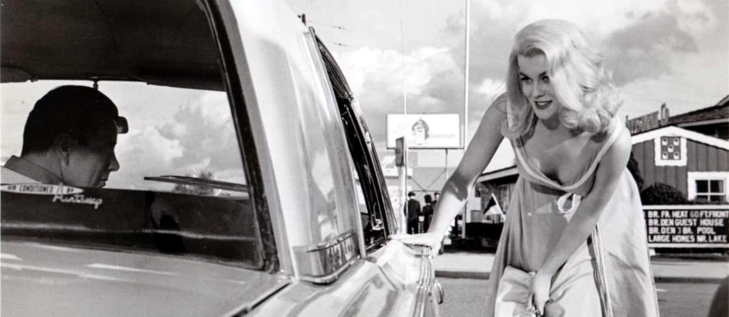
Most of the movie was shot on the Universal lot, including the Mexican scenes; the Tijuana street sequence is active and lively, even if the lighting is pedestrian. It’s clear that nobody went to San Diego: we spotted a street sign for Ponca Avenue, which is not far from Universal’s studio gate. (top image ↑)
Writer director Douglas Heyes had an impressive career writing and directing for TV. He scripted a few features (Ice Station Zebra) but for theaters directed only this movie and a remake of Beau Geste. His direction isn’t bad but what we see has a TV movie feel, and the characterizations never fully come together. When the fade-out shot zooms in on David Stratton’s wedding ring, we’re reminded how little we know about him. We’re also waiting for a trick ending, expecting Jody or Ron top pop up alive and well.

Some fun faces float on the periphery of this thing. Favorite Audrey Dalton has but one brief close-up; her photo on David’s dresser gets much more screen time. When it’s implied that Virginia Stratton couldn’t fit into Jody’s dress, we’re offended by the suggestion that the drop-dead gorgeous Ms. Dalton could possibly be overweight. Seen on TV are Doodles Weaver as a kid show host, when Jody mimes ‘baring her claws’ before a cartoon image of Sylvester the Cat — a reflexive effect that Steven Spielberg took to an extreme in the later Universal picture The Sugarland Express. There’s also a brief glimpse of our beloved local newcaster Jerry Dunphy: “From the desert to the sea, to all of Southern California, a good evening.”
Tough-guy Leo Gordon has a bit as a polite police Sergeant thoughtfully protecting Dave’s political reputation: David has a lot of influential friends, you know. The cop functions like the psychiatrist in Psycho, nicely wrapping up loose ends. If we want to split hairs, Kitten with a Whip also begins a bit like Psycho, with credits that resolve out of animated patterns of parallel lines.
Kitten with a Whip is not a complete camp disaster, like John Brahm’s terminally mis-judged, unintentionally hilarious Hot Rods to Hell (1966). But in 1994 it did suffer the humiliation of being featured on an episode of Mystery Science Theater 3000. Its big attraction is to see Ann-Margret broadly overplaying as the manic, manipulative Jody, and seeing her in action is entertaining in itself.
“I feel so shiny good about you! About everything! Like, wonderful!”
Here’s John Sayles on Kitten With a Whip:

