

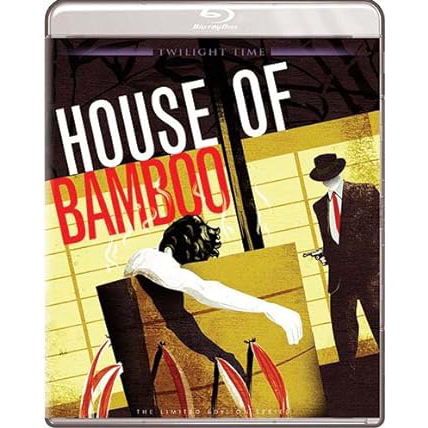

(Note, this is a reprint review from August 13, 2015. The disc is OOP.)
The uniquely weird House of Bamboo masquerades as a straight crime story, but we best appreciate it as a storytelling concoction that could only come from the fertile imagination of writer-director Samuel Fuller. It represents the high point of Fuller’s relationship with mogul Darryl F. Zanuck. Fuller first proposed a movie set in Russia. Zanuck countered with a dream assignment, to shoot 20th-Fox’s first picture in Japan, ten years after the end of the war. Fuller came up with an adaptation of the earlier noir crimer The Street with No Name, combining it with an idea he had for a gang of thieves that strategize their capers along military lines. Beautiful CinemaScope photography lends realism to a story premise direct from the Sam Fuller school of Tall Tale-spinning.
Sam Fuller’s dynamic direction made him the darling of the French Cahiers du Cinema critics. This exotic gangster epic forms a far-East duo with Fuller’s much crazier Hell and High Water, a Cold War comic book movie.

Tokyo, 1954. Thieves hijack a joint U.S.-Japanese army train under Mt. Fuji, bringing Army cop Capt. Hanson (Brad Dexter) into the jurisdiction of local inspector Kito (Sessue Hayakawa). The perpetrators are American ex-G.I.s led by Sandy Dawson (Robert Ryan) and his ‘Ichiban’ Griff (Cameron Mitchell). Dawson’s raids are planned like military actions; one of his rules is to never leave a wounded man behind. A fallen gang member is soon replaced by Eddie Spanier (Robert Stack), a hothead loner who tries to muscle in on Sandy’s Pachinko gambling parlors. Spanier becomes Dawson’s new favorite, much to Griff’s displeasure. There’s only one problem: the new man is really Eddie Kenner, a military policeman working as a mole inside Dawson’s unit.
Long a favorite of film students, House of Bamboo is an exciting cross-cultural fantasy. In the middle ‘fifties Americans were assured that Japan was a pacified nation with almost no crime and few weapons in civilian hands. American visitors felt safer on the streets of Tokyo than in their own hometowns. By and large that picture was true, but Japan did have its own problem with organized criminals that controlled gambling and vice.

House of Bamboo puts forward the conceit that a gang of American Gaijin, few of whom can speak the language, could operate Pachinko parlors while carrying out wild-west style armed robberies, holdups and murders right in the middle of Tokyo. Anyone familiar with later films like Battles Without Honor and Humanity will realize that Sandy and his pushy crew would be turned into sushi the first time they tried any muscle business on Yakuza turf. There were plenty of black market crimes involving servicemen and perhaps a few ex-servicemen, but the idea of Gangland USA operating on the Tokyo streets is comic-book stuff. We can imagine the Japanese authorities approving of the script, as it glosses over real post-occupation problems, denying the existence of homegrown Japanese crime.

Sam Fuller’s script is an ex-infantryman’s escapist fantasy, an occupation daydream. Sandy and his men all have mistresses they call ‘kimonahs’ (sic). When not serving formal tea, these pliant Japanese beauties dance the Lindy Hop. This would seem to be the reward for victory — breakfast in bed with a smiling Japanese ‘kimonah.’ No wonder Fuller alluded to protests that followed his film crew on the streets of Tokyo. He mentions the protesters scattering when he turned his cameras on them — the occupation was officially over but the fear of arrest must have been real.
Fuller had no intention of insulting the Japanese, quite the opposite. In its own way his film shows respect for the nation. It acknowledges that Japan’s separate culture is worth appreciating, an idea not often encountered in Hollywood pictures. Sam proceeded to make one of his most exciting and interesting pictures. For something a little more realistic try Sydney Pollack’s The Yakuza, which is exaggerated in other ways.
Robert Stack’s Eddie Spanier stomps through Tokyo like the proverbial Ugly American, yelling at people for not speaking English and roughing up Pachinko operators employed by American gangster bosses. Spanier meets Sandy in a nifty reveal when Griff knocks him through a CinemaScope-shaped paper wall. The entire gang is waiting on the other side; Sandy is impressed by Eddie’s tough-guy manner.
Fuller’s style might be called comic book/travelogue/graphic. In search of Mariko, the widow of an American gangster (Shirley Yamaguchi), Spanier walks a complicated path of gangplanks connecting boats on a canal, ostensibly to ask some questions but really to show off the undeniably authentic location. At one point he comes upon the unlikely sight of a kabuki troupe rehearsing on the roof of their theater, taking all those colorful costumes out in the chilly air. Fuller likely didn’t have the lights to shoot indoors; the interiors were all filmed back on the Fox lot in Los Angeles.
With the trip to Japan being the film’s one fiscal extravagance, Fuller cut corners where possible. Most of the actors playing Sandy’s gang probably never left Hollywood, although Cameron Mitchell is seen outside a castle moat and Robert Ryan definitely shows up for the finale. A second look at the picture is required to catch all of the Japanese locations matched (presumably) with California stage settings.

We’re willing to believe that Jean-Luc Godard used Eddie Spanier as a behavior model for Lemmy Caution in his Alphaville. Both secret agents are strangers stalking through an alien culture. They show contempt for most everything they see, at least until an attractive skirt catches their eye.
House of Bamboo allows Samuel Fuller to put his own spin on the gangster genre. Sandy hands Spanier a wad of bills to buy a new suit. “I like my boys to look sharp,” he says, an echo of the Edward G. Robinson – Douglas Fairbanks Jr. relationship in the classic Little Caesar. The execution of a wounded comrade during a getaway, and the blocking of a train robbery from beneath a railroad overpass, point forward to The Wild Bunch, a movie that blends western and gangster mythologies.
The movie pays off with two kinds of spectacle. Fuller stages a (for 1955) wild shootout in a fascinating kiddie playground on the roof of a multi-story department store. According to Fuller’s autobiography the store was owned by the Nikkatsu movie studio. A giant globe-shaped amusement ride suspends the little kids eight or ten floors above the street, which to this parent seems like insanity. With bullet hits echoing on the stereophonic soundtrack, the situation revisits the ‘Top of the World’ theme from White Heat and the ‘The World is Yours’ mantra from the classic gangster film Scarface.

Sandy’s military obsession is shown to be just one facet of his psychosis. Fuller claimed that the gang leader’s preference for his chosen Ichiban was invisible to all the actors save Robert Ryan, but his attraction to Robert Stack’s Spanier couldn’t be more obvious. Sandy makes it his personal business to supervise Spanier’s kimono Mariko, as if she were his proxy. He asks the whole gang why he broke his own rule and saved Spanier, while Griff looks hurt and jealous in the background. ↑ With Robert Stack playing most of his scenes wearing the same cold stare, this is Robert Ryan’s film all the way.
Finally, Sandy’s mistaken revenge against a squealer results in the kinkiest violent act ever in a film noir: he bursts into a Japanese bath and without pause empties six shots through a wooden bathtub. Then he lifts the head of the man he’s just killed and gently explains why it was necessary. The audience usually jumps, and then laughs, a defense mechanism against the outlandishness of it all. Fuller’s staging and Ryan’s performance in the one-shot scene are remarkable.

↑ Accomplished actress Shirley Yamaguchi is said to have been a Boston resident; House of Bamboo teems with other notables in roles large and small. Cameron Mitchell (Blood and Black Lace) is excellent considering that Fuller never really gives him a close-up. The same goes for DeForest Kelley’s unbilled henchman Charlie, he of the wicked grin and smart remark. Brad Dexter (The Magnificent Seven) is colorless as the military policeman and Sessue Hayakawa (Bridge on the River Kwai) has almost nothing to do as his opposite number in the Tokyo police. Biff Elliott (I, The Jury) has a death scene in police custody. Members of Sandy’s gang without dialogue (or screen credit) include Robert Quarry (Count Yorga, Vampire), John Doucette and Harry Carey Jr.. Mariko’s uncle is played by Teru Shimada, the industrialist Osato in the much later You Only Live Twice.
Darryl Zanuck became an independent producer not long after this film wrapped, which ended his interesting collaboration with Sam Fuller. Their abortive Tigrero! project fell through and for the next several years Fuller proceeded to make remarkable but only moderately successful pictures. * It was at this time that he says he conceived his epic war film The Big Red One, which had to wait 25 years to be filmed, and then on a dime-store budget. Only in Warners’ Merrill’s Marauders would Fuller again film one of his personal combat films on an appropriate scale.
House of Bamboo is a truly eccentric fantasy of American crooks in a Japanese milieu. It makes a strange double bill with Fuller’s bizarre Cold War thriller Hell and High Water. Be careful in the bath!
Here’s Allan Arkush on House of Bamboo:

1 comment