
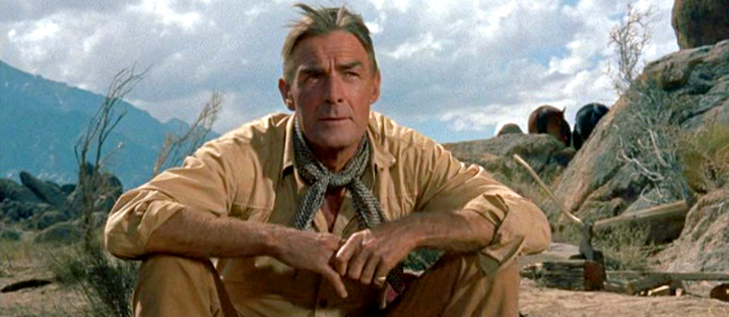


With dumb action fantasies now the only E-Ticket to Hollywood’s billion dollar club, it’s good to know that we still have the simple pleasures of older film entertainment to remind us of a world of sanity. These five modest westerns suggest a time when making a movie could be a relaxing, idyllic experience for a small number of professionals having fun working hard in the outdoors, bringing back images of rugged conflict. Beautiful Southwestern desert landscapes spread out before us in glorious CinemaScope. Directors that habitually filmed on distant locations, often stated that a main reason for doing do was to get away from the infuriating politics and interference found on the studio lots.
Although praised highly by film critics, director Budd Boetticher has never been a household name. Jim Kitses’ early auteur study Horizons West captured the essence of Boetticher’s unique approach to westerns, contrasting it with that of his contemporaries Anthony Mann and Sam Peckinpah. It’s still the most illuminating ‘auteurist’ book I’ve read on the American western.
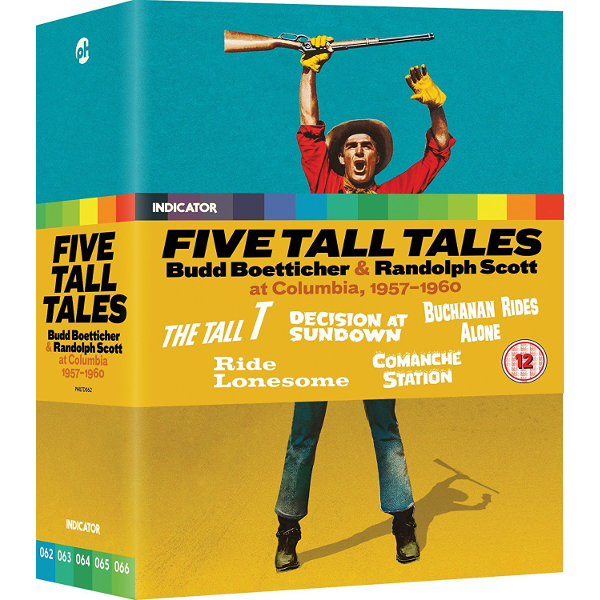
Powerhouse Indicator’s five-disc Five Tall Tales: Budd Boetticher & Randolph Scott At Columbia is a labor of love. The five medium-scale westerns contained inside all star Randolph Scott and were made between 1957 and 1960. They’re called the ‘Ranown Cycle,’ a name combo of RANdolph Scott and producer Harry Joe BrOWN. Critically speaking, the cycle includes one Scott western vehicle (Seven Men from Now) and excludes another (Westbound), both of which were produced outside of Columbia. The five features have small, sometimes tiny casts and no big stars other than the reliable box office draw Scott. They benefit from expressive color cinematography in interesting locations by ace cameramen like Burnett Guffey and Lucien Ballard. But the real praise goes to the writing and direction. Boetticher’s ‘casual’ little dramas are more forceful than many an epic, and he arranges the building blocks of the western genre to interesting effect.
The Randolph Scott Ranown westerns can be first recognized for their atypical treatment of the standard concept of the hero and the villain. Some of the bad guys are quite sympathetic and some of Scott’s ‘heroes’ are rather inflexible, even downright hostile. Burt Kennedy scripts three of the films but all have a winking sense of humor at some level. In keeping with genre demands, a steady supply of gunplay is offered, all in the service of the story.

In each film the Scott character is mirrored by a darker gunfighter, not necessarily an outright villain. They tend to be talkative and likable; more often than not they yearn for the same peace and security sought by the hero. Most of the tension is derived from cagey interchanges in which the two men evaluate one another and debate their conflicting philosophies. Because (most of) Scott’s characters are not easily provoked, the antagonist will try to shake things up by broaching sensitive topics with a third party, usually the woman of the piece. Critic Andrew Sarris called the movies ‘floating poker games’ in which the two male leads test one another for weaknesses. The arena-like stages for the final conflict are often correlated with director Boetticher’s great love for bullfighting.
These are indeed formalistic westerns: you’ll note that everyone follows a personal code, and that the codes form an understanding between adversaries that doesn’t need to be explained. Scott, for instance, won’t shoot anyone in the back, no matter what. More than one villain rescues Scott’s character, on a point of honor. Scott usually keeps his mouth shut even when the heroines impugn false motives to his actions. Action determines character, and Scott’s westerners remain true to their personal natures.

The Tall T begins almost as a comedy before being upset by a brutal standoff. Brennan (Scott) is held with the honeymooning Mimses (Maureen O’Sullivan and John Hubbard) by road agent Usher (Richard Boone) and his young helpers Henry Silva and Skip Homeier. The new husband turns out to be more than willing to desert his wife; Brennan and Doretta Mims band together to separate and defeat the outlaws. The murder of some innocents makes for a grim change of tone, and a shotgun killing is particularly intense. The original story is by Elmore Leonard (the subject of a fine audio interview in one of Indicator’s extras).

In Decision at Sundown Scott breaks with his standard characterization. Bart Allison and his friend Sam (Noah Beery Jr.) come to town to kill the rich Tate Kimbrough (John Carroll), who Bart holds responsible for the death of his wife. It’s Kimbrough’s wedding day, and Allison coldly informs the bride Lucy Summerton (Karen Steele) that she’ll be a widow by sundown. The ensuing standoff in the streets becomes more complicated when Kimbrough’s mistress Ruby James (Valerie French) gets involved. In this one Scott is not only a murderous threat, he’s entirely wrong — one can easily imagine the same story with the Bart Allison character played as a stock villain.
The leather jacket Scott wears in this film is either the same one he uses in Ride the High Country, or a close copy.

The amusing Buchanan Rides Alone is the closest Ranown film to a comedy. Just like Clint Eastwood in Fistful of Dollars, loner Buchanan arrives in corrupt Agry Town and finds himself arrested as part of a land/politics dispute. The promise of a ransom for another prisoner, young Juan de la Vega (Manuel Rojas) is enough to pit members of the Agry family against one another. Deputy Pecos (L.Q. Jones) switches loyalties to help Buchanan and Juan, setting the stage for a cross-border skirmish. Standing off to one side of the slaughter is Agry’s hired gunfighter Carbo (Craig Stevens), an equally cool customer who takes an immediate liking to Buchanan. The film begins with a fine off-color joke: Buchanan calls Agry Town a place where everything seems to cost $10, and then does a double-take at a bar girl. Randolph Scott wears a curious too-small hat in this one, perhaps to fit with his essentially humorous character.

Boetticher graduates to CinemaScope in Ride Lonesome, perhaps the most compact and formally perfect of the series. Brigade (Scott) is playing bounty hunter, taking outlaw Billy John (James Best) to town. For personal reasons, he wants Billy’s murderous brother Frank (Lee Van Cleef) to catch up with them. Along the way Brigade meets newly widowed Carrie (Karen Steele) and a pair of less-dangerous outlaws, Sam Boone (Pernell Roberts) and his sidekick (James Coburn, in his first feature film appearance). Whoever brings in Billy will be granted amnesty, so Boone very badly wants to use Billy to clear his record. Brigade refuses to cooperate. The threat of Indian attacks ups the tension both within and without. The scenery and action are spare; Boetticher reserves his strongest compositions for the stark hanging tree waiting at the end of the trail.

Comanche Station is the most wistful film of the series. Like a ghost of the desert, Cody (Scott) has searched ten years for his wife kidnapped by the Indians. He ransoms a white captive sight unseen, before learning that she’s Mrs. Lowe (Nancy Gates), a captive only recently gone missing. They are joined by outlaw Ben Lane (Claude Akins) and his sidekicks (Richard Rust and Skip Homeier). Lane wants to reap the reward for Mrs. Lowe’s return, and is willing to kill for it. Mrs. Lowe wrongly assumes that Cody has a mercenary motive, while both Cody and Lane wonder what kind of unworthy husband would hire others to bring back his wife. Cody clearly wishes that Mrs. Lowe might end his own loneliness, but he doesn’t let on.
I recommend not seeing this final picture right after Ride Lonesome as their story structures are almost identical, and they utilize almost all the same locations. Oddly, Comanche Station seems to end in the same place that it started, among the rocks of Lone Pine’s Alabama Hills. Even more oddly, the hanging tree seen in Ride Lonesome returns for one shot, in the middle of a flooded area. Could it really be in the same place, but at a different time of year? Boetticher researcher Jeremy Arnold tells me that the movies were not filmed concurrently.
Some of the features advance surprising insights about how men relate to women. In The Tall T Brennan forcibly kisses Doretta Mims, but only to make her stand up and fight for herself. Bart Allison in Decision at Sundown is in denial about his wife’s true nature, and is impressed by another woman’s commitment to her man. Brigade in Ride Lonesome shows tenderness to Carrie but is too consumed by vengeance to respond to her overtures. And Cody in Comanche Station, refusing to give up hope for his lost wife, underestimates the relationship of the married woman he brings back from captivity. Almost all Boetticher films carry a sub-theme about falsely judging other people. Even the hero learns that the truth can only be determined when action decisions need to be made.

On the surface Boetticher’s westerns still display traditional genre values. The Indians are a generic threat to provide action scenes. The fairly ridiculous Indians of Comanche Station wear loincloths in the scorching desert and are outfitted in obvious rubber skullcaps with Eastern-style Mohawk hairstyles. Yet none are demeaned with disrespectful parts. The same goes for the Mexican characters in Buchanan Rides Alone, who exhibit a sense of honor unknown to the Anglo residents of Agry Town. The sight of the rational, principled Mexicans watching the greedy Gringos blow each other’s brains out is a pretty accurate image of the America as seen by foreigners. That might be expected given Boetticher’s career as a bullfighter in Mexico. His Bullfighter and the Lady may be the most insightful and respectful movie ever about a ‘gringo’ in Mexico.
The five movies are superficially similar yet very different. Each little moral story is effective in its own way. The hero and villain are certainly compared, but they are not the ‘binary opposites’ seen in some of the films of Anthony Mann and Sam Peckinpah. They don’t combine to form a complete personality, as might the main characters of Ride the High Country or Bend of the River. The villain invariably recognizes the superior moral position of the Scott character, and tries to charm his way into Scott’s good graces.
All of the films are solid, satisfying western adventures. With his chiseled face and graceful presence Randolph Scott is a pleasure to watch. And nobody rides a horse like Randolph Scott. After Comanche Station Scott would do one more western before retiring, the beautiful Ride the High Country for Sam Peckinpah. In a way, High Country is an elaborate riff on the Boetticher/Kennedy canon, but with two old westerners instead of one. It’s a great movie to go out on.