

It’s a familiar story, yet with a fresh spin. Cavalry westerns had become the forte of John Ford, who would end up making five of them. Horse soldiers figure strongly in at least two other Ford westerns. This MGM film has much the same subject matter but a different feeling. Escape from Fort Bravo doesn’t come off like a recruiting film for the U.S. Army. MGM’s music arrangers give a contemporary tilt to a cavalry marching song. Images of the troop riding through giant stone canyons aren’t composed in a reverent manner, as if the rock formations were a giant church-landscape. No, Robert Surtees’ glorious color images are often picture-postcard pretty: they almost say, ‘this is 1953, America, you live in a beautiful country. Get out there and see it in your new Chevrolet.’
John Ford’s cavalry westerns took place immediately after the War Between the States. They commonly made sentimental gestures to the Confederacy, through ex- rebel officers now serving for the Union in far-flung Arizona. At least one recent non-Ford B&W western set during the war had confected the idea of Union warders and Confederate prisoners banding together to fight Indians, out in the western desert. Robert Wise’s Two Flags West (1950) forces enemies Joseph Cotten and Jeff Chandler to fight on the same side. Warfare isn’t simple any more; a separate peace is arranged where gray will fight alongside blue, as long as the enemy isn’t Confederate. The question is, can a divided American once again find unity? History pretty much tells us to throw in the towel on that one.
Escape from Fort Bravo dispenses with the national unity politics in favor of a straight escape caper — a genre that director John Sturges would make the peak of his career ten years later.

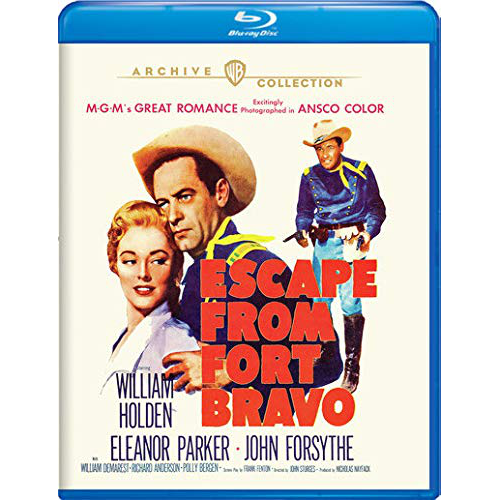
Fort Bravo has no political message or literary pretensions. The story is from Michael Pate and Philip Rock, whose other feature writing claim to fame is the abortive science fiction film Most Dangerous Man Alive. Screenwriter Frank Fenton retained their interesting blend of ideas. During the Civil War a Union Fort in Arizona is holding a number of Confederate prisoners. After the hard-headed Captain Roper (William Holden) force-marches an escaped prisoner (John Lupton) back to the fort, Commander Colonel Owens (Carl Benton Reid) worries that Roper’s brutality has gone too far. The ranking Confederate prisoner Captain Marsh (John Forsythe) isn’t happy either, but stays on speaking terms with Roper. Owens’ daughter Alice (Polly Bergen) is set to marry Lt. Beecher (Richard Anderson) and receives a guest for the wedding, Carla Forester (Eleanor Parker). All are surprised when Roper warms up to Carla. A romance begins to shape up… except that Carla’s really the lover of Captain Marsh, and part of a clever plan for a Confederate escape.
Part of MGM’s first year of films composed for wide screen projection, Fort Bravo impressed critics and the public. It doesn’t matter that we can guess exactly why Carla Forester has crossed hundreds of miles of treacherous Apache country, seeming just to dress up and entice Captain Roper. Star power and chemistry make that part of the movie work, as John Sturges never had much of a knack for romantic scenes. Holden and Parker give their roles conviction and flair. They share their first kiss on a dramatic rock under a bright blue sky … this must be the Hollywood Arizona that’s always 70 degrees in the sun.
When Roper is used as a patsy for the escape, we expect him to blow a fuse and ride for vengeance. But our handsome hero’s reputation for sadism turns out to be untrue — Roper never loses his cool over Carla, and in fact understands what she’s done. Perhaps the odd touch of having Roper grow roses is supposed to be a clue about his true nature. But the important issue is simple pragmatism. When Roper catches up with the escapees it is obvious that they need to pull together to survive the pitiless Apache attacks.

Sturges’ assured direction makes all of this work extremely well. The wedding dance at the fort isn’t a joke, even though Captain Marsh is allowed to attend. We still think that it’s really nice that the Confederate prisoners, corralled in the fort’s parade ground, are in such good shape. Marsh even has a dress uniform suitable for the party, and apparently has bath privileges, too.
Agincourt in Arizona.
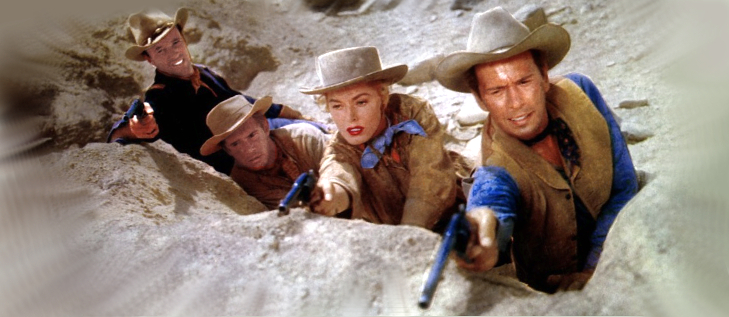
The final act’s Apache siege out in the desert is highly inventive. Sam Peckinpah might pooh-pooh the details, such as the fact that these Apaches begin by acting like old-school movie Injuns, riding up in clear sight to be shot down. Historical Apache raiders got their scary reputation through guerilla tactics, never showing themselves and attacking only when they had the advantage. The siege part of the attack uses a gimmick so clever that we don’t care if it’s not authentic… the Apaches stay out of sight over a hill and lob in volleys of arrows, guided by spotters. The native bows aren’t like English longbows, yet the tactic seems practical. The Apache had brilliant warriors. They could have heard about European warfare, but also could have invented the trick themselves. The scene is so well directed that it doesn’t matter — matinee audiences for Fort Bravo were surely delighted.
In 1953 John Sturges was doing fine at MGM even though production was slowing down. He had begun lobbying the front office to film The Great Escape. He already had a reputation for getting along well with difficult talent, especially Spencer Tracy. Escape from Fort Bravo is Sturges’ first film in color. The script was tailored for William Holden, who at first balked at Roper’s being fooled by Carla. Polly Bergen was in Sturges’ previous film, a comedy. John Forsyth had played the starring role in Robert Wise’s The Captive City, and Wise recommended him to Sturges.

Featured players William Demarest and William Campbell make an amusing light comic relief team, with Demarest’s old salt easily upstaging the egotistical younger Reb’s smart remarks: “Why don’t you take a nice nap, and I’ll wake you when you’re dead.” With those two working there’s no need for a ‘chorus’ of soldier voices. Only John Lupton (Battle Cry) stands out as a young poet who has recurring bad luck in his escape attempts. That just leaves Richard Anderson’s Yankee officer Beecher to comment on Roper’s conduct. Beecher also thinks the Captain is a sadist, but of course changes his tune when Roper proves so capable in the final siege.
Escape from Fort Bravo avoids heavy duty drama and instead takes itself just seriously enough. Those Indians are a terror, but Carla and Roper can go for a fun ride outside the fort. The best thing about Fort Bravo is that its final action is not interrupted with gloppy romantic nonsense between Roper, Carla and Marsh. Screenwriter Frank Fenton would apparently save all that up for the next year’s Garden of Evil. Instead of sitting around analyzing each other, the people in Sturges’ films do things.

The fort was a standing set at the Corriganville Ranch but Fort Bravo’s spectacular desert scenery was filmed in several sites in New Mexico, with key scenes shot in Death Valley. Viewers that know their classic science fiction will immediately recognize the prime Death Valley location from Rocketship X-M. The exact same camera angles can be seen in Michelangelo Antonioni’s Zabriskie Point — the vast dusty gulley where a dozen couples have dream sex, serenaded by The Grateful Dead. The battle with the volleys of arrows was also filmed in Death Valley, off the Artist Point Road (thank you Mike Del Gaudio and Eddie Henn), in a dry wash nicely chosen for its stark ‘no place to hide’ quality. Some arrows were ‘shot’ on wires but none of the action was under-cranked (sped up). That and excellent sound effects add greatly to the realism.
Few knew that the respected actor Michael Pate was a writer as well. Pate had just played an Apache in John Farrow’s Hondo and was to soon become typecast as Indians. Glenn Lovell’s excellent John Sturges biography Escape Artist, the Life and Films of John Sturges tells us that Sturges found out that Pate had a good knowledge of Native American lore, and casually asked him some questions about Apaches. The director was more than a little embarrassed when Michael Pate informed him that he was the writer of the original story.

Fort Bravo did so well that it led directly to Bad Day at Black Rock, a triumph that made Sturges a ‘low A-list’ director. The positive reviews trumpeted Sturges’ energetic, dynamic direction. One reviewer said that the action scenes were so exciting, they looked like 3-D. Perhaps that accounts for some reports that the show had been planned in 3-D. What with the onslaught of Cinerama, 3-D and CinemaScope in 1953, it’s likely that EVERY studio film was briefly considered for 3-D. Daily Variety often printed quotes from ambitious independent producers kiting ‘optimistic’ facts about their film projects.
Let’s see, we have a Civil War Union prison stockade out in the western desert. A Union captor and a rebel prisoner form an uneasy alliance, and even compete for the same woman. There’s even a scene where the rebel prisoners mock the Union officer, by whistling Dixie. I’ve read the original treatment and shooting script for Sam Peckinpah’s Major Dundee and am convinced that its basic outline was cooked up by cut ‘n’ pasting pieces of older movies together, mostly Columbia epics. But the basic Dundee setup would seem taken directly from Escape from Fort Bravo, expanded to epic proportions, with twenty-five speaking roles. Movie fans that like the motto ‘Less is More’ will find plenty of reasons to consider John Sturges’ movie a top-rank western entertainment.
