


Why review the 1984 Dune again? The second part of the Denis Villeneuve version has received a warm welcome, and some moviegoers are quick to dismiss David Lynch’s expensive, commercially disappointing epic. It is now 40 years old, and pundits still occasionally report that Mr. Lynch will take it out of mothballs for a major re-edit. If he ever gets the notion to do such a thing, I say let him revise or enlarge or reinvent or deconstruct to his heart’s content — even a completely abstract Dune with Lynch’s touch would be a worthwhile project.
Dune ’84 still thrills this viewer. It has more vibrant and memorable characterizations, better music (even if it’s sometimes synthy-thin) and more imaginative designs. Lynch’s epic has an insane expanse of exposition to cover, an impossible task; Villeneuve’s two-part show is more than twice as long yet leaves out entire aspects covered by Lynch, like The Spacing Guild and its Navigators. It is STILL 80% complicated back-story. But hey, the newer version has plenty of good aspects as well, especially on a big screen.
Not that I want to see it again, but it’s worth reminding readers of the existence of a SyFy Channel Miniseries. And a core of Alejandro Jodorosky fans would rather ignore all the versions and obsess about the Chilean-French filmmaker’s never-filmed, yet influential version.

We were blown away by Arrow Video’s 2021 4K Ultra HD of Dune ’84’s 137- minute theatrical cut. We especially asked to cover Viavision’s new Dune — Limited Edition 3D Lenticular Hardcase because it is the first Region A Blu-ray release of the movie’s notorious Extended TV Version, which made a quiet TV syndication debut in June of 1988, in a flat pan-scan version. Universal released a widescreen 2:35 DVD of this longer cut in 2006.
Was this re-edited by a studio committee, or by a focus group?
The Extended TV Version gave Universal something longer to tout in TV promos, approximately 35 minutes of ‘new’ scenes. It offers a lot of much-desired elaboration, character detail and ‘elbow room’ for the too-dense epic. As we’ll explain, it also has some really awkward aspects, through cut & paste editing that interrupts David Lynch’s mysterious moods. The director signalled his opinion of Universal’s recut by opting for the dreaded ‘Alan Smithee’ directing credit. When it came time to decide what pseudonym to use for his screenwriting credit, somebody chose a combo of famous betrayers: ‘Judas Booth.’ Mmmm … think there were some hard feelings with this one?
We’ve always loved Dune ’84, and not just because we’re partial to complicated movies with storytelling problems. Lynch’s feudal struggle for galactic domination still ‘sets our minds in motion.’ So much of George Lucas’s Star Wars was lifted from the Frank Herbert books, it isn’t even funny. The director may have disowned his giant epic, but his vision is as exciting here as it is in his more celebrated films. Our coverage of this deluxe Viavision box concentrates on the Extended TV Version and the extras. A closer breakdown of the Theatrical Cut and the Dune phenomenon can be found at our CineSavant 4K review.
Uhhh … so mansplain us some more about this here ‘Extended’ version, CineSavant.
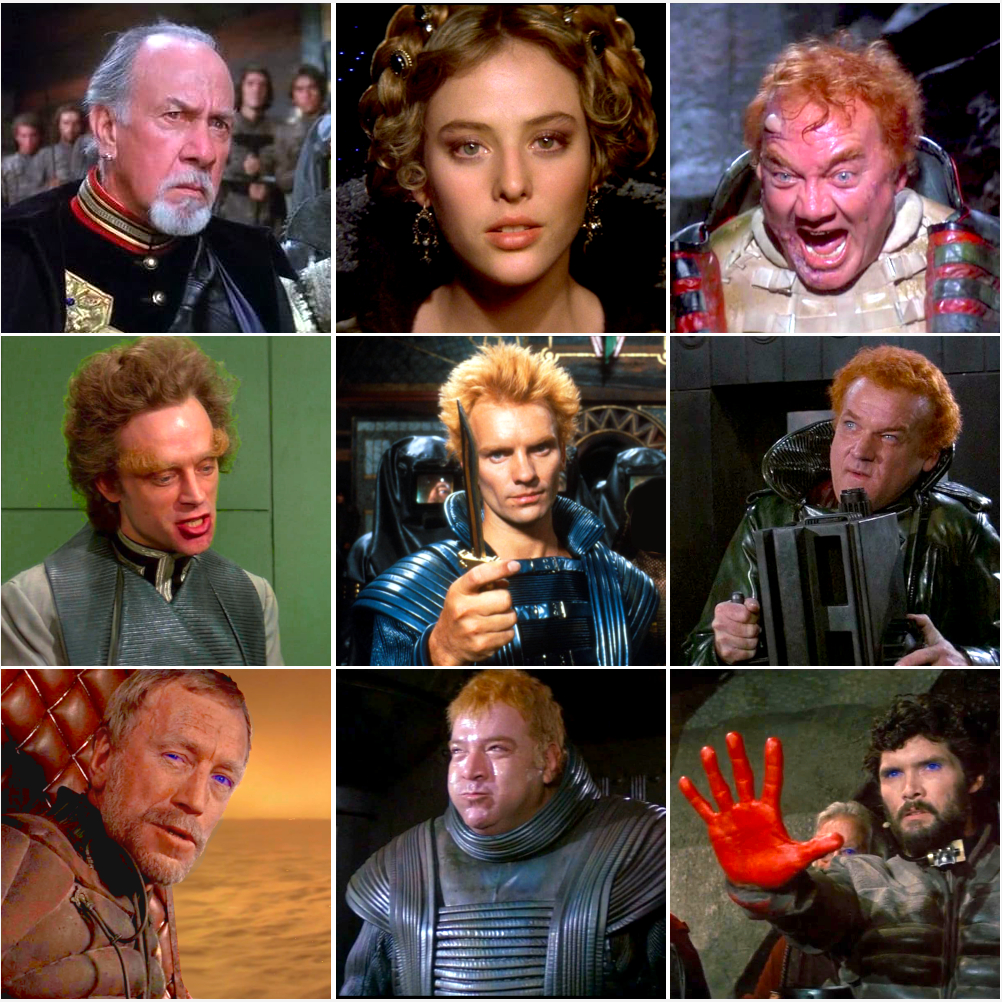
From the very start Dune had the reputation of a talk-a-thon, where 30 characters spend so much time explaining galactic politics, that there’s not enough room for meaningful action and drama. When we saw that the Extended TV Version was 50 minutes longer, we hoped it would make the show easier to follow. Nope, viewers unfamiliar with the book will still need a tour guide to understand what’s going on. Univeral’s recut probably began by reinstating last-minute trims, restoring dialogue to scenes that had been slashed cut to a minimum — like the two opening scenes with José Ferrer’s Emperor. But a lot of exciting & meaningful material was recovered as well. “Alan Smithee’s” editors reinstated several scenes deleted in full, including one with Patrick Stewart’s warrior-balladeer playing a stringed musical instrument. There’s more needed detail and some more ‘quiet’ moments that benefit several performances greatly. Richard Jordan’s promising Duncan Idaho is now at least a little more than just a passing blip. Linda Hunt’s interesting Shadout Mapes now does more than deliver a couple of expositional telegrams.
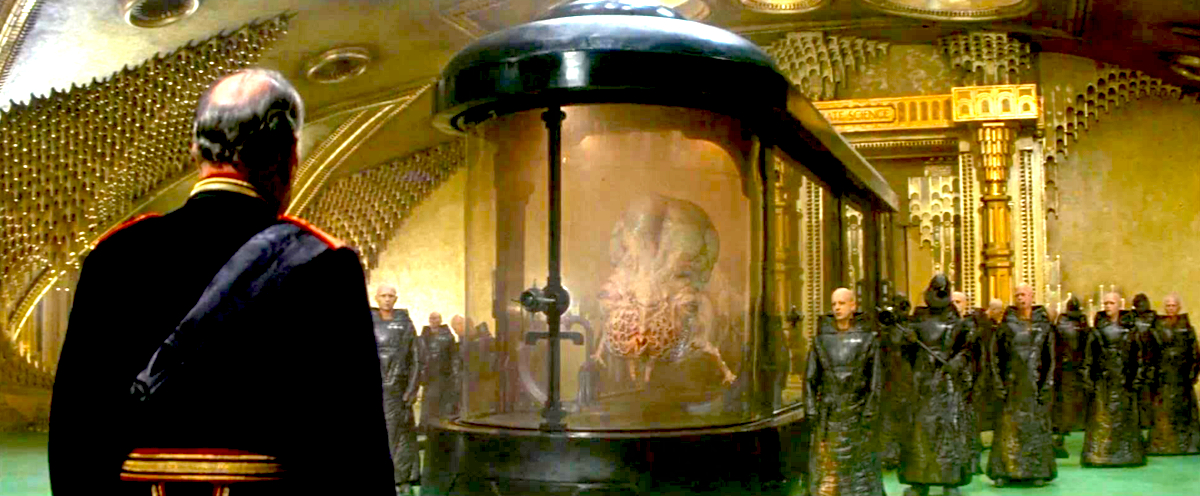
After we go underground with the Fremen, even more important scenes are reinstated, such as a knife fight and a burial. Best of all is the milking of “The Water of Life” from a baby Sandworm, which may be Carlo Rambaldi’s most impressive mechanical effect creation. It’s as weird as the mutated 3rd Stage Guild Navigator, the gnomish ‘thing’ that floats in an aquarium. Both feel related to David Lynch’s nightmarish Eraserhead.

The Extended Cut also adds more redundant voiceover exposition. The Theatrical Version began with an expository monologue-prologue from Princess Irulan (Virginia Madsen). She sounds great, but the speech communicates little. Universal couldn’t/didn’t rehire Ms. Madsen’s services, so we now do without Irulan entirely. A generic male voice (Sci-fi actor William Phipps) takes us on a mind-numbing rehash of Dune politics that adds eight minutes to the running time. It is visualized with concept art not in keeping with the film’s look; shots of the main planets are inserted here, copied from later in the movie. That repetitive blackboard lecture is soon followed by Paul’s original review of the key planets in the federation, viewed on his tablet-like laptop device. The new narrator pops in throughout the Extended TV Version, adding and restating information. His voice flattens out the introduction of major characters.
The Extended cut also expands every time some character travels from one world to another, as if some executive said ‘I don’t know where we are. Show ’em going to Kaitan each time.’ Since there aren’t enough shots of spaceships landing or traversing starfields to go around, It’s all repeated effects footage. Some arrivals show incorrect spaceships landing on the wrong planets. Is this the Emperor’s home orb, or is it planet Caladan? Worse, the editors sometimes just plain cheat. When the Reverend Mother Mohiam (Siân Phillips) arrives on Caladan, a cockpit view is stolen from a later scene of Paul and Jessica being taken out to the desert to die … we can plainly see mother and son tied and gagged at the bottom of the frame! Toward the end, various effects shots unfinished in the film proper are replaced with flat artwork place holders. We appreciate the effort to expand the canvas — but it’s quite a mish-mosh.
The extended cut was also heavily censored, dropping several moments of semi-perverse Lynchian details, bits of gore and unpleasantness. Completely eliminated are shots in which Baron Vladimir (Kenneth McMillan) molests a flower-boy and pulls out his heart-plug. Lynch knew that villainous mustache-twirling would no longer suffice; the squeamish details of spit and pus were really essential to his theatrical version. Vladimir doesn’t spit on Lady Jessica, although Piter de Vries still wipes the spittle away. Rabban doesn’t crush a little creature in a hand-juicer and then suck its fluid through a straw.
Restorations, broken epics, bad news and good news.
When a favorite is involved we always want to see ‘more.’ But Hollywood history is littered with broken epics, movies that were mangled because studios lost faith in them. Way back in 1925, MGM destroyed Erich von Stroheim’s 9.5-hour version of Greed, with the idea that such a long movie is an insane idea. Well, today’s preferred format for ‘big’ stories is the streaming limited series, which tend to stretch from 6 to 10 episodes. If Greed had survived, it might have found a home on Netflix. We were intrigued when Samuel Fuller’s The Big Red One was reconstructed; the same goes when Orson Welles’ Touch of Evil was re-worked.
We’re grateful that some key scenes were returned to Major Dundee. The restoration of a cut of The Wild Bunch closer to Sam Peckinpah’s personal cut was a major achievement; we’re always hoping that Warners might restore various minor cuts to the film, including its foreign Road Show intermission. Thanks to Criterion’s beautiful disc set, we can now also enjoy Sergei Bondarchuk’s amazing 1967 War and Peace, a four-part epic that clocks in at a fully satisfying 7 hours. And Universal allowed Bob Gale to reconstitute a full, correct long version of 1941.

Perhaps the biggest success story along these lines is Wim Wenders’ Until the End of the World. When he wanted to release a 5-hour, three-film version, Warners refused and forced him to deliver a 158- minute cut. On his own dime, Wenders finished his long version separately. He then had to wait many years for the rights to revert back to his company, permitting him to release it as he intended. That’s called believing in one’s own work.
It’s been over twenty years since Peter Jackson’s three-part Lord of the Rings films became big hits. New Line’s big gamble demonstrated the same kind of showman’s confidence that Erich Pommer and UfA had back in Weimar Germany, with Fritz Lang’s Dr. Mabuse der Spieler and Die Nibelungen, each of which was a massive two-parter. It looks as if Lang’s Metropolis was meant to follow the same deluxe format, before UfA collapsed, and MGM and Paramount came in to chop the Sci-fi epic down to nothing.
We are soon to see another example of a film originally released in a compromised version: Peckinpah’s Pat Garrett and Billy the Kid is about to be released in three distinct versions. Let’s hope that one of them is all-inclusive.
The De Laurentiis organization was always big on ‘comic book’ movies, having had (European) success with Diabolik and Barbarella, and doing okay with the much later Flash Gordon. Some advocates for the Villeneuve films like his darker approach, with hardly a smile in the entire saga. The new version’s sober tone may be more in keeping with Herbert, and all those gigantic Arrakeen sandscapes were impressive in IMAX. We found Part One to be ponderous and muted, and enjoyed Part Two much more with its well-organized spectacle. The battles and fights are excellent too.

After seeing both versions, we’d rather save our criticism for the Star Wars franchise, which lifts so much from Frank Herbert, we’re tempted to wonder if George Lucas ‘adopted’ the Joseph Campbell storytelling mythos as his inspiration to put copyright bloodhounds off the trail. Thanks to a son who has read the Herbert books and likes the Villeneuve version, I’ve learned what everybody else knows, that Paul Atreides has a ‘surprise’ heritage, very much like Luke Skywalker’s.
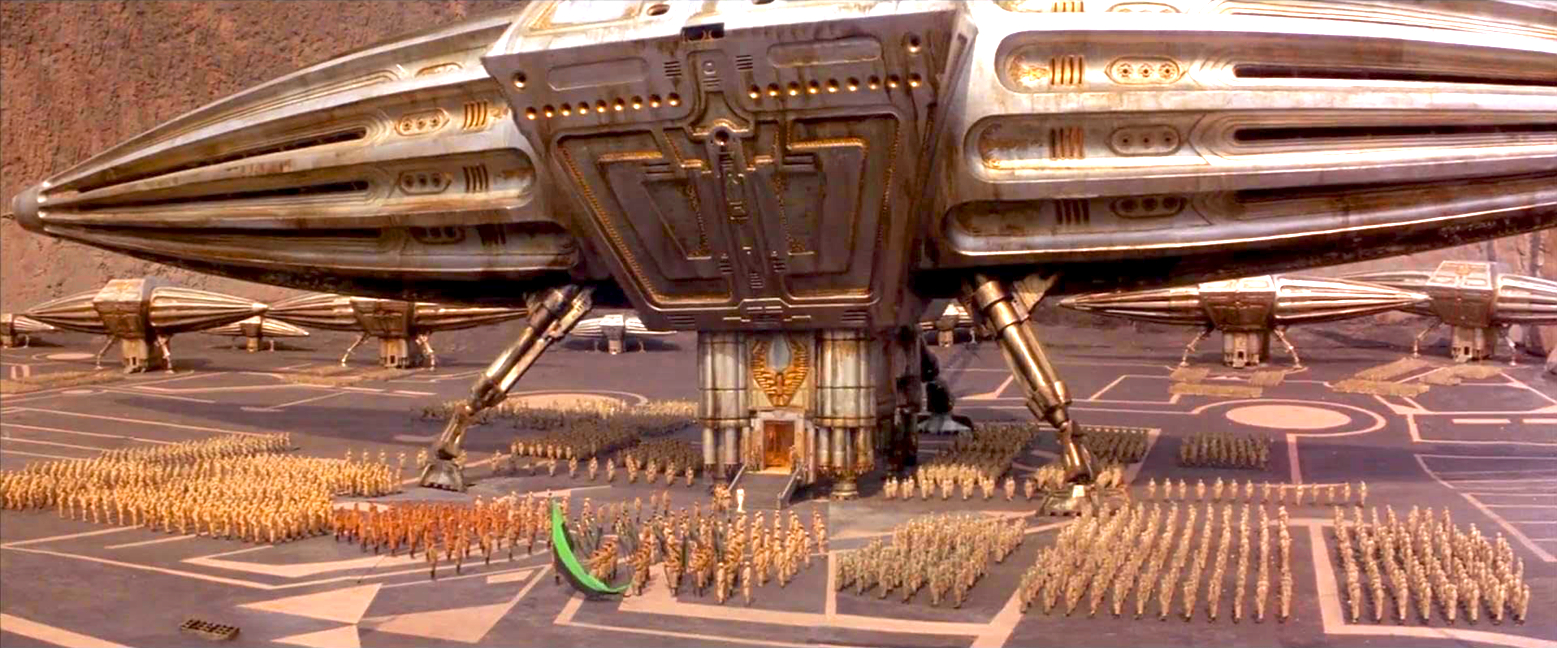
One can’t deny the power & vision of David Lynch’s imagery: as we’ve tried to illustrate, Lynch comes through with some terrific screen art. It’s too bad that he couldn’t have been given more time and the resources to enlarge his Dune out into two movies, like the Salkind/Lester The Three Musketeers. Frankly, what Lynch was trying to accomplished needed a longer format as described above — three, maybe four movies. He concluded that taking on such a giant epic was a misstep, but we respectfully disagree. His Dune looks so good and does so many things so well, it has nothing to apologize for.


Chris Gore from FILM THREAT raved about this fan edit, that includes near everything with additional efforts to polish, mix, fix and tidy up whatever. https://youtu.be/faHQA_0d9Mo?si=MGAhxGZkA6FzHgNO
This is the version I always watch when I want to see the 1984 version. There’s a special quality to the acting in the Lynch version like watching a play rather than a movie.
“Shot for shot, David Lynch’s galactic epic is as brilliant as any of his films, with vivid characterizations, strong performances and a parade of weird, strikingly Lynchian visuals.”
When I first read this, I thought you were joking. Dune (1984) is one of the five worst films I’ve ever seen (along with Superman IV (1987), Batman & Robin (1997), Freejack (1992), and Suicide Squad (2015)). I thought it was incompetently made, and the visuals were embarrassingly cheesy. It was bewilderingly confusing, and I laughed out loud multiple throughout the film at the unintentional hilarity of what was happening on screen.
Caveats: I’ve never read any of the Dune books, so I have no affection or bias toward the source material. I saw this film a few months before the new film was released in 2021. I unabashedly love the new Dune films, but I had not seen them before I saw the ’84 version, so again, no bias for another version over this. And I had been disappointed in Denis Villeneuve’s previous film, Blade Runner 2049 (beautiful to look at, but the story was dull as dishwater), so I had no expectations for the new film prior to seeing it.
As I read you review of the 1984 version, I can’t believe that we were watching the same film. I saw literally none of the craft or artistry or even creative ambition that you described.
Different strokes for different folks obviously.
The “Alan Smithee” version that the Sci-Fi Channel cobbled together is all but unwatchable.