

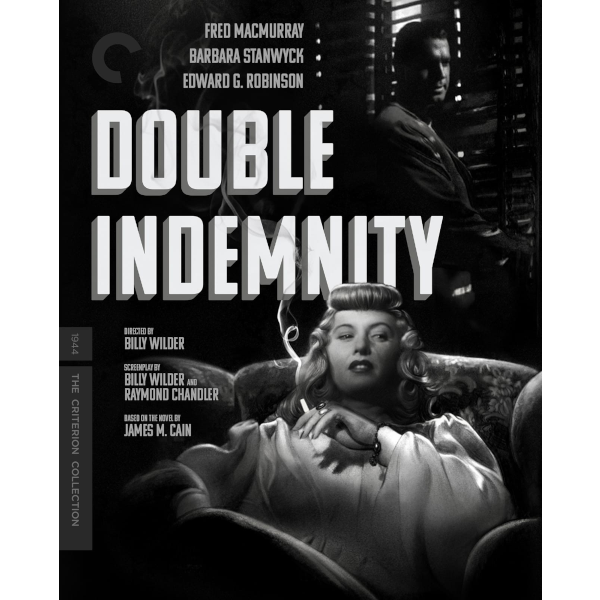

Here’s a review that’ll write itself … just describing Billy Wilder’s big achievement is a pleasure.
The more we ruminate about film noir, the more Double Indemnity seems to be THE picture that set the style in motion. In 1944 America must have been psychologically ready for something ‘tougher,’ something that didn’t play like a variation on Going My Way, guaranteed to contain 12% moral uplift, good hygiene and spiritual values.
Yes, the war opened a lot of American eyes to the worst of human nature. Americans disabused of some of their pre-war complacency probably welcomed the movie’s more adult attitude toward human lust and greed. A meaningful percentage of viewers were surely shocked by a movie that didn’t present the usual sanitized, wholesome Hollywood image. Double Indemnity broke through the Production Code, bringing to the screen the essence of hardboiled crime fiction, where murder can be cold-blooded and venality is a major motivator. The source was a novel by the dean of hardboiled fiction, James M. Cain. It was co-written by the crime novelist Raymond Chandler and co-written and directed by a Viennese immigrant fascinated by American culture.

By directly addressing adultery and premeditated murder for profit, Double Indemnity opened the floodgate for all manner of previously taboo subject matter. Wilder scored in the thriller genre as Alfred Hitchcock and Fritz Lang never had, glamorizing the attraction of sin and wrongdoing, and holding out just enough hope for a humane finish to leave audiences in hushed silence.
Just a scant ten years earlier Billy Wilder understood barely more English than what he had heard in pop song titles. Much of the film’s dialogue sounds more like his work than that of James M. Cain or co-writer Raymond Chandler, turning hardboiled crackle into something a person might actually say. Viewers familiar with Wilder often see little difference between his comedy smart-talk and the writing in his acid noirs:
“Sometimes honeysuckle can smell like murder.”
Modern audiences now respond with approving laughter, rushing to assert that they’re in on the joke. But Double Indemnity is not a parody, it’s the real deal. It never fails to deliver the sickly allure of greed and treachery, California style.

James M. Cain’s original story isn’t about nice people. The smug & self-satisfied Pacific All-Risk insurance salesman Walter Neff (Fred MacMurray) pays a call on Phyllis Dietrichson (Barbara Stanwyck), gets an eyeful of her anklet chain and is soon helping her concoct a murder for love and profit. They make the killing look like an accident. Their slick insurance swindle initially slips by Pacific All-Risk’s Barton Keyes (Edward G. Robinson), a claims investigator obsessed with ferreting out cheaters and frauds. Keyes is Neff’s one friend; Neff has taken on this murder project right under Keyes’ nose just to prove himself superior to the little man and his calculating mind. The murderers’ scheme continues to defy detection. Luck is on their side as well. But the partnership in crime begins to unravel when Walter learns something that chills his blood: he may be only the latest in a line of Phyllis’ chumps and victims.
Although films noir certainly pre-existed Double Indemnity Billy Wilder was the man with the nerve and persuasive skills to get this fundamentally anti-Code story before Paramount’s cameras without a censorship ‘cleanup.’ After this precedent hit big other studios immediately rushed out hot James M. Cain properties that had been held up for years: Mildred Pierce, The Postman Always Rings Twice. The film’s look was equally influential. A big slice of Hollywood filmmaking veered away from the norm of high-key glamour toward a style favoring darkened rooms and sinister silhouettes. Pessimistic themes became commonplace, along with characters entangled in sordid, anti-social intrigues. Sex and aberrant psychology came out into the open.

Double Indemnity breezes by on a steady stream of stylized dialogue. The most impressive speeches are by former gangster icon Edward G. Robinson, who gives some passages a machine-gun delivery almost as exaggerated as those of James Cagney in Billy Wilder’s later comedy One, Two, Three. Fred MacMurray’s delivery is pitched partway toward the laid back beat-talk that Robert Mitchum would soon bring into vogue. With these ‘intimate’ buddies every question is a smart remark answered by another smart-remark question. “How would you like a $50 cut in pay?” says Keyes. Neff answers, “Do I laugh now or wait until it gets funny?” For contrast, Phyllis Dietrichson’s purred come-ons and breathy objections all come under the heading of pure femme fatale poison.
Even now the movie is strikingly cold-blooded in its depiction of murder, a violent act that plays out over Phyllis’ face as she revels in her own capacity for erotic destruction. But the previously self-confident Walter is horrified to learn rumors about Phyllis’ background and how she became Mrs. Dietrichson. The phrase Double Indemnity is insurance terminology but also suggests the peculiar jeopardy of partners in murder: it’s essential that they trust each other, but as each already knows what evil the other is capable of, trust is impossible. As usual, Barton Keyes puts it best:
“It’s not like taking a trolley ride together where they can get off at different stops. They’re stuck with each other and they’ve got to ride all the way to the end of the line and it’s a one-way trip and the last stop is the cemetery.”

“I killed him for money – and a woman – and I didn’t get the money and I didn’t get the woman. Pretty, isn’t it?”
Eddie Muller says that Wilder and Chandler do quite a bit to humanize Cain’s cold-blooded characters. Co-workers Keyes and Neff share the movie’s special relationship. The diligent and honest Keyes is fascinated by the statistics of fraud, larceny, and murder. He displays utter delight in getting the goods on chiselers like Fortunio Bonanova’s crooked truck driver. Keyes isn’t interested in the money and women that motivate Walter to break the law. He is most definitely attracted to Walter, an affection that has become a shared, cynical joke.
Walter Neff is essentially a self-loving opportunist. The crack salesman lacks Keyes’ fundamental morality; he’s been quietly looking for a way to game the system for years. It’s as if both Walter and Phyllis are incomplete personalities, suppressed sociopaths that hold themselves apart from other people. Only in extreme situations do they discover unexpected streaks of human sensitivity.
The screenplay recognizes the tragedy of a wisdom that comes too late for Walter. Phyllis’s sad daughter Lola Dietrichson (Jean Heather of Going My Way) is enduring a miserable romance with a bitter hothead, Nino Zachetti (Byron Barr of Pitfall). The kids are a perfect pair of patsies. Walter protectively persuades Lola from telling what she knows about Phyllis, while Phyllis independently prepares to frame Zachetti in a complicated second murder and double-cross. Phyllis experiences a last-minute flash of decency, while Walter is so sick of himself that he turns self-destructively noble. Yet Walter proves to be human, redeemable. Reduced to noir loser status, the cocky cynic makes a generous romantic gesture to the troubled young couple.

Double Indemnity crashes to life with Miklos Rozsa’s doom-laden score. With variations he would recycle it in a dozen more films noir. An ominous title image shows a dark shadow of a man on crutches looming toward the camera, a ghost come back to haunt the guilty. The movie raised Billy Wilder’s prestige several notches within the industry. Alfred Hitchcock was so impressed that he took out a trade ad to praise him. No kidding: Hitchcock was not known for publicly patting other directors on the back.
Wilder and Chandler’s picture transcends the notion of ‘cheap’ pulp thrills. It’s a vision of damnation, of a vulnerably corrupt human who makes choices that almost literally amount to selling his soul. We see Walter Neff coming home, after committing what appears to be a perfect murder. There’s no reason to believe anyone suspects or that Keyes can possibly detect the crime. Yet Billy Wilder has Walter experience a sudden clammy sensation, a shiver of cosmic foreboding. Wilder’s dark dramas Wilder hit nerves more chilling than in any horror movie:
“Suddenly it came over me that everything would go wrong. It sounds crazy, Keyes, but it’s true, so help me. I couldn’t hear my own footsteps. It was the walk of a dead man.”
Just South of Paramount in Larchmont Village are at least three streets with vintage apartment buildings like the one where Walter Neff walks, with basement parking places. The driveways are proportioned for the cars of the 1920s, and now seem far too narrow. The street is lined with palm trees and greenery, and walking there at night can feel a bit like a Walter Neff stroll, with everything quiet and no feeling that anybody’s watching. But you can hear your own footsteps.
Another Los Angeles ‘thing’ that Double Indemnity gets just right: in the final showdown at Phyllis Dietrichson’s, radio music drifts in, the song Tangerine. Walter asks Phyllis about it, perhaps to make sure that they’re alone in the house. Nighttime audio can be deceiving in Los Angeles, especially in the canyons. The music is from ‘down the street somewhere’ but it could also be in the next room. The D.A. Vincent Bugliosi noted the phenomenon when he wrote about the Manson killings in Helter Skelter: gunfire two doors down might sound as if it came from far away.
Does Walter Neff live in a utility closet? Wilder and Chandler need to give Phyllis someplace to hide in the hallway scene, but having Walter’s door open OUT into the hallway is just not the answer. I’ve never seen an apartment door hung that way: the exposed hinges would allow any burglar to enter without bothering with the lock. Stanwyck’s wig never bothered me but the false door business always did.
The big hit Double Indemnity was nominated for seven Oscars but won none. Was there a mild industry backlash against the ‘immoral’ subject matter? The winner that year for both Best Picture and Best Director was Leo McCarey’s Going My Way, the antithesis of Wilder’s movie, and wildly popular. Actress Jean Heather played in both of them!
A lot of discussion centers on Billy Wilder’s assembling the dynamite star pairing of MacMurray and Stanwyck as his heartless killers. They had previously co-starred in Mitchell Leisen’s Remember the Night. Wilder could very well have enjoyed casting them as heartless murderers, as a way of sticking it to the director with whom he had so many disagreements.

