
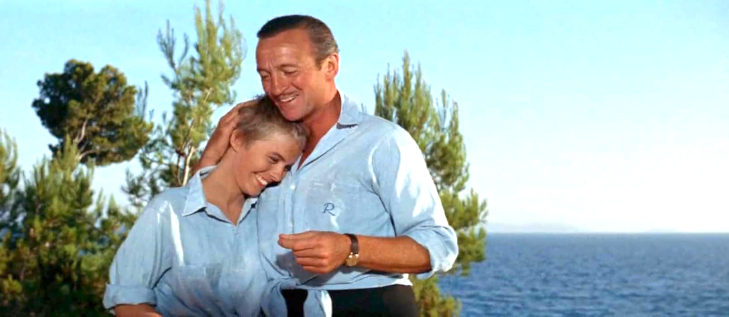


Françoise Sagan’s novel was big news in the 1950s, popularizing the existence of an affluent French ‘smart set’ that had the luxury of leaving older social rules behind. At least 4 versions have been made including one just last year. The critical consensus is that the newest effort doesn’t measure up to Otto Preminger’s vintage version, made back when the erotic content of the story had to be kept on the margins. It’s certainly not perfect, but it has something unique — Jean Seberg in top form.
French film critics must have flipped when one of their favorite Hollyood auteurs Otto Preminger took on Françoise Sagan’s confessional-declaratory novel Bonjour Tristesse, to be produced in the English language, with non-French actors in leading roles. Given that handicap, David Niven and Deborah Kerr couldn’t be bettered as a wealthy Paris playboy and an opinionated fashion designer. The French locations are genuine, at least. The real compensation is Preminger’s discovery Jean Seberg, as the daughter growing up within an odd set of privileged, decadent values. Lensed by cinematographer Georges Périnal and quite impressive in CinemaScope, Bonjour Tristesse is an awkward but beautiful film that won a loyal band of devotees, including the critics of the French New Wave.

Very apparent in 1958 was Otto Preminger’s non-judgmental attitude to the material. The show does not billboard preachy sentiments, or offer a character that serves as a moral spokesperson. We can’t dismiss Jean Seberg’s flighty teenager as a simple delinquent, who needs to be put on a tighter leash.
The acting and personalities in Tristesse are guaranteed to hold our attention. The pampered Parisienne Cécile (Jean Seberg) wins boyfriends with ease but just as easily drops them when she becomes bored. She sees little incentive to do anything but enjoy the nightlife and have a good time. But while pacing a dance floor with Jacques (David Oxley) she becomes sad when remembering the events of the previous summer… In St. Tropez, Cécile and her father Raymond (David Niven) loll about a seaside villa pursuing suntans, swimming and the night life. Raymond frolics with his latest casual girlfriend, Elsa (Mylène Demongeot).
Our first thought is that Raymond is a bad influence on the teenaged Cécile, what with all the sun and nights spent drinking, dancing and gambling in town. They are very close and affectionate to one another. They have housemaids to wait on them, beautiful wardrobes and fancy cars to drive. Neither Cécile nor Raymond care that she’s flunked out of school. She jokes that the locals deem them ‘wicked people from Paris.’ Cécile is not exactly the image of propriety, but she’s certainly her own person.

Cécile’s ‘good time’ is spoiled when Raymond’s old flame fashion designer Anne Larson (Deborah Kerr) shows up. Elsa soon finds that it’s time to leave. The exact nature of Raymond’s earlier relationship with the always-formal Anne remains unclear. Soon they are engaged, and the fun stops: Anne takes charge, insisting that Cécile bear down on her studies, and cutting off the teenager’s flirtation with the handsome young neighbor Philippe (Geoffrey Horne, of Bridge on the River Kwai). The normally lax Raymond accedes to Anne’s new regime. Cécile feels abandoned by her father, who is once again treating her like a child. The headstrong teenager is not the type to be manipulated by anybody. To her thinking, it’s Anne that needs to be gotten rid of.
Otto Preminger’s pursuit of Bonjour Tristesse began in 1955. His next picture Anatomy of a Murder would begin a streak of prestigious hits, but in 1957 Preminger was considered a hit-or-miss director who made Laura and then receded into murky melodramas and poorly-conceived pictures like The Court-Martial of Billy Mitchell. Preminger’s Joan of Arc picture was criticized for his casting of American Jean Seberg in a role way over her abilities. But the director didn’t give up on his discovery: Seberg’s performance as Cécile confirmed her as a new star, at least in Europe.
To adapt the Françoise Sagan novel Preminger hired the revered playwright and screenwriter Arthur Laurents ( Rope, Anastasia). Bonjour Tristesse suffers as would any racy French novel made to conform to 1950s Hollywood standards. The sleeping arrangements at villa Raymond are made chaste and proper, as Elsa has her own room. To pre-empt what should be an active sex relationship with Raymond, she’s been given a severe sunburn. The book’s references to Cécile’s budding sex life is sidelined as well. The closest thing to an orgy is a line of drunken dancers down at the resort town. Everyone keeps their clothes on and the conversation stays above board.

Preminger successfully establishes that Cécile and Raymond share a strong mutual affection. The maids disapprove of their hugging and kissing, yet their relationship is just close, not physically incestuous. Powerhouse’s essayist Peter Cowie relates the film’s dynamic to that of Preminger’s earlier Angel Face, wherein the spoiled daughter Jean Simmons considers murder to monopolize her father’s affections. We also note Deborah Kerr’s later horror film The Innocents, in which she plays a literal nanny, imposing her personal insecurities on her adolescent charges. As far as Cécile is concerned, Anne Larson is monopolizing her father. Cécile’s response is so natural, it’s almost involuntary. She doesn’t realize that her scheming is dangerous.
Bonjour Tristesse accomplishes lot considering the uphill battle Preminger and Laurents must fight. The disc commentators remark on the film’s ‘avant garde’ feel, but casual viewers often find it as awkward as any Hollywood item attempting a European flavor. Authenticity is just not possible when the spoken language is English and the main actors are all English or American. No matter how good the acting or how authentic the locations, none of it seems French. The movie looks to be largely post-dubbed, although the looping is excellent. In this context the authentic accents of Walter Chiari and the pert Mylène Demongeot almost come off like speech impediments.
Censorship mutes the daring aspect of Françoise Sagan’s novel, much the way the Production Code wiped out much of the context that explains Holly Golightly in Breakfast at Tiffany’s. Cécile talks about ‘the wicked people from Paris’ but nothing scandalous appears on screen. Our natural response is to assume that Raymond is sleeping with his lady friends, and that Cécile and Raymond may be getting cozy off-screen. But plausible deniability is maintained.

The glossy Hollywood production works against against the film’s avant-garde quality. Shots in cars with artificial rear projection block comparisons with the French New Wave. Preminger’s escapade into chic European cinema comes complete with a fancy flashback structure, a memory motivated by Cécile’s melancholy voiceover, a construction common to soapy melodramas. As it is, the transition into the main flashback feels too abrupt. The fancy opticals morphing from silvery B&W to color, and back again, are very distracting. Viewers in 1958 may not have been listening to Cécile’s voiceover narration.
Tristesse may be the first major Hollywood film to use the absence of color to distinguish between present reality and flashbacks to the past. The Wizard of Oz is a precedent, if we substitute an alternate dream world, and sepia tone. Both films are mainly in color, with bookends in monochrome. Click your heels together, Cécile!

The ‘present time’ Paris scenes are all in B&W. To add to the atmosphere, the authentic existentialist entertainer Juliette Gréco sings Georges Auric’s downbeat title tune in a nightclub. But having her sing in English only adds to the impression of ‘ersatz French movie.’ Greco was currently being groomed for major stardom by an even bigger Hollywood name, Darryl Zanuck, in John Huston’s 1958 The Roots of Heaven.

The actress Jean Seberg had picked up a lot of life experience in one year. She is effortlessly convincing as a carefree woman living La Dolce Vita on daddy’s money; she is the main reason to see the movie. Some American reviewers still considered Seberg to be ‘Preminger’s Folly,’ whereas the critics of the French New Wave embraced her whole-heartedly. Ms. Seberg did the best she could with an erratic career. She must have had a commitment for another performance for Columbia, for she appeared in the next year’s The Mouse that Roared as a standard girlfriend accessory for star Peter Sellers. One of her best performances came 5 years later in Robert Parrish’s Paris-set In the French Style, opposite Stanley Baker.
Is it possible that Paris saw Tristesse dubbed into French? The veddy English Roland Culver and Jean Kent are Mr. and Mrs. Lombard, and Londoner David Oxley ( The Hound of the Baskervilles) is Jacques, Cécile’s handsome dance partner. Martita Hunt is so good as Philippe’s card-playing mother, we don’t care that she’s not French. Ms. Hunt made her mark in numerous classics, from Great Expectations to The Brides of Dracula.

Goateed choreographer Tutte Lemkow can be seen dancing in the nightclub party sequence; his interesting looks must have served him well in auditions because he shows up around this time in many Columbia pictures, such as The Guns of Navarone. As a choreographer Lemkow later engineered the complex bal des vampires in Roman Polanski’s The Fearless Vampire Killers.
Fans of Bonjour Tristesse are unconcerned with any of the drawbacks noted above — the show does convey some of the spirit of the Sagan book. The central drama functions well, and Jean Seberg’s performance could not be improved. Tristesse may be to Otto Preminger what Marnie is to Alfred Hitchcock: point out its supposed flaws to a committed fan, and they’ll likely assert that they love the film more because of those supposed flaws.

