


The great director Michael Powell’s career was all but finished in 1969. After leaving his partnership with Emeric Pressburger, he hit a major commercial bump with the critical outrage levied against Peeping Tom, and never again had a major international release. The most promising project, and the film that reaches the heights of creativity we associate with Powell, is a show co-produced by actor James Mason and filmed on the Great Barrier Reef in Australia.
Dismissed by most critics and not widely released by Columbia, 1969’s Age of Consent remained an obscurity for decades, which is terribly unfair. In the first year of the ratings system, Michael Powell used that new freedom to express a positive, healthy attitude toward sensuality. Few directors old or young saw the ability to show nudity as anything but a commercial hook. Left with few commercial options in the contracting Brit film industry, the talented Val Guest found himself doing brainless nudie pictures like Au Pair Girls. Powell’s contemporary Alfred Hitchcock responded with the sick, rather constipated commercial sadism of Frenzy. Teamed with actor-producers James Mason and Michael Pate, Powell instead takes the high road, creating an easygoing idyll on the sunny waves and breezy beaches of Northern Australia.

Good movies about artists and models are rare. And the setup of an unconventional painter paired with a consort willing to remove her clothing for art is most often a subject for cartoon jokes. The champion for serious intensity with this subject may be Jacque Rivette’s epic La belle noiseuse, which spends four riveting hours plumbing the psychology of a ‘blocked’ artist regaining his creativity through a muse. Is an artist’s creativity a Life Energy, or re-directed sexual stimulation? Does a sensitivity for visual beauty override sex attraction? I suppose the difference lies in whether the artist is honest with himself.
I also note that Powell’s old-school thinking assumes a conventional heterosexual setup: the male artist paints the submissive woman. Ms. Mirren notes that when directing her, Powell spoke to her with a Victorian delicacy, asking her to imagine sex in the context of a future marriage. Fully aware of his talent, the splendidly liberated Mirren surely let it pass.

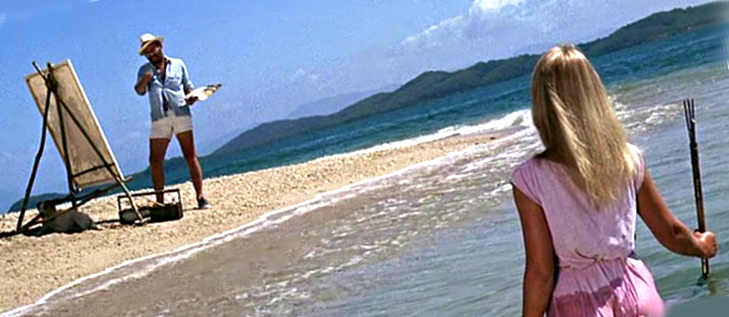
From a book written in the 1930s, Peter Yeldham’s screenplay follows celebrated artist Bradley Morahan (Mason) on a journey for creative rebirth. Bradley’s abstract pictures sell well for New York art dealer Godfrey (Frank Thring), but the artist feels unfulfilled and empty. He takes off for his home country of Australia and retreats to a remote island near the Great Barrier Reef to recharge his creative batteries. Taking up life in a beach shack with a dog (Lonsdale), he must put up with an annoying neighbor or two. He’s eventually pestered by a visit from his rascally, dishonest friend Nat Kelly (the wonderful Jack MacGowran). Bradley’s great discovery is Cora Ryan (Helen Mirren), a curious local teen living in relative isolation. Cora steals to buy liquor for her alcoholic grandmother Ma Ryan (Neva Carr-Glyn), and is hiding money to enable her to run away to the city.
Wary of men, Cora nevertheless becomes intrigued by Bradley’s creative focus. He asks her to pose for him. Convinced that his interest is in his art, Cora follows through and becomes the artist’s stimulating muse. Alone in her shack, Cora imagines herself as a glamorous, sexy adult. She poses in the nude for Morahan, happy to be earning money and intrigued to see her body transformed into artworks. Cora dives to the reef, becoming an erotic aquatic sculpture for Bradley’s sketches. In the midst of her self-discovery, she must dodge the repressive fury of the witch-like Ma Ryan.
Age of Consent presents the beautiful and uninhibited Cora as the key element in Morahan’s beachcombing paradise. For once we see a movie about a serious artist that actually convinces. Cora initially seems a male sex fantasy, an enticingly fleshy mermaid selling seashells by the seashore a la James Bond’s Honeychile Ryder. To our surprise, Consent steers clear of the issue of an older man exploiting a younger woman, or underaged sex. Perhaps the executives at Columbia were wary of James Mason’s association with Stanley Kubrick’s Lolita? We’re not certain how old Mirren’s Cora is supposed to be.

1969 was the first full year of the newly adopted ratings system, which opened a flood of gratuitous nudity in mainstream filmmaking. The adolescent peek-a-boo games of earlier shows like What’s New Pussycat and The Blue Max were at first augmented with flashes of real nudity, as noticed in pictures like The Big Bounce and The Best House in London. The bold approach of Age of Consent was to accept the nudity for exactly what it is, not as a cheap way to excite the audience.
With its potentially salacious title and larges stretches of nudity, Age of Consent could easily have become a skin flick for dirty old men. Michael Powell instead delivers a semi-autobiographical examination of the relationship between Art and Life. When a jealous Cora accuses Bradley of ‘thinking only of the pictures,’ we’re reminded of how the warped ‘artist’ Peeping Tom related to women only through forbidden film. The eccentric Powell is described as having been extremely camera-obsessed; we can easily imagine him having similar disputes with the women in his life.

Critics weren’t impressed by the film’s storyline, which has Bradley troubled by a nosy neighbor (Andonia Katsaros) and plagued by Jack MacGowran’s unwelcome houseguest/thief Nat. A local boy (Ted Farrell) tries to molest Carol in a motorboat, and a struggle ensues when Ma Ryan discovers Cora’s hidden stash of money. Happily, the real subject of the film is simply watching Bradley and Cora develop their artist/model relationship.
Age of Consent builds a tone of contemplation, not the tension of a thriller. Powell lets Nature set the pace of events. The reef island is more than just sunny, a living place; it feels more like the South Seas than anything I’ve seen this side of The Thin Red Line. The time of day sweeps big changes across the landscape, and Bradley must take time off when tropical storms move in. The artist, his dog and his model are beautifully integrated into a post-Gaugin dream, without the colonial and racial issues. Powell called it a ‘Girl Friday’ movie — a man alone in nature, but with a woman. Bradley Morahan personifies the (fictitious?) artist that puts his creativity before his libido. Cora is an undisciplined, near-feral thief, but also a practical woman who knows what she wants.
It’s a sensational film debut for the stage actress Helen Mirren, who comes off as fearless and marvelously unabashed. She throws herself into the project with an abandon that fulfills the spirit of the ratings system to free artists from old, repressive rules. Mirren’s Cora is a believable nature child, separate from Hollywood notions of glamour. In the old days, a typical Polynesian princess looked like Gene Tierney and wore full Max Factor makeup. By contrast, the close-ups of Cora feature her unshaven legs, un-plucked eyebrows and sunburned skin. She chomps on food like an eight year-old. Mirren has made light of prudery throughout her career, championing nudism and refusing to see the shame in any of it.

The film qualifies as an old man’s movie, an idyll that weaves dreamy thoughts around a young woman’s body. Helen Mirren is really like a classic sculpture in this show, whether standing like a female Triton or swimming through the dangerous coral as an aquatic Venus. The women I’ve seen this show with have marveled at the beauty of Ms. Mirren as well.
Forget the abysmal nature-child baloney presented in the Brooke Shields vehicle The Blue Lagoon (1980), a self-proclaimed ‘sensual story of natural love.’ There’s also the precedent of ‘native’ women as sexual playthings, when Mexican Rosenda Monteros portrayed a briefly nude Polynesian in 1962’s Tiara Tahiti, which also starred James Mason. The only honest film I’ve seen about an isolated ‘natural nymphette’ is Luis Buñuel’s The Young One, wherein Key Meersman plays a 13 year-old raised on an island, who becomes an object of lust for an older man.
Cora is devious and cagey when she steals and connives, but also curious and wistful as she regards herself in a mirror, assessing her own sexuality. James Mason’s artist seems stuffy at first, but opens up once he becomes a happy beachcomber. He ‘creates’ his own world with found materials. A painted saw blade becomes a ‘sun’ for part of his shack. Before he finds Cora, he begins to fashion an art-woman out of pieces of plants. Then he moves on to a sand sculpture. Although Michael Powell wasn’t impressed by the paintings seen in the movie, they suffice as the creations of a wistful idyll.

The fact that Helen Mirren is an eager participant, acting with her body rather than just parading herself, makes all the difference in the world. I don’t know if this particular picture would please or displease today’s feminists, as the story basis is usually regarded as an oppressive male fantasy. In this case a very independent woman character is at the center. Cora Ryan is as individualized as Powell and Pressburger’s previous heroines Alison Smith, Joan Webster and Victoria Page.
The question is, is it a dirty old man’s movie? For some reason, Columbia pictures hated it. That same year they released a movie about hippies selling heroin, they found this show to be immoral? It must have been simple prudery: some critics as well must have felt uncomfortable recommending a movie with at least ten minutes’ worth of scenes of a naked woman swimming in a coral paradise. The new Freedom of the Screen produced a lot of smut and only a little genuine cinematic liberation. In context Consent seems a healthy project, an honest and rewarding attempt to explore content previously forbidden on movie screens.

