

Remember the clever moment in the original The 39 Steps, when the hero Richard Hannay is led away from the political speaker’s podium under arrest, in handcuffs, and the crowd cheers him anyway? It’s no longer an absurd joke. More accurately, the awful joke is on us.
Kazan and Schulberg’s A Face in the Crowd is one of the few media-savvy social satires that still seems prescient in the millennial years; Network is another standout. Kazan was no stranger to movies with political messages. Before his ‘snitching is the American way’ civics lesson On the Waterfront, the director’s twisted version of the Emiliano Zapata story disparaged the notion of Mexican land reform in Viva Zapata! 1953’s Man on a Tightrope, Kazan’s accurate and stirring account of Communist tyranny in a Soviet satellite country, is one of Hollywood’s few anti-Red films that doesn’t embarrass itself.

The 1957 scorcher A Face in the Crowd takes on a much more complicated problem, a pernicious trend of which ordinary Americans weren’t fully aware. Budd Schulberg’s nasty story is the ultimate cautionary fable about a new threat: telefascism. The premise is that the mass-communication revolution of 1950s TV could give birth to a media-spawned ‘demagogue in denim,’ an uneducated bully eager to lead a sheep-like public that he claims is even stupider than he is. The frightening Face in the Crowd bursts with vulgar images from the consumer-crazy decade. Several scenes serve as a primer explaining how Madison Avenue could sell politicians the way they sell toothpaste. Not since Billy Wilder’s acid-laced Ace in the Hole had a movie offered such negative view of America. Is it any wonder that Face was rejected, as a patronizing, elitist insult to the American success story?
Schulberg’s particular telegenic plague starts the usual way — a new personality is ‘discovered’ to embody the will and wishes of the masses. Arkansas radio producer Marcia Jeffries (Patricia Neal) finds an arresting personality in guitar-plucking jailbird Larry ‘Lonesome’ Rhodes (Andy Griffith), whose down-home approach immediately connects with a broad public. An instant hit, Rhodes moves on to a Memphis television show, picks up writer Mel Miller (Walter Matthau) and errand boy-turned agent Joey DePalma (Anthony Franciosa) and proceeds to the big time in New York. Rhodes charms the hicks with his smooth-soap folksiness, but secretly considers his fan base to be idiots that believe anything he says. He’s soon a top-rated star courted by advertisers — and one sponsor (Percy Waram) who wants his help to elect a non-telegenic congressman (Marshall Neilan) as President. Rhodes tops his general insincerity with a callous betrayal of Marcia’s affections, but she stays loyal to him — even when he turns out to be already married. Only then does Marcia realize that Rhodes is a power-mad maniac.
The standard Issue Picture for the 1950s is Mark Robson’s The Harder They Fall, which is also from a novel by Budd Schulberg. Its hero becomes involved in the boxing game, finds out that racketeers are in charge, and steps in to do the right thing. At the fade-out he sits down at his typewriter to write the gutsy exposé that will tell the world what needs to be done. Ah, freedom in action. With the TRUTH thus exposed, are we now to assume that the fight game is clean and above board?

In Face Kazan and Schulberg tell a more complex story, that before the avent of Television would be considered social science fiction. The formidable Lonesome Rhodes is an original villain, but the real problem lies with society in general. A Face in the Crowd agrees with Lonesome Rhodes’ notion that the American public are indeed simpletons easily led by personable TV charlatans who say things they like to hear.
Rhodes learned the hobo way what buttons to push to reach Just Plain Folk, because to get a meal he needed to flatter everyone from overworked housewives to stubborn store owners. People respond to his hearty laugh as something friendly, when what it really says is screw you. Rhodes learns how to work a radio show to his advantage and then uses his folksy wiles on the television elite. Sponsors don’t care what kind of lying nonsense spills from Lonesome’s mouth, because he draws an enormous audience for their wares. He goes from bum to housewife’s friend to countrified superstar and tries to make the next leap into politics. In Budd Schulberg’s eyes he’s an Americanized Hitler, a phony man of the people with an ever-expanding ego.
For Patricia Neal’s character the story is Pygmalion in reverse. By giving a new name to an itinerant bum, Marcia Jeffries creates her own Frankenstein’s monster. Lonesome Rhodes is a wily mass of selfish desires, an uneducated sharpie tickled pink by his ability to outsmart his fellow man. Like Frankenstein’s creation, he wants to be loved, but only on his terms — take everything, give nothing. Some of the first words out of his mouth are, “What’s in it for me?”

Americans love wicked satire as long as they aren’t made the butt of the joke, as in the final shots of Robert Redford’s Quiz Show that depict a slow-motion studio audience laughing directly at the audience. They also want to be reassured that whatever bad forces are afoot are not equated with the American system. Ace in the Hole was despised in part because it doesn’t give audiences any squirming room; practically everyone in it is a craven sell-out trying to make a buck from a tragedy.
A Face in the Crowd says that something is rotten in both Arkansas and the country in general. An All-American baton twirling contest becomes a spectacle of vulgarity, with nubile girls putting on an exhibition that plays more like burlesque than a talent show. Lonesome Rhodes’ Rock’n’Roll advertisements for a worthless pill bring back memories of tacky TV blurbs with dancing cigarette packs and animated stomachs. Rhodes isn’t just an entertainer, he provides an entire range of communication strategies. He generates sales for the pill by suggesting that it has energizing aphrodisiac properties. Rhodes is a lightning rod that concentrates the power of the television money-making machine; A Face in the Crowd posits the whole system as corrupt, as indicated when a recalcitrant chemist voices his doubts about the phony pill product but is later seen trumpeting false claims in its ads. He rationalizes his endorsement with a lame, “Well, it won’t kill you.”
Lonesome Rhodes’ career builds like a rolling snowball and Schulberg pays it off by postulating the next logical step. The top-rated TV personality has already reshaped the media landscape by proving that his slightest on-air suggestion can sell products and mold opinion. He has wiped out the power of advertising executives in much the same way that Hitler dissolved Germany’s legislature, by a direct appeal to the people, his people. His next goal is to play kingmaker and get a stuffy congressman into the White House through personality coaching and a few guest spots on Rhodes’ Cracker Barrel opinionizing show. The script says outright that a politician can be marketed just like any other consumer product, and Rhodes instinctively knows how to go about it … while reserving for himself a new cabinet post, Secretary of Morale. It’s the American dream – next stop, the Presidency. This show could have been written by Nostradamus.

One real-life trend behind A Face in the Crowd that Schulberg and Kazan dare not touch is the explosion of revivalist religion on ’50s TV. Extremely popular Televangelists often sought to parlay their fame into political power, with mostly middling results. Lonesome Rhodes is strictly a secular, Hee Haw– kind of demagogue. The born-again minority would eventually find influence way beyond their numbers, eventually arriving at their present ability to warp and steer public policy.
(spoiler)
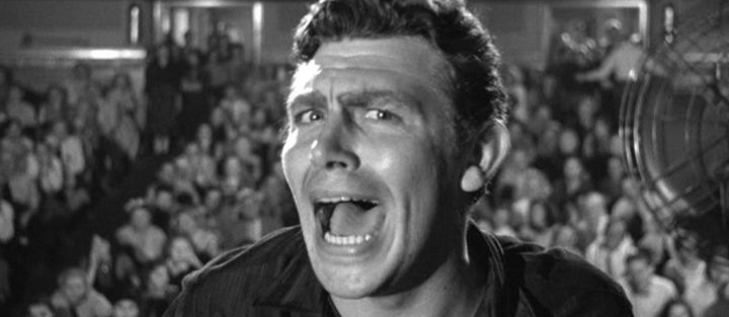
A Face in the Crowd does end with a variation on the The Harder They Fall formula; intellectual Mel Miller’s tell-all book about the demagogue in denim will ring down the curtain on yet another charlatan who thought he could fool the public at large. In the film, Lonesome Rhodes’ Ides of March comes when his hidden contempt for the public is aired on live television. The sorry truth is that history has proved this to be a liberal myth. Telling the truth can have little effect in a public discourse flooded with lies and half-truths, where a mass audience has been gathered under the belief that Authorities are Fake and rational facts are Elitist Propaganda. There are plenty of examples proving that once a celebrity like Rhodes achieves critical mass, he grows a shield of Teflon. If you can fool enough of the people enough of the time — and you have an enormous TV audience — your irrational minority can drown out the rational majority.

The movie Three Days of the Condor struck closer to today’s ugly truth. The hero rushes to bust a national conspiracy wide open by taking his story to the New York Times, but the villain surprises him by not standing in his way:
“We don’t need to kill you, go ahead and squeal. Nobody cares.”
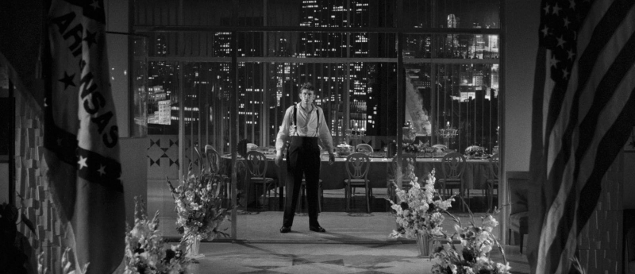
The only way to get rid of such a monster is to take away his cameras and microphones. In the film Lonesome Rhodes ends up isolated and powerless, a wailing monster alone in his penthouse apartment. It’s assumed that broadcasters and sponsors would reject him. Today, Lonesome would simply be snapped up by another cable station that needs his ability to draw a crowd, regardless of his notoriety. Political attack dogs would descend upon his detractors, and any evidence of his treachery would disappear.
A Face in the Crowd is a sharp drama that stays in focus even if it goes on a tiny bit too long. Andy Griffith is so convincing as a sleazy good ol’ boy, it’s a wonder that he was able to move on to the likeable characters of his later television shows. Patricia Neal is equally important; it’s one of her two or three best films. Her characters always had a credible sensuality but her Marcia is the most direct. She’s sexually addicted to Lonesome Rhodes. When it comes time to take Lonesome down, Marcia behaves like a junkie in withdrawal.
Walter Matthau’s Mel Miller is a baggy-suited stand-in for writer Schulberg, who gets in a potent dig for TV writers: the crew of scribes at Rhodes’ gleaming studio are discovered working in a cramped, dark room. Anthony Franciosa makes a good debut appearance as a conniving opportunist with a gleaming smile. But grabbing the most attention is Kazan’s discovery Lee Remick, as the starstruck Arkansas baton-twirler who becomes Rhodes’ plaything wife. The ultimate symbol of the trashing of core values, Remick’s marriage is mocked on Rhodes’ TV show. Although Remick would soon show her worth as an actress she’s used as a vapid sex object, attracting Lonesome’s attention from fifty yards away and showing how nimbly she can toss a very symbolic baton in the air.