
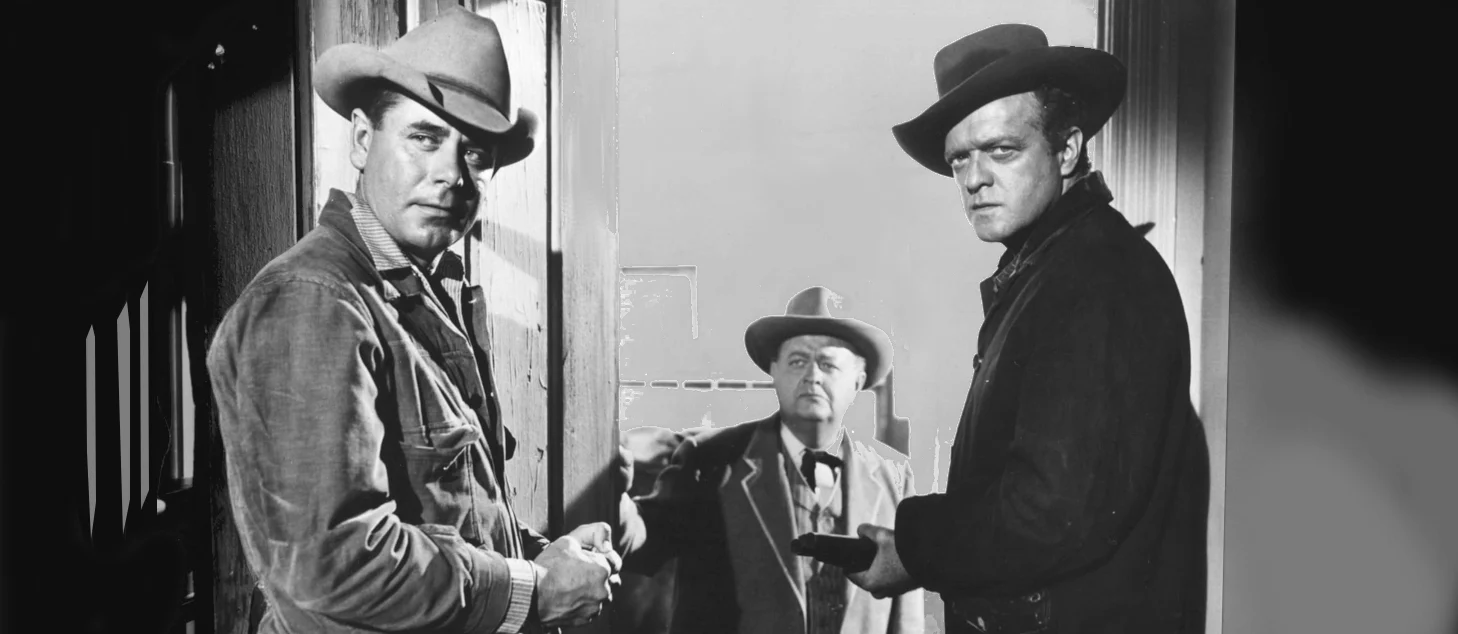

This uncontested western classic lacks ‘classic earmarks.’ It’s not about the glorious winning of the West, turning the desert into a garden, or legendary gunmen exercising their professional skills. The source story plays like a contemporary crime tale. It’s from the celebrated Elmore Leonard, then a pulp fiction writer trying to earn a living. In a tense, compressed span of time, a rancher struggling to subsist must undergo a harrowing ordeal with a very dangerous man. There’s nothing glamorous about the violence angle, either. The law-abiding rancher-deputy finds himself making a grave threat:

“I want you to understand one thing. If you start across this eight feet between us, I’m gonna pull both triggers at once.”
When genre film criticism had its first flowering in the late 1960s, critics in the U.K. argued the relative merits of the Old Guard John Ford and Howard Hawks, against later specialists Anthony Mann, Budd Boetticher and the newly crowned genius writer-director Sam Peckinpah. Omitted from the accolades was writer-director Delmer Daves, who didn’t specialize in westerns until the 1950s, when he wrote four and directed eight.
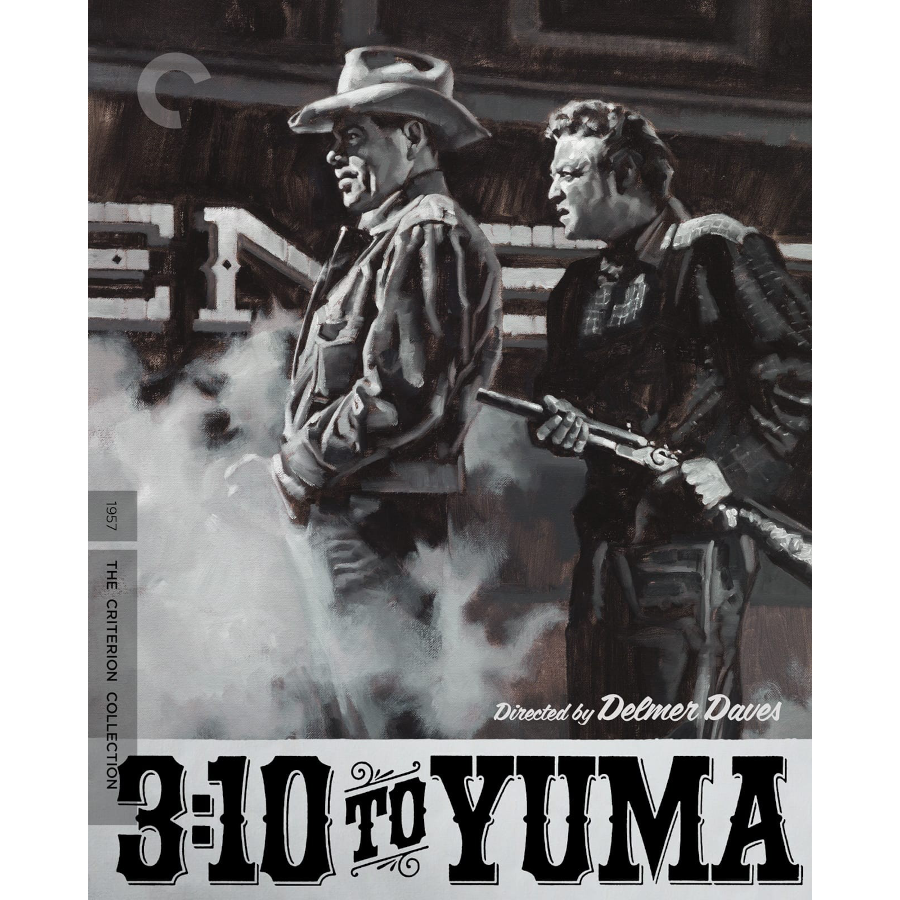
A product of the studio system at Warner Bros., Daves had made his name writing and directing in a variety of styles. His first western Broken Arrow in 1950 was a big hit for 20th Fox. His best were written by screenwriter Halstead Welles: 1959’s The Hanging Tree and the practically perfect western gem 3:10 to Yuma, released by Columbia in 1957. Starring Glenn Ford and Van Heflin, the film was also writer Elmore Leonard’s first movie sale, when he was a specialist in western tales. That was an auspicious beginning, even if Leonard spent another 15 years establishing himself as a screenwriter.
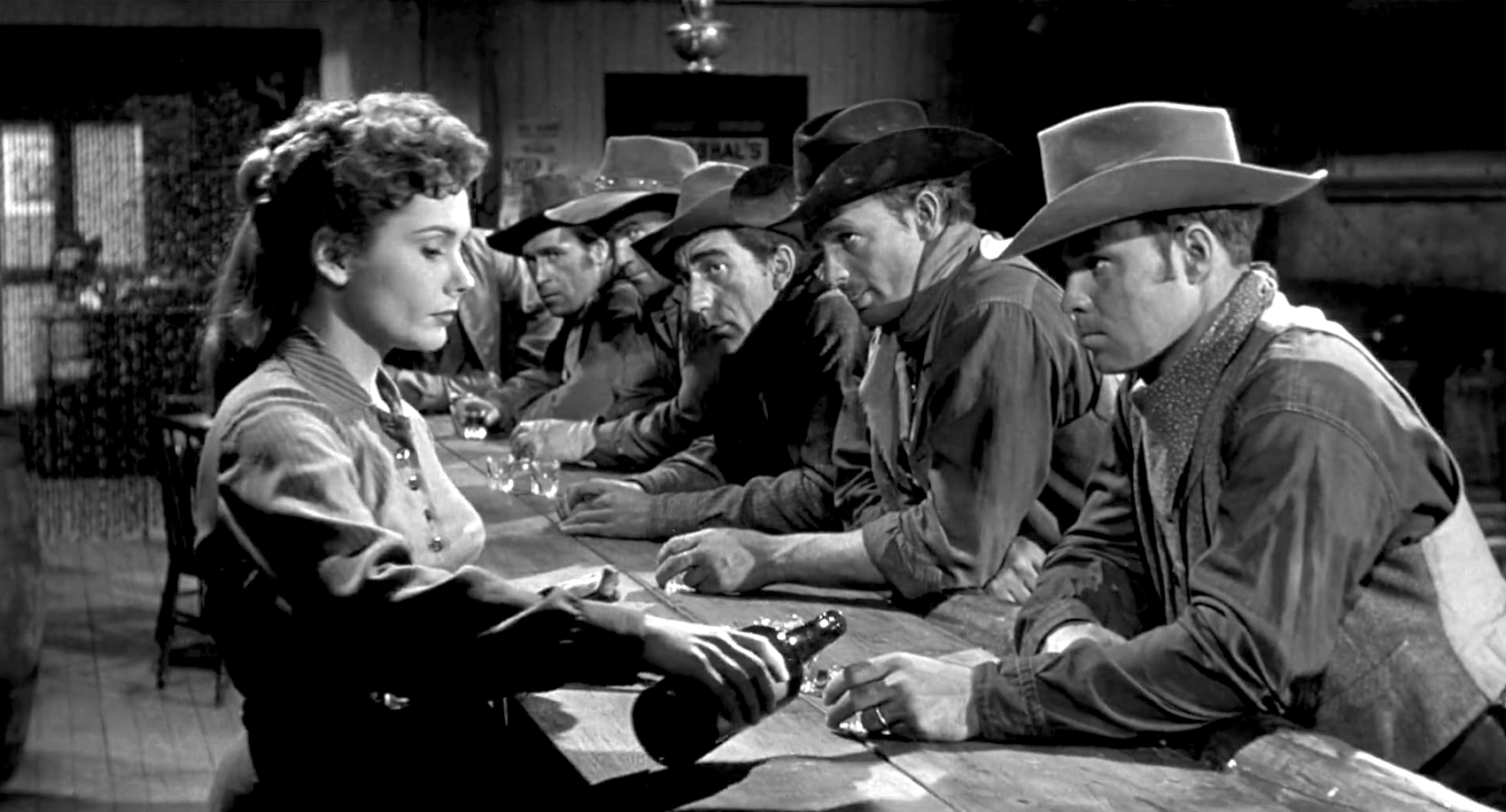
Hard times have come to the tiny Evans homestead. A drought has caused several neighbors to fail. Barely holding his ranch together, Dan Evans (Van Heflin) and his young sons witness the robbing of a stage outside the town of Bisbee. Two men are killed. The thieves pass through town to put the marshal on the wrong scent, but their leader Ben Wade (Glenn Ford) lingers behind to court young bartender Emmy (Felicia Farr), and is arrested. In desperate need of money, Dan takes on the perilous task of escorting Wade to Contention, there to catch the train to the penitentiary at Yuma. He’s armed only with a shotgun, and his one helper is the town drunk, Alex Potter (Henry Jones). If Wade’s gang catches up with the deputy and his prisoner, Dan hasn’t got a chance.
The atmospheric 3:10 to Yuma knows exactly what it’s doing, from its initial B&W image of the dry, cracked earth of Dan Evans’ ranch. The Ned Washington – George Duning title tune is sung by Frankie Laine, whose style made an impact in another hit western of 1957, Gunfight at the O.K. Corral. Mel Brooks would famously lampoon/celebrate Frankie Laine for his Blazing Saddles, yet the rendition of the song ‘3:10 to Yuma’ so perfectly matches the images that nobody would think of laughing. The basic setup of one man ‘alone against the odds’ draws comparisons with Fred Zinnemann’s High Noon. But Yuma is a tale of pragmatic survival, not social criticism.
Elmore Leonard and Halsted Welles present Dan Evans as a good man faced with grinding realities. If it doesn’t rain soon his little ranch will be finished. Dan’s loyal wife Alice (Leora Dana) reluctantly agrees that he must take the job of escorting Ben Wade to justice, as the money offered by the stage line owner Butterfield (Robert Emhardt) will buy needed water for their cattle. But Dan has to babysit Wade for hours with little or no help. Locked together in a tiny hotel room to await the 3:10 train, Dan must listen to Ben Wade’s arguments for letting him go. As time drags on, Wade’s reasoning gains in credibility.
Early on, Dan has trouble convincing his kids that he’s in no position to oppose a gang of armed outlaws. The theme runs through a number of 1950s pictures — as if insecure in his masculinity, father figures must do the extra mile to convince their kids that they’re not cowards, not the boss of the family. Good examples are the crime stories Violent Saturday and Suddenly, in which little boys expect their fathers to be men of action. Dan Evans defuses his boys’ concern, but finds himself forced to take the violent male role anyway.
In terms of simplified politics, Howard Hawks’ Rio Bravo is always cited as a rebuttal to the defeatist civics lesson presented in Carl Foreman’s High Noon. Delmer Daves’ 3:10 to Yuma presents a much more reasoned response. Both films conclude with the hero’s wife rushing to his side. Grace Kelly decides to ease up on her rigid pacifist principle, so as not to abandon Gary Cooper. Dan’s wife simply wants to reinforce her support. She’s not weighing religious or moral issues, just hoping that her family is not obliterated. Alice earlier declared that when faced with trouble, “we must be able to do more than just stand by and watch.”
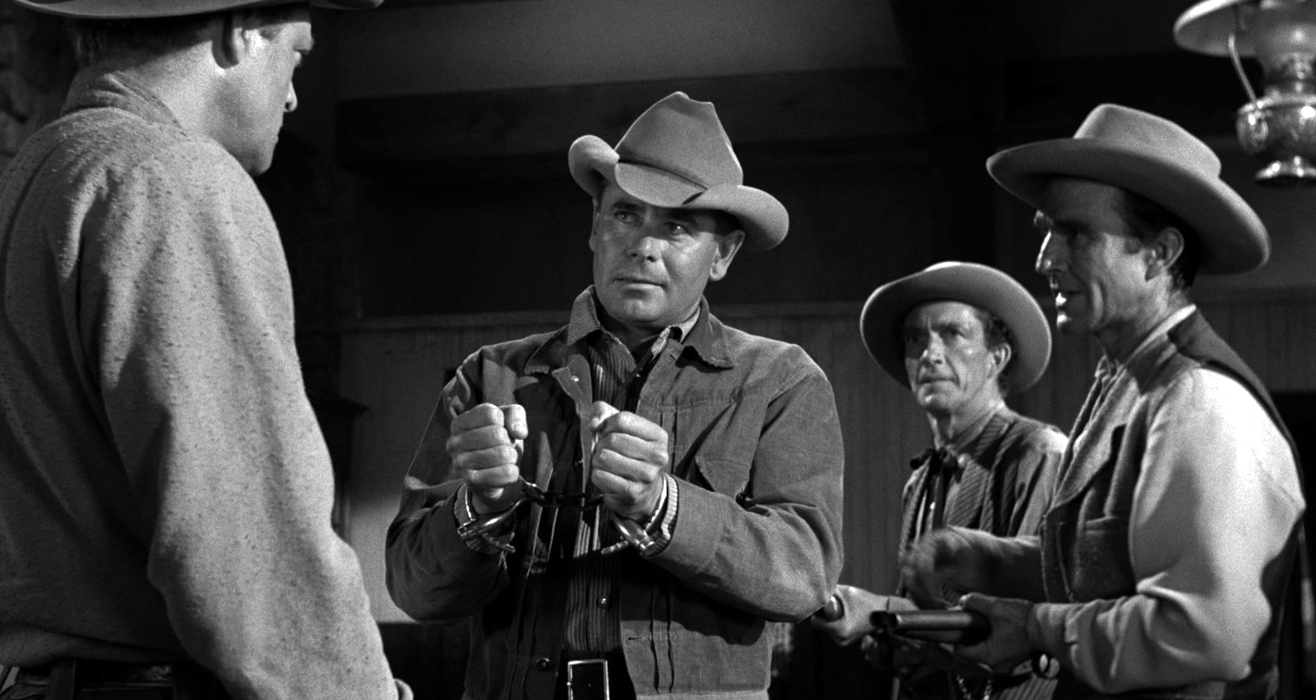
Is doing this damn job really necessary?
When Dan Evans ponders ‘the right thing to do,’ he’s concerned with his personal code. Ben Wade makes a generous offer to buy his freedom, but Dan has already given his word to his peers. Neither can Dan put an end to his hazardous ordeal by simply killing the outlaw, and telling Butterfield that Wade tried to rush him. When things seem hopeless, even the banker Butterfield offers Dan an easy out. But refuses to quit out of sheer principle: another good man has already died in the stand-off. Doing the right thing is never an easy row to hoe; some of the best westerns offer moral dilemmas, instead of shoot-first-and-laugh escapism.
Van Heflin will always be remembered for his straight-arrow homesteader in George Stevens’ handsomely produced sodbuster western Shane. The actor was better when playing characters caught in a moral gray zone, as seen in his excellent portrayal of a ‘terrorist’ Southern officer committed to burning a Vermont town in Hugo Fregonese’s Civil War tale The Raid. In 3:10 to Yuma Van Heflin gets to play a character regaining his sense of self-worth and integrity.

Glenn Ford may not have been as versatile an actor as Van Heflin, but he was second to nobody when it came to projecting star charisma. The actor’s heroic persona was so well established, that the writers must billboard his outlaw ruthlessness right up front. Ben Wade shoots two men in cold blood during the stage holdup — one of them is his own gang member, who foolishly let himself be taken hostage. Ben’s gang, headed by the no-nonsense killer Charlie Prince (Richard Jaeckel) wouldn’t dream of questioning his judgment, even when it comes to shooting a confederate.
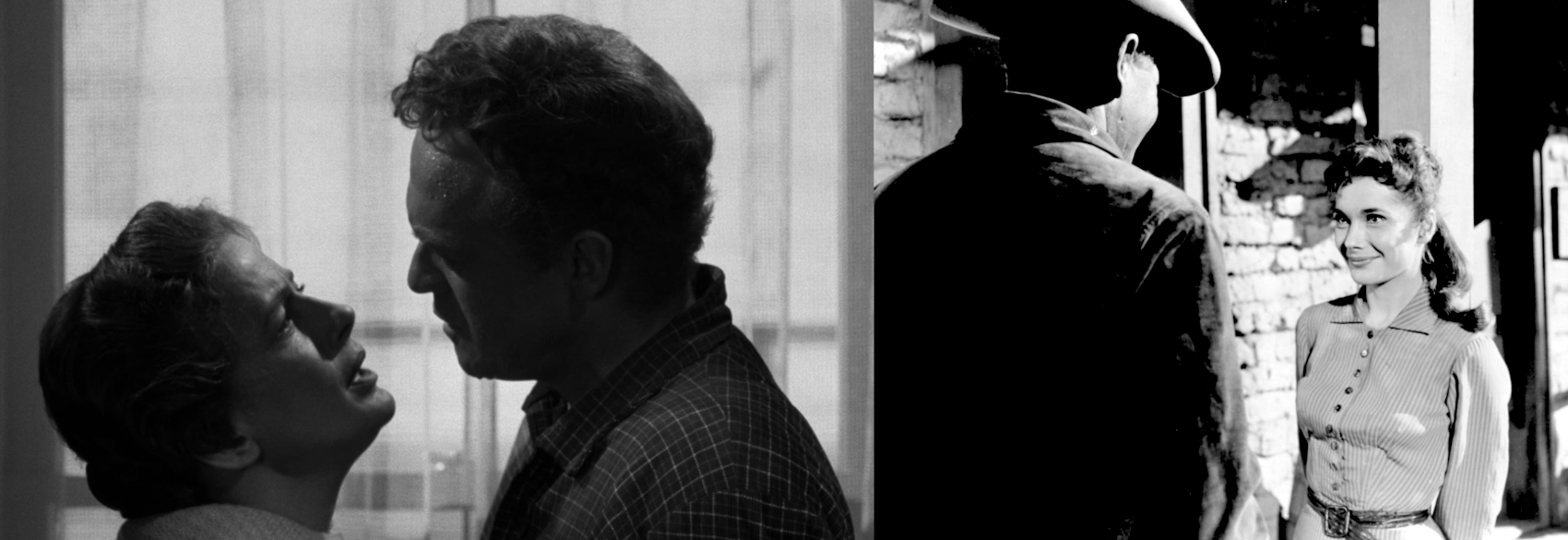
It’s entirely possible that a script adjustment was made to insure that every female in the movie sees Ford’s character as attractive. Alice knows about Ben Wade’s murderous quality, and she still finds him interesting. Ben clicks almost immediately with Felicia Farr’s dreamboat bartender Emmy. As soon as their eyes meet, he’s willing to risk his neck for the privilege of spending some time with her.
3:10 to Yuma is a modern western, less concerned with the winning of the West than the non-epic reality of the hard life on the frontier. Shane sticks close to the romantic western tradition, from its Technicolor scenery to Alan Ladd’s nearly-superhuman hero. It upholds the stock formula that making the West a decent place to live requires a Manichean conflict between good and evil. By contrast, the drama in 3:10 to Yuma is personal, not political. Ordinary people are just trying to subsist with a modicum of dignity. The film reaches its satisfying conclusion without resorting to a single western formula cliché. The drunken Alex Potter isn’t used as comedy relief, and the rich owner of the stagecoach line is not set up to be a capitalist villain.
Charles Lawton Jr.’s splendid B&W cinematography flatters the Arizona desert. The rocky landscape is not just the same arid wasteland: at the finale one can almost smell the freshness of the desert rain. We’ll believe that the production timed its schedule to grab a breathtaking master shot right at dawn, when the sun low in the sky brings out the desert’s beauty. Delmer Daves’ sensitive direction earned critical praise. The only grousing came from critics that took exception to his over-use of crane shots to give this small-scale show a ‘big country’ epic feel. But for the dramatic final confrontation, Daves keeps his camera down close to the action. *
I didn’t even know that the 2007 movie was a remake of something.
Hi Jenny Fan …. the original is very different, you might like it!
The ending to the 2007 version is more interesting, but sort of ridiculous too.
will you be doing a review of the new limited edition of Excalibur?
Definitely Eric, if I receive a copy to review. Always enjoyed it.