
Have you ever seen this beautiful picture on a screen, in CinemaScope and Technicolor? The last theatrical release I know of was in 1971. I remember the show holding a giant audience at the Fox Venice spellbound — the hipsters and beach folk respected the tale of Captain Nemo: it was for all of us a magic childhood touchstone, and we were surprised to discover how subversive it was.
One the best projects Walt Disney ever undertook, 20,000 Leagues Under the Sea is an essentially faithful adaptation of Jules Verne’s most popular ‘Voyage Extraordinaire.’ It was received as a breathtaking wonder upon its Christmas release in 1954, and it kept its glow in many reissues thereafter — I don’t remember ever hearing a kid say anything bad about it.

Disney’s vision was matched by the solid practical help of his businessman brother. For his first bigscreen live-action superproduction he picked a property with countless unknown production hazards. It needed special effects the likes of which nobody had seen before. It would be filmed in a brand new process for which there were few lenses available. Although he had been producing live-action features in England for a couple of years, Disney was still known primarily as producer of animated cartoons. Working independently, he proceeded to assemble the best technical resources in Hollywood, renting space and know-how from the big studios. (For instance, the film’s ‘nuclear bomb’ pyrotechnic looks to have been concocted by the experts that created the blast for Sam Fuller’s Hell and High Water, released earlier in the year.) Disney tackled this challenge at the same time that he was building one of the wildest dream projects of the 20th Century — Disneyland.
About sixteen years ago Disney released an impressive DVD with many extras. This plain-wrap Anniversary Edition Blu-ray easily beats it in the transfer department.
1870. ‘Alarming rumors’ of a monster have emptied the sea lanes, and the United States dispatches a warship to track it down. Along for the ride are two French scientists, Professor Aronnax (Paul Lukas) and his faithful aide Conseil (Peter Lorre). When their ship is destroyed by the monster, they and harpoonist Ned Land (Kirk Douglas) find their way to its floating hulk, which turns out to be a submersible water craft. It’s actually the Nautilus, the invention of mad revenger Captain Nemo (James Mason), who exercises his grudge against war-making nations by sinking their warships and munitions shipments. At first charmed by Nemo’s personal undersea empire, the three captives soon conspire to escape, and to put an end to Nemo’s engine of destruction.

20,000 Leagues Under the Sea opens with a screen bathed in light from a rippling underwater source. As the show was one of the first filmed in the new anamorphic CinemaScope process, the wide image is extra-wide, spread out to a ribbon-like 2.55:1 aspect ratio. Disney shrewdly composed his titles in the center, anticipating an eventual transfer to the television format. The other time I remember seeing flat titles used on a ‘scope film was for Roman Polanski’s Chinatown, which also begins by composing its main titles as if they were from an Academy-ratio 1940s film noir. The story begins with some amusing scenes in San Francisco and an exciting passage aboard Ted De Corsia’s warship. But we are soon literally immersed in Captain Nemo’s fantastic underwater world, cruising in a submarine so well designed that we accept its reality without question. There are undersea diving suits and a round iris window to view the magic of the deep. The craft’s cramped but cozy interiors are invitingly believable.
Today, the most startling aspect of Leagues is its tone. There’s some singing and a cute trained seal, and Kirk Douglas’ blustery seaman and Peter Lorre’s dour valet share a few comic gags. But the film overall is deadly serious. At a time when real submarines were risky craft likely as not to kill their crews, Jules Verne proposed this super-sub as a fanciful visitation from the future, with its propulsive secret only superficially explained. His Captain Nemo was an escaped slave, once an Eastern prince — not a white man — who somehow became a scientific genius, creating miraculous futuristic technologies solely for revenge. (Actually, for subsequent published versions Verne changed Nemo’s origin… see my review of MGM’s silent Verne saga The Mysterious Island.)

Verne’s unlikely hero is easily recognized as what we now call a Terrorist Madman. He’s a political zealot who uses violence to strike back at the colonial powers that have oppressed him, and tortured and murdered his family. In the original book, he was a slave put to work mining the ingredients for high explosives. Everything he does is motivated by loathing for what he refers to as ‘that hated nation.’ If Verne had added a religious motive, Nemo would be a clear cipher for Osama Bin Laden, packing a weapon of mass destruction in the form of his futuristic submarine.
James Mason’s filmic Captain Nemo glowers and fumes with an intensity that overshadows the whole enterprise. His singular vendetta is echoed in grand shots of the Nautilus prowling the blue depths accompanied by the grim chords of Paul Smith’s musical score. Nemo sees all politics and nations as an Enemy to be opposed at every opportunity. He may be irrationally conceived, but he’s a magnificent antihero. The movie endorses the humanistic reasoning of the dull Professor Aronnax, who assumes that Nemo is a misguided madman. Preparing to destroy a ship loaded with nitrates to make explosives, the Captain works himself into a psychotic, homicidal fever.
Just about the only actor who could pull off the same role would be Vincent Price… but in our hearts we know that Price is really a rather jolly fellow. James Mason is obsession personified. When playing opposite the jocular everyman Kirk Douglas, who pulls clown-faces and acts all hale and hearty, James Mason’s gloom wins every time.

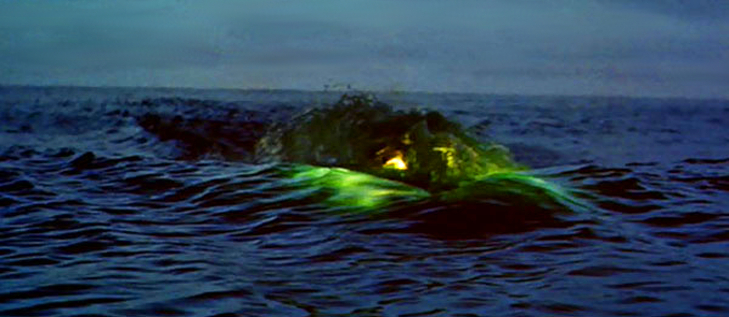
The adventures of the Nautilus are magnificently realized. It cruises beneath the waves and navigates submerged tunnels like a beautiful but dangerous sea creature. In attack mode it churns a terrifying wake, its glowing eyes screaming across the water’s surface. It needs no torpedoes, and uses its knifelike keel to rip through the hulls of its seagoing prey, gutting warships like a sword. We don’t see the Nautilus take on any iron warships, but we believe it would have no trouble sinking anything afloat.
There was a Fox Theater chain in California that began every film performance by opening its curtains over a film’s logo, or the first shot in a coming attractions trailer. I remember going to see the Disney release Summer Magic (or was it A Tiger Walks?) and cheering like mad along with a theater full of other ten-year olds, when the first thing on the screen was the trailer for 20,000 Leagues. The high-pitched Tasmanian Devil whine of the Nautilus zoomed toward us, its wake splashing over its yellow viewport eyes. The sight of the sub’s screaming attack projected on the shimmering curtains as they opened was a wonderment. Moviegoing in the big theaters was magic back then.
The pace of the action is deliberate and linear, and perhaps too slow for modern audiences. The comedy relief now seems a necessary diversion from the film’s dark themes. When the movie was newer we kids accepted dedicated villains at face value, as if they needed no motivation to provide us with exciting, violent thrills. Nemo’s vows of vengeance and delirious musings now seem all too relevant, as is his suicide pact with his dedicated crew. The only crewman with a speaking part is played by Western villain Robert J. Wilke (High Noon, Man of the West). It is subtly disturbing to see an actor associated only with degenerate outlaws as Nemo’s respectful, loyal, devout right hand man. No doubt Disney was simply trying to be faithful to the book that had fired his imagination as a kid back in Kansas, but because he didn’t alter Nemo’s political motivation 20,000 Leagues retains an amazingly dark streak at its center.

A sidebar note: The Disney I love is the maverick producer before Disneyland, before he became an institution. With an almost edgy creativity, Walt had no problem expressing his personal fears and quirks. There are scenes in Snow White and the Seven Dwarfs, Bambi and Pinocchio that terrify little kids. Fantasia and Dumbo have sections that express the delirium of a drug addict or an alcoholic. If Dumbo has a message beyond mother love, it’s that You Have to Get Plastered If You Want to Fly, Kid. Even the smaller project The Adventures of Ichabod and Mr. Toad delights in the joy of social irresponsibility. 20,000 Leagues recognizes Verne’s antisocial hero as yet another of the author’s futuristic visions. Along with the atomic submarine, he foretold the day when colonialism would give birth to implacable terrorist avengers.
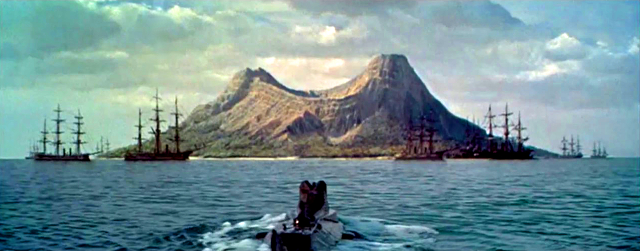
The end of the Nautilus in Disney’s version is a bleak götterdammerüng. If I recall correctly the book had the damaged sub fall victim to a Norwegian maelstrom. Writer Earl Fenton pulls in ideas from Mysterious Island and other Verne stories. Nemo returns briefly to his secret island base Vulcania only to discover it overrun by colonial troops. The slopes of the island’s interior crater were filmed at the distinctive Red Rock Canyon 150 miles North of Los Angeles. We get a quick impression of Nemo’s super lab — complete with radar dish ?? — before he pulls a patented Bride of Frankenstein lever to blow it all to kingdom come. Nemo prevents ‘that hated nation’ from stealing his scientific secrets and exacts a revenge of sorts by nuking a small army and navy of assorted national interests. The setup — a ring of ships around a central super-explosion — must have reminded audiences of the Operation Crossroads Bikini Atom Test of 1946.

Nobody ever seems to point out that this mainstream fantasy film ends with the murder of hundreds, perhaps thousands of First World colonial troops, performing an ‘operation enduring obliteration’ police action against a terrorist foe. There isn’t a similar scene in films until the overtly radical Giù la testa (Duck You Sucker!) in which James Coburn gleefully dynamites an armored cavalry column, content to ‘rid the world of a few uniforms.’ We’re given Aronnax’s verbal judgment on Nemo as a warped madman, but the Professor seems naïve when he volunteers to spread Nemo’s message of Peace Or Else among the warring human tribes. The official moral preaches that the world isn’t ready for Nemo’s technical miracles, which is a laughable understatement. Humanity might as well be a bunch of apes fighting over a rancid waterhole. Everyone with whom I ever saw 20,000 Leagues Under the Sea wanted Captain Nemo to prevail and sink every warship afloat.
Fans of Disney’s movie know that this huge success inspired a series of Verne screen adaptations. The ones that found financial success were Mike Todd’s Around the World in 80 Days, the Schneer-Harryhausen Mysterious Island and Fox’s Journey to the Center of the Earth, which also starred James Mason as a charming, less neurotic scientist. The A.I.P. epic wanna-be Master of the World could have been great. Vincent Price comes through with a fine performance as the Captain Nemo- like Robur, but the production took too many shortcuts. The most magical of the Verne adaptations came from Czechoslovakia, Karel Zeman’s utterly charming and creative Vynález Zkázy.