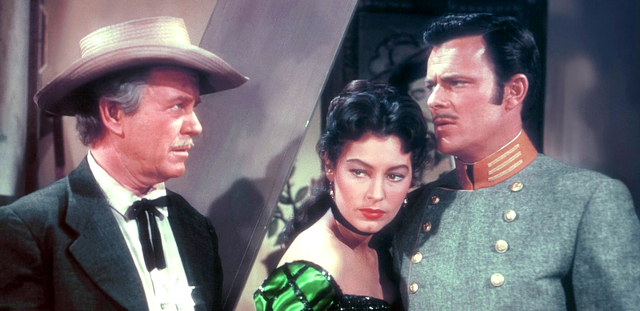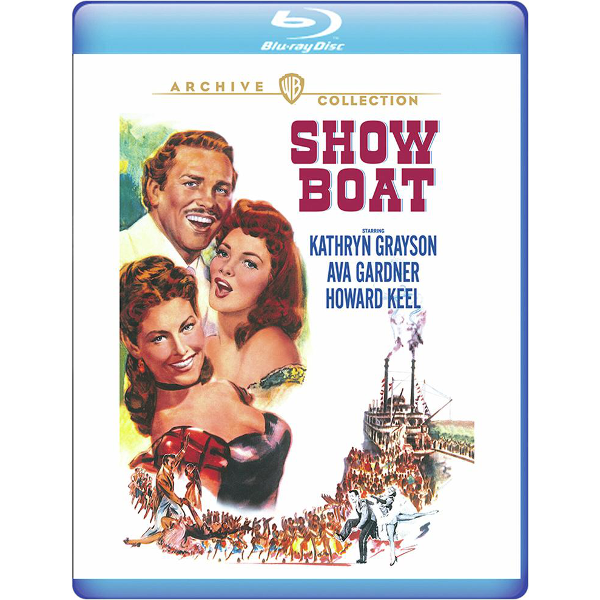

Here’s how the story goes: most people my age first encountered Show Boat through MGM’s 1951 version and found it perfectly fine. The color was pretty and the Kern/Hammerstein music superb. Ava Gardner made for a soulful Julie and William Warfield belted out “Old Man River” with authority.
Then we eventually saw the incredibly good 1936 James Whale version, which MGM pretty much mothballed when they made their remake, the same way they bought up Paramount’s Dr. Jekyll and Mr. Hyde and locked it away so their Spencer Tracy version wouldn’t have competition. The 1936 Show Boat starring Irene Dunne is nowhere near as well known as it ought to be, an understandable consequence of being nearly unseeable for forty or fifty years. At least two generations of fans missed it entirely.
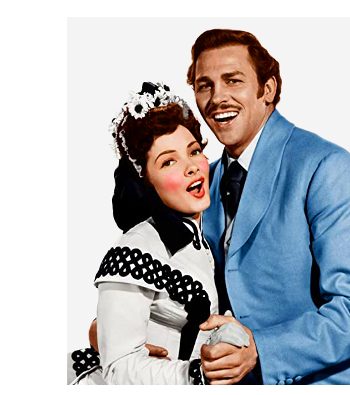
Filmed in Technicolor, George Sidney’s ’51 remake isn’t a patch on the older Whale version. Simplified and sanitized, it drops almost all of the African-American content and removes most of the original story’s domestic abuse and abandonment. Screenwriter John Lee Mahin also rewrote most of the dialogue.
But the story remains in digest form. Cap’n Andy Hawks (Joe E. Brown) runs the Cotton Blossom, a Mississippi show boat featuring music, comedy and dancing. Andy’s wife Parthy (Agnes Moorehead) keeps the books and watches to make sure her daughter Magnolia (Kathryn Grayson) doesn’t get involved with the performers. Parthy forbids Magnolia to associate with the leading lady Julie LaVerne (Ava Gardner), but soon the irate boatman Pete (Leif Erickson) blabs Julie’s secret to the sheriff, and she and her man Steven Baker (Robert Sterling) are forced to leave the show. Magnolia replaces Julie on the Cotton Blossom stage, and Andy hires the gadabout gambler Gaylord Ravenal (Howard Keel), whom Magnolia is already crazy about, to play opposite her. Parthy objects when the play requires the two to kiss but there’s nothing she can do — Gaylord eventually takes Magnolia away from the Cotton Blossom. When his gambling goes bad he abandons her, not knowing she’s pregnant.
Show Boat ’51 transforms the complex and often dark original story into a more carefree and breezy entertainment, like the popular Rodgers and Hammerstein musicals that began with 1943’s Oklahoma! Ellie May and Frank Schultz (Marge & Gower Champion) are no longer comic relief, but a show-stopping dance team. Gaylord Ravenal is less of a louse in this version; when he leaves Magnolia he doesn’t know that she’s pregnant. Their long separation is partly a result of miscommunication, not just a husband behaving like a craven rat. The rather downbeat third act was dropped; at the fade-out Gaylord and Magnolia’s daughter Kim is still a young child. A new upbeat finale brings Ava Gardner back into the picture: we last see a sentimental Julie LaVerne blowing a bittersweet kiss to the reunited couple.
The historical makeover extends to the boat itself — real showboats were simply barges, pushed from one Mississippi town to the next. When Walt Disney made his Anaheim theme park, his Frontierland riverboat was surely inspired by the beauty seen in this Show Boat, with a bow adorned with twin staircases for impromptu performances.
This 1951 version turns up the color and sweetness, avoiding social-issue trouble by keeping African-Americans off the screen. Critic Donald Bogle is right, post-war movies avoided negative depictions of African Americans mainly by eliminating them. The white characters have little contact with black characters, and the once-important role of Queenie, the cook (Frances E. Williams, un-billed) is almost entirely eliminated. The movie opens with black sharecroppers rushing to see the Show Boat, but down on the dock the crowd is almost entirely white. We hear a black chorus, but don’t see them.
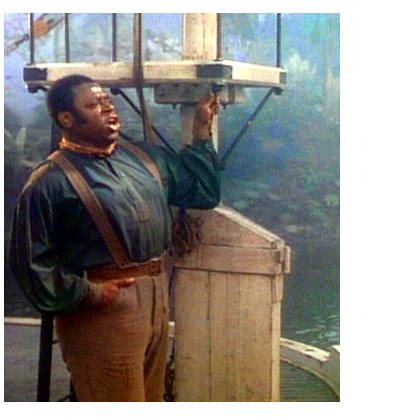
What remains is William Warfield’s Joe singing the play’s most famous song “Old Man River.” Joe reprises that one tune but his duets with Queenie, Julie and Magnolia are gone. Warfield receives last billing, after the villain Leif Erickson. The 1936 Joe had been played and sung by the legendary Paul Robeson, whose postwar activism and public demands for civil rights legislation made him an early target of the blacklist and the FBI. In 1950 the U.S. State department had seized the singer’s passport to prevent him from spreading ‘anti-American’ propaganda overseas. We wonder what Robeson thought of this whitewashed remake.
The Show Boat remake always raises the question of why the studio’s own talented, under-used Lena Horne was not cast as the ‘passing for white’ Julie LaVerne. MGM’s 1946 Jerome Kern musical biography Till the Clouds Roll By had presented a cameo version of Show Boat with parts of four songs. Kathryn Grayson played Magnolia’s part in that excerpt as well (Grayson had been mentioned as casting as Magnolia in an MGM remake of Show Boat since 1943), singing “Make Believe” in her trilling operatic voice. In the Clouds excerpt, the brilliant Lena Horne portrayed and sang Julie LaVerne’s part, beautifully.
When the time came to do a full-on remake of the movie, the idea of casting Horne became a big problem for the studio. Horne, a terrific singer and actress, had been under contract to MGM since 1942. She had appeared in roles of varying sizes in ten feature films, including a co-starring role in Minnelli’s 1943 Cabin in the Sky; she was also loaned to Fox for a co-starring part in Stormy Weather (1943). It’s clear — and well known — that MGM designed some of its musicals so that segments with black performers could be easily excised by Southern exhibitors with as little disruption as possible. She was understandably unhappy (even furious) with the studio for consistently casting her in these kind of isolated scenes and numbers.
While Horne would have been almost perfect casting for the role in any production of the show, MGM was nervous about possible distribution problems with the movie should she be cast. It was difficult to appease Southern censors (especially Lloyd Binford of Memphis) and key Southern distributors, which would not readily accept movies showing blacks mingling with whites in a non-subservient manner. Julie LaVerne was a major role and her scenes could not be easily deleted or scissored away. So the studio looked elsewhere for its Julie, and Lena Horne never had the opportunity to play a role that many thought ideal for her.
A possible (but implausible) weak argument supporting MGM’s decision not to cast Horne is that Julie LaVerne is supposed to be passing for white, and that Lena Horne is too obviously black. That would seem disingenuous considering that ‘darkening’ white actors had been done to suggest ‘negro blood,’ most notably actress Mary Anderson in The Underworld Story (1950). Any studio spokesman would insist that racism played no role in these decisions, yet the kind of discrimination being practiced was no different than the scandalous ‘miscegenation’ subplot in Edna Ferber’s story.

The studio’s solution, after a brief flirtation with the idea of casting Dinah Shore, was to give the role of Julie LaVerne to MGM star Ava Gardner. She naturally relished the strong role, especially as altered for this new version — instead of quietly exiting as Magnolia becomes a star, Julie LaVerne returns at the finish to set things right and bestow a benediction on the reunited lovers for the fade out.
But even Ava Gardner was blind-sided to an extent by MGM. Gardner recorded all of Julie’s songs and the studio apparently previewed the movie with her singing voice intact, but then decided to replace her. Annette Warren, who had already sung for Lucille Ball in Sorrowful Jones and Fancy Pants, dubbed Ava’s songs in the picture.
It’s no wonder that some Hollywood actresses felt cheated and suppressed by their studio employers. Ava Gardner was expected to be a sultry sexpot and little else, and Lena Horne was considered musical spice, to be used sparingly. In an interesting contractual twist, Gardner’s singing was heard on the MGM Records Show Boat soundtrack album. She received occasional royalties from the record to the end of her life.
All the acting is fine in this version but the characters aren’t as vibrant. Agnes Moorehead has to play her usual old sourpuss. Joe E. Brown drops his comic persona for the Andy Hawks role, and so seems a little less special. The Champions just do their thing, which is always good; the disc reminds us that the beloved Marge Champion passed away just last October. William Warfield’s voice is commanding but his Joe feels like a glorified walk-on. Kathryn Grayson’s singing is pretty but her acting doesn’t command our emotions; she doesn’t show up on too many favorites lists. We have to give Howard Keel proper appreciation for making his Ravenal work so well — he and Ava Gardner keep the movie afloat.
MGM shrewdly cut corners on Show Boat by only filming second-unit on location at Natchez Mississippi. The studio-bound Cotton Blossom boat was moored in a back-lot pond where it could scarcely turn around, but MGM’s clever optical effects department used excellent matte effects to place it on a broad river. The movie has some of the best Technicolor rear-projection scenes ever, with the cast standing in front of images filmed weeks before in Natchez. The extra resolution of this new Blu-ray makes a full appreciation possible.
It’s amusing to see Robert Sterling (of Voyage to the Bottom of the Sea) in the reduced part of Julie’s white husband. MGM had had enough trouble getting the Breen office to allow use of the vital miscegenation plot point. It was one thing — to the PCA, anyhow — for actresses like Gardner and Helen Morgan to play black women married to white men… but quite another for a black actress to play a black woman married to a white man. That would not have flown back in the day. Superimposed on this absurdity was another level of irony: Lena Horne was in real life a black woman married to a white man.
Actors that I haven’t spotted but are said to be visible in the cast are Carol Brewster, Linda Christian, John Crawford, Joyce Jameson, and a 14 year-old John Phillip Law. Adele Jergens and Ian MacDonald should be easier to spot. Fans of both versions of Show Boat have heard the old stories I’ve just told, but they do want to know if the new Blu-ray is an improvement on the very early DVD of the ’51 show. So continue reading…