
Chasing Warners’ Halloween-ready Hammer Horror box two weeks later is a Blu-ray set called Special Effects Collection, which could be called the ‘classic stop-motion animation collection’ save for the fact that one of the titles, a definite classic, just ain’t got none. The good news is that all four of these winners come in eye-pleasing Hi-Def transfers, at 1080p. Even the TCM cable channel adds compression; here things are so clean that we can freeze frames or go frame-by-frame to study the magnificent artistry of these practitioners of the lost cinematic arts of special effects. Because HD Blu-ray runs at the same 24 frames per second as 35mm film, there is no frame-sharing or shuffling to spread 24 images across 30 for every second of film. It’s gorgeous even at eight frames a second.
The coming of these pictures is a ‘special’ occasion, so I asked an old friend to write a short article on some aspect of stop-motion. In this case no secrecy is needed because the writer in question is Randall William Cook, who I met as Randy Cook back at the UCLA film school in the Fall of 1970. Randy was stop-motion animating even then, as I reported in an early Savant article, The Hollywood Children of Ray Harryhausen. Asked for something fresh on our favorite subject of effects, Mr. Cook discusses not just the artistic craft involved, but about how today’s high resolution video scans can show ‘more’ of a vintage movie than even original theatrical prints showed. The article is Randall William Cook: As Never Seen Before: ‘New’ Vintage Stop-Motion on Blu-ray.
I reviewed the four titles in the Special Effects Collection thoroughly when they came out on DVD. Rather than rehash those reports, I offer these links:
The Son of Kong Mighty Joe Young
The Beast from 20,000 Fathoms Them!
That also frees me up to go straight to my reactions to the new screenings of these four classics.

“Animals always know when you’re trying to help them.”
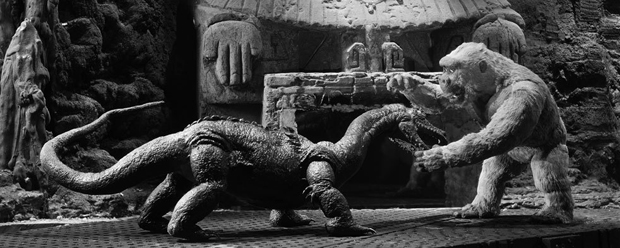
The Son of Kong isn’t given much respect, and I completely understand why fans of the incomparable pater simians King Kong have little use for it. Kong has never been topped for creativity, imagination and technical innovation, despite two major remakes and dozens of imitations. Son was reportedly in and out of theaters in a flash back in the Fall of ’33. The movie is about 70 minutes long, but we don’t arrive at Skull Island until the forty-minute mark. Kong’s offspring Kiko turns out to be a goofball who behaves like comic relief from a Farmer Alfalfa cartoon. He bats his eyes, flips the finger at us and becomes embarrassed when he interrupts the leading characters canoodling by a campfire.
The technical stuff is still pretty impressive, if you ask me. We’re given the Bum’s Rush through the Lost World scenario — find Kong, fight 3 monsters, find diamond, island goes blooey. The individual set-pieces are great, even if one is reportedly a holdover from the original film. What’s most impressive today is the realization that this pre-Code feature is even more rooted in the Great Depression than the first film. It’s like other downbeat movies set on the bread line, except that instead of adopting Shirley Temple, the destitute couple befriend a giant albino gorilla.
The show is all about failure. The wind has definitely left the sails of Carl Denham (Robert Armstrong) in the wake of his floppo ‘8th Wonder of the World’ debacle. He and his old buddy Captain Englehorn (Frank Reicher) are scouring the Indian Ocean for a cargo, having ducked a subpoena… something about owing millions for damage to NYC! Carl finds forlorn showgirl Hilda (Helen Mack), also on the skids, having just lost her father. The S.S. Venture suffers a mutiny in the form of a mini-Bolshevik revolution. Our ‘bourgeois’ heroes are marooned in a rowboat at sea.
Critic Andrew Sarris was moved by Helen Mack, who he said personified the ‘hitting rock bottom’ attitude of many in the Depression. Glamorous Sylvia Sydney has come to represent working-class outrage and rebellion, but Helen Mack is the face of nice girls that got stepped on by hard times and were permanently demoralized. Hilda smiles but it’s a sad, defeated smile. She wears that same look even when she and Carl get rich. We wish Hilda and Carl the best of luck. We also want to know what our favorite cook Charlie (“Everybody on DECK!”) is going to do with his ⅓ of the diamonds.
The Son of Kong has always looked pretty good; I remember seeing a perfect 35mm print once at the old Vagabond Theater. The effects are as sharp as a tack. The animation is certainly interesting to watch at this resolution and clarity. For the first time I notice one phenomenon that counts as a technical flaw, if one wants to be a spoilsport. The old Willis O’Brien animation technique uses a lot of glass. Panes of glass are sandwiched in front of and behind the animation platforms, to hold painted foliage and other parts of the matte sandwich. Also, rear-projected image elements, when little live action figures are inserted into scenes, are also projected onto equally reflective glass screens. At the higher HD resolution we frequently see faint reflections of the animation models in dark areas of the glass. It’s just not possible to flag off every bit of rim light in such a small area. It’s nothing tragic, but it is worth looking for to get a better understanding of the processes being used.
“Don’t worry kid. There’s nobody in the world gonna shoot Joe now.”
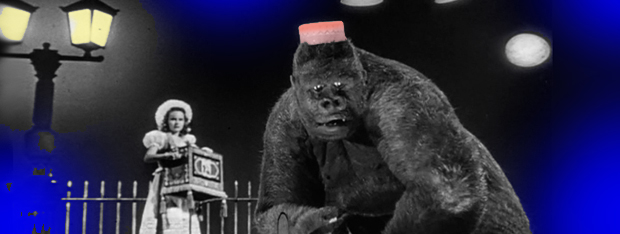
Mighty Joe Young is probably the most expensive movie of these four, as Willis O’Brien captained a large Guild crew and a generous budget to put together the film’s seven or eight fantastic special effects showcase scenes. We don’t see much in the way of compromise in the illusions. When the cowboys try to rope Mister Joe Young, Terry Moore’s twelve-foot African gorilla, we see stop motion in conjunction with mattes, glass mattes, rear projection and extensive miniatures. There’s even an entire animated horse and rider, wisely kept in silhouette or partly blocked by the foreground ape.
Between the Kong movies and this show O’Brien didn’t get to do much stop-motion animation personally, but some of his best work involves large miniatures. The burning orphanage is one of the most accomplished special effects set pieces of all time. For dozens of very exacting shots, a gigantic model building was rigged to fall apart in slow motion, with live and superimposed flames. The angles work closely with the stop-motion animation to tell an exceedingly exciting, dynamic story. The Blu-ray retains the scene’s bright red tints.
The story is a juvenile replay of Kong. The monster is a simian Rin-Tin-Tin, a lovable innocent who dotes on his mistress Jill Young (Terry Moore, still with us) while suffering as a caged performer in Max O’Hara’s glorified Golden Safari nightclub. The club’s long bar is backed by near-perfect rear projection screens showing wild lions behind glass. This had to be one expensive undertaking; the quick action with patrons gawking at the bar is one of the movie’s least rigid scenes. Joe is the film’s best actor, even with Robert Armstrong hamming it up. In his feature debut ‘first technician’ Ray Harryhausen and Pete Peterson give Joe more personality than any other stop-motion character in film history. Joe displays surprise, joy, awe and fear, not in the cartoonish Son O’ Kong style, but with a carefully judged performance halfway between a baby and puppy.
Little kids love Joe Young and probably identified with him more than any other movie monster ‘pet’ until Steven Spielberg’s E.T. The Extraterrestrial. When Joe goes into action a mix of sentiments hit us all at once, as they do in silent melodramas as basic as Way Down East or The Kid. For matinee thrills the show is just sensational, and it earned an effects Oscar. Did it go to O’Brien, or to the producer? The only other contender was Walter Wanger’s Tulsa.
“And Lee – the clavical suspension appears to be … Cantilevric!”
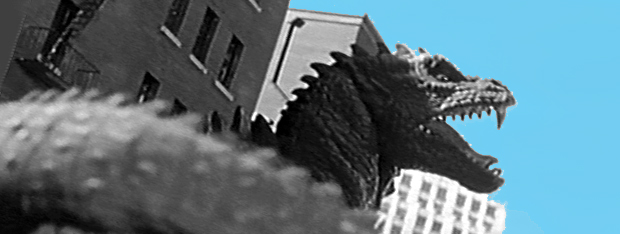
Willis O’Brien ‘old school’ effects meet Ray Harryhausen ‘new school’ effects in the spectacular The Beast From 20,000 Fathoms. Harryhausen was forced to invent a new technique to combine animation and live action in a way he could control on his own, working on the cheap as a lone wolf. I’d like to have seen how Harryhausen convinced the independent producers of this show that he could pull off such outrageously ambitious illusions with the non-budget they were willing to spend. Ray had to become an expert cameraman and lighting artist as well as an animator, to make his two-foot dinosaur puppet appear to be ‘inside’ the re-photographed rear projection plates taken on the streets of New York City. Sure, we can see the flaws in the illusions — superimposed water, static grain when a still shot is used for rear projection — but they are heavily outweighed by the grace notes in the work. The graphic simplicity of the Arctic Rhedosaurus’s attack on a lighthouse is unforgettable — the scene takes place mostly in silhouette. An upward angle on the monster’s head bobbing as it stalks lower Manhattan, the skyscrapers moving in the background, is awesome: You will believe that a dinosaur is on the prowl, right in the middle of the city.
Harryhausen’s work has a beauty sometimes lacking in his later B&W films, where he was often forced to work around blah action cutaways and whatever stock shots could be rounded up. Did the great art director-turned film director Eugène Lourié call some or all of the shots, or did he just stick to the live action? I like to think that Lourié and Harryhausen collaborated, that the man who designed Children of Paradise appreciated Harryhausen’s special talent. Lourié would effectively remake this film twice. The derivative The Giant Behemoth is too budget-conscious and 1961’s Gorgo is a lavish Technicolor production. In truth, The Beast was also partly remade in 1998 as Sony’s Godzilla. A plunderer of other people’s movies, Roland Emmerich lifts this film’s basic plot, right down to the idea of the military shooting big guns at the monster from the city’s rooftops.
Seen anew, The Beast holds together very well once it gets beyond the stock footage of the arctic atom test. (A monster buried in the arctic? Under the ice, it’s open ocean up there!) Seen in full resolution, we can see that Lourié’s talking scenes are impressively designed and lit. David Buttolph’s music score promises menace and spectacle right from the opening whirlpool. Anybody familiar with NYC will recognize that the Rhedosaurus emerges from the East River just below the Brooklyn Bridge, on docks now replaced with restaurants and shops for tourists. Much of the rampage is meant to take place around Wall Street in Manhattan’s tip, although the stock shots of Times Square being evacuated come from a Civil Defense exercise in November of 1951 — Detective Story is on a movie marquee.
The Rhedosaurus is just a big lizard, so Harryhausen can’t give it the human enjoyed by old Mighty Joe. Yet the ‘Paleolithic survival’ puts forward a lot of personality. The producers missed the boat by not fully plagiarizing Ray Bradbury, and having the dino be attracted to the lighthouse foghorn thinking that he’s found a mate. When stalking the streets of Manhattan the monster looks confused and disappointed and angry, as if professor Elson were right, and he did expect to find the reptilian equivalent of Rita Hayworth waiting patiently in his ‘spawning ground.’ When the Rhedosaurus charges into an intersection looking like a giant, pissed-off puppy, just imagine it thinking in David Byrne terms: “This is not my beautiful house. This is not my beautiful wife.” I’d be snapping up a cop for a quick snack, too.
“What kind of sense does that make? Is sugar a rare cargo?
Is there a black market for it? Did you ever hear of a fence for hot sugar?”
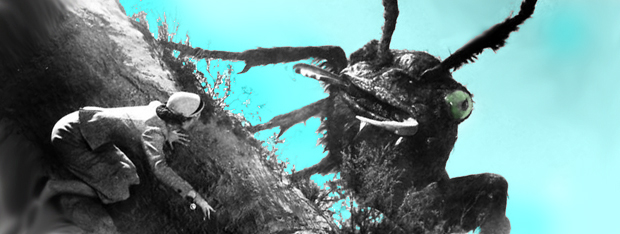
Monster fans will get something new with this Blu-ray of Them!, the terrific sci-fi thriller that launched the big-bug craze the way Beast revived the notion of cities attacked by giant monsters. This show’s special effects are only one element of a fully fleshed-out thriller with an excellent script, crackling direction and sharp performances. It may be the best film directed by Gordon Douglas, who gives the action a Michael Curtiz-like snap while maintaining a feeling of documentary realism. Admit that big ants are on the loose and no more concessions to fantasy silliness are required. If nests of rampaging formicidae were to break loose, we’re ready to believe that the result might look something like Them!
James Arness finds his inner John Wayne (“Mer-muh-cologist!”), Edmund Gwenn is a fuddy-duddy dispensing Santa-scientist warnings of doom, and James Whitmore steals every scene with behavior tricks. The Cold War sneaks in via grim news announcements and the feeling that every lawman is an ex-G.I. who wants to save little children and keep Commies & unwelcome insects off the streets. For the investigators, tracking down the ants plays like a noir semi-docu. Five million people live in Los Angeles. None of them have seen these giant ants?
I go into the film’s special effects in my older DVD review but this new viewing impressed me even more. The outtakes seen in the extras show that the mechanical ant mockups can’t move fast or realistically enough to be credible in a full shot. The direction and especially the editing make them seem alive and menacing. The ants are almost always only partially on-screen, with camera motion and other action keeping the frame energized: timbers being smashed, dust, smoke and fire; flashes of gunfire. It’s almost as if editor Thomas Reilly had to invent a new style, selecting fragments of film that highlight the most expressive motions. The uncut dailies give us a better look at the key ant’s eye — as explained in that early Cinefantastique article, the eyes contain water and soapsuds agitated from within to make them glitter and corruscate. That’s a really creative way to add visual interest. The waving antennae look great too — they really seem to move in an insectile manner.
Frankly, stop-motion animation would have made this a completely different movie. Yes, we’d likely be given images of bugs swarming like The Zanti Misfits, overrunning the military defenders as in Starship Troopers. But they might look like Puppetoons, and their interaction with the cast and soldiers wouldn’t be anywhere near as up-close and personal. I’m very happy with the claustrophobic Insect Horror experienced by James Arness, trapped in the dark, stuck with a jammed Tommy gun and mobbed by snapping ant jaws. It’s great stuff, especially for 1954. Them! was nominated for best Special Effects. That it didn’t take home the prize is forgivable, considering that the winner was Disney’s 20000 Leagues Under the Sea.
It’s also fun now to realize that the ‘Martial Law’ montage of troops moving in to cover the manholes of downtown Los Angeles is all filmed on the Warner standing set known as the New York Street. They use every inch of it and every good angle. It was all still there in 1979 for the filming of 1941. Smart viewers can pick out the intersection where the P-40 crashes into the U.S.O marquee (it’s a high angle, with the marquee on the right). But the budget also permitted new film shoots at City Hall and in the downtown storm drains. Them! never looks Cheap!
The movie became a staple diet on syndicated TV in the 1960s. I had it memorized, right down to the splice breaks in the print shown by L.A.’s KHJ channel 9. A fresh new audience for great vintage monster thrills shows up every seven years or so. So by all means don’t be afraid to introduce your favorite kid to the joys of giant ants in the New Mexico desert.