

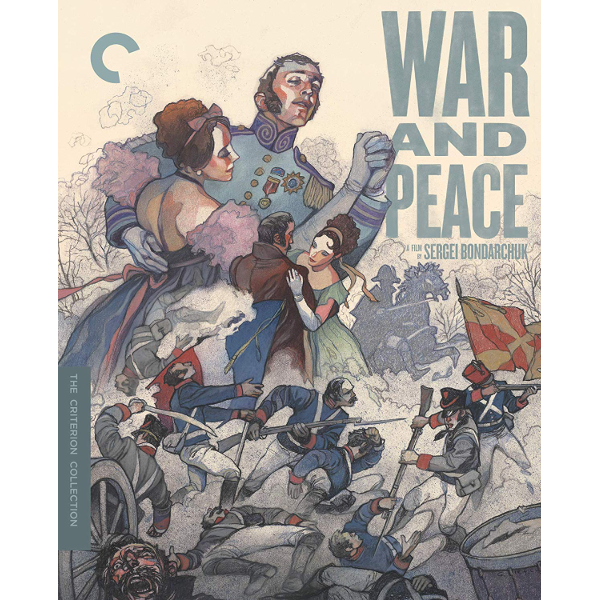

Thanks to the streaming of miniseries and the binge watching of long form episodic TV, a 7- hour movie no longer seems too much … although I’d think twice about doing it in a theater without plush seats. This four-part behemoth hasn’t a slow moment. The pride of an entire nation is behind it — the Soviet Union treated it as a national epic.
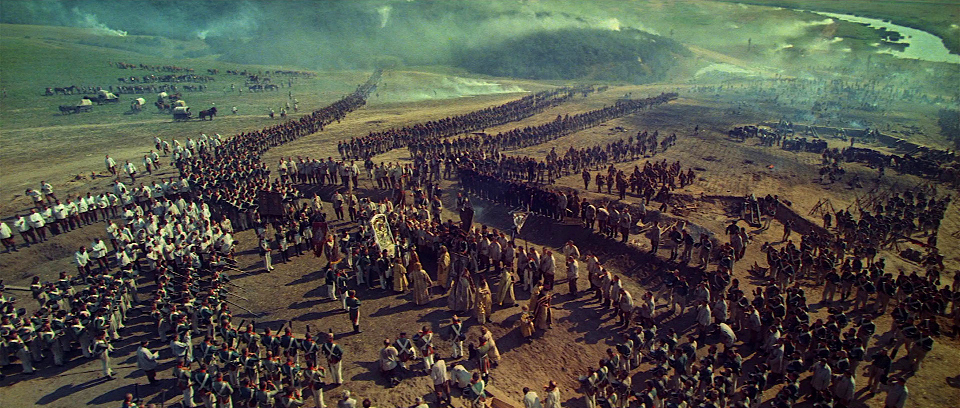
In high school in 1968, a downtown theater served up the USSR’s War and Peace in halves over two weeks. It was severely cut, the prints looked grainy and the color was weak at best. It was all dubbed into awkward English, and Natasha’s voice made her squeak like Minnie Mouse. I understood little but was still impressed. The eye-popping visuals have stayed burned into my memory, especially a God’s eye view, receding into the heavens, of the Austerlitz battlefield spread out below. It looked as if it took in miles of smoke and fighting. On a giant screen, it was jaw-dropping.
In 2003 the Ruscico disc company put out a DVD with a so-so transfer and Russian-only menus that were difficult to navigate. It was still a wonder to behold, especially in the original language. Now Criterion and the New Russia have created a stunning encoding of the whole show, accompanied by the expected battery of Criterion extras. 2019 is going to be a great summer for discs, but this one will be a highlight.

This version of Tolstoy’s novel was approached as a priority as important as the Soviet space program. Unless the Chinese have made something bigger, War and Peace is surely the most gargantuan production ever, with entire armies filling the screen and covering vast landscapes. The recreation of the Napoleonic era in St. Petersburg and Moscow is marvelous to behold. Director Sergei Bondarchuk makes the story work even better at the intimate level. The romantic adventures and heartbreaks of the central trio of Pierre, Natasha and Andrei lead to at least four or five emotionally devastating highpoints.
Previously, there was the 1956 Dino DeLaurentiis version. Except for some awkward casting, it wasn’t half bad, but it pales beside the opulence and scope of this colossus. Criterion’s version looks far, far better than previous releases, and is packaged with helpful extras and easily-navigated menus. More on that below.
In the U.S.S.R. the show was released as four separate movies, starting in 1966.
Film 1: Andrei Bolkonsky: The sweeping story of Russian nobility during the Napoleonic wars begins in 1805. At the Moscow Rostovs, young Natasha (Lyudmila Saveleva) is a child dreaming of romantic affairs. Frequent guest Pierre Bezukhov (Sergei Bondarchuk, the director) takes a serious liking to her. Russia allies with Austria against Napoleon, so before he leaves to fight, Prince Andrei Bolkonsky (Vyacheslav Tikhonov) parks his pregnant wife in the country with his father and sister. For Natasha’s brother Nikolai (Oleg Tabakov) it is a first battle. Back in Moscow, Pierre is easily pressured into marriage with the beautiful but decadent Hélène (Irina Skobtseva), who is soon rumored to be taking lovers. Pierre challenges one of them to a duel, and has a crisis of conscience after wounding the man severely. Andrei returns to his country home just in time to see his wife die in childbirth. He determines that life is worthless. Then Spring comes and the world seems to be reborn.

Film 2: Natasha Rostova: At a glorious ball, Natasha is a wallflower until the meek Pierre encourages Andrei to dance with her, whereupon both fall gloriously in love. Andrei carefully proposes through her family, electing to wait a year before marriage. A year seems like forever to the still-immature Natasha. She goes on a wolf hunt and to the opera, where, with the connivance of Hélène, young wastrel Kuragin (Boris Smirnov) catches her eye. Falling in love, and not realizing what will happen, Natasha agrees to elope with the scoundrel, a fate barely avoided by the intervention of her sister and Pierre. When Andrei breaks off their engagement, Natasha believes her life to be over at age seventeen.
Film 3: 1812 : Napoleon Bonaparte invades Russia once more, obliging Andrei to again take up his sword. His father remains in denial as the French advance steadily across Western Russia. Pierre takes leave of Natasha to go observe the big battle at Borodino. He speaks to Andrei the night before. The battle is an enormous clash of thousands of troops, and at the end the French prevail. Andrei is seriously wounded.
Film 4: Pierre Bezukhov: The main Russian Field Marshall realizes he can’t stop the French, and so elects to abandon Moscow without a fight, burning all useful resources on the way. Millions become refugees, and caravans of rich Muscovites flee Eastward. Pierre disguises himself as a common citizen with the vain idea of assassinating Napoleon Bonaparte, but instead makes friends with a French officer who moves into his apartment. The Russians refuse to parlay with Napoleon, and leave him in a dead city with the poor. His soldiers loot tons of booty they can’t possibly carry home. Pierre is arrested as an arsonist but is spared the death penalty. He witnesses a mass execution and is sent on a march by the French. On the refugee trail to the East, the Rostovs take in the mortally wounded Andrei, and he and Natasha spend time together declaring their love. When Napoleon quits the city, the Russian winter closes in to decimate his army as they withdraw. Pierre and Natasha are reunited.
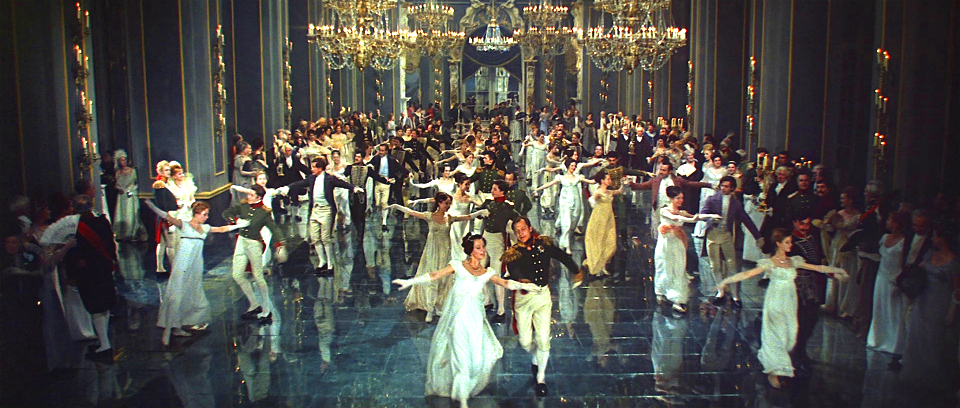
The old Ruscico disc had its graces (many subtitle choices, for one) but it can’t hold a candle to the restored encoding of this top-of-the-line Soviet blockbuster — preview scans of some scenes increased my anticipation. It’s wonderful that such good color was pulled from the film, as the Soviet color movies I’ve seen never looked very good. As ever, seeing this in the original Russian is essential. It’s amusing to note that the elite of St. Petersburg frequently opt to speak French. We hear the lines ‘simo echoed in Russian,’ just like Soviet audiences heard it back in the day.
Actor Bondarchuk makes a brooding, introverted Pierre, too shy to dance at a ball. He’s convinced of his insignificance even as he’s inheriting a massive estate. Pierre’s adoration of Natasha is matched only by his belief that he’s unworthy of her. He makes an excellent foil for the dashing, closed-minded Prince Andrei, a traditionalist who chides Pierre about his scandalous associations. But Andrei boorishly persecutes his own loving wife because he feels tied down by family obligations. Both men evolve interestingly through the story, experiencing the tumultuous events and their mutual love of Natasha from different perspectives.
Lyudmila Savelyeva is a radiant Natasha, starting as a pixie dreaming girlish dreams and bursting with childish enthusiasm. Her miniature features and expressive eyes are a feminine ideal. Besides the big ball, she performs a show-stopping folk dance at her Uncle’s place in the country. Clearly meant to be the soul of everything precious in Russia, the character is the film’s biggest success. In the extras we discover that Soviet audiences flocked to the 1956 Ponti-De Laurentiis / Paramount version. They apparently thought the show was okay but they LOVED Audrey Hepburn as Natasha. Ms. Savelyeva has the same delicate elegance.

Director Sergei Bondarchuk’s work is tastefully literate but also dynamic and bold. Given resources to dwarf American epics, he maintains his disciplined cinematic vision even in the large battle scenes. Any doubt that this is a celebration of classic Russian moviemaking goes away with the entrance of Natasha, bursting through some doors in three Potemkin-ish cascading short cuts that end on her beaming face. The camera stays put when it’s proper to do so, but when the director has something to express, it trucks and pans and cranes and tilts, and seemingly flies through the air. The big ballroom dance dissolves into West Side Story- like blurs and soft colors, and then the camera whips around in dizzying waltz circles, or flies down the hallway, watching the dancers from on high. Bondarchuk introduces little choreographed cuts by flashing a fan in front of the camera, a device that is unusually successful. The one visual experiment that seems one too many is when the director inserts subliminal flash frames at every cut point. It just seems distracting.
When the story quotes Tolstoy’s abstract thoughts, the characters often look for answers in the sky. Bondarchuk accompanies disembodied speeches with shots of clouds and vast landscapes, such as seen in the main titles. These provide a break from the melodrama on the ground. The high aerial shots are always at a conceptual remove from the narrative. We don’t get the feeling that the 1812 era is being hyped with visuals alien to the historical experience.
Bondarchuk was criticized by some reviewers for his eclecticism; in one scene he’ll use split screens that seem to come from Pillow Talk, and another brings on multi-imaged superimpositions that evoke Metropolis. There is an ‘Abel Gance’ tendency toward camera gymnastics, but most of the film is visually straightforward. Bondarchuk is a classicist who makes the camera do some of the acting, and the result is by and large a big success.

I mentioned the picture’s four or five emotional high-points, most of which are heavy-duty dramatic scenes: Natasha’s hysteria at having her elopement foiled, Pierre’s witnessing of the firing squads, the death of Andrei’s young wife. In a Western film, we might expect the music to play a larger role in dictating the tone of the drama; most Hollywood epics lean heavily on their scores for their emotional telegraphy. War and Peace builds its emotional climaxes mostly through unadorned theatrics, and giant close-ups.
But the battle scenes make an impact that I don’t think I’ve seen in any other epic. Giant battle scenes are always an opportunity to admire the organizational patterns of masses of combatants moving in concert for the camera. Knowing how difficult it is to get just one actor to open one door and not look false, the moving panoramas of soldiers and organized mayhem in shows like Zulu Dawn are impressive displays of film as a giant engine of movement. The gigantic computer-animated battles in Lord of the Rings: The Two Towers are impressive, but this is 100% real. War and Peace outdoes them all for sheer vastness of scale and precision of effect.
The extended battle of Borodino presents a vision of unending, unlimited conflict, the sum total of human energy expended on death and destruction. The battles inundate us with the chaos of warfare, not strategies we can read or follow as a story. The overall impression is of total insanity. A master shot might use a crane or a dolly or start with a wide shot and end up on a detail. In many masters it looks as though tens of thousands of soldiers and horses are rushing every which way, marching in set patterns. There are some shots of massed diamond-shape formations moving across the landscape, like a carpet of men. The longer it goes on, the more elaborate it gets.

Bondarchuk’s experts use smoke as a choreographed element. Plumes of cannon-hits erupt from the foreground all the way back to what might be a mile’s distance. The wind carries clouds of black and white smoke across the screen in patterns that accentuate the blind chaos of the battle inferno. Bright sunshine turns to dark shadow and back again as the smoke ebbs and flows.
No soldier has the big picture of this struggle. The artillerymen keep firing, laughing as their friends are blown to pieces, drunk with the insanity of killing. Not even the generals know what’s going on. Both commanders sit helplessly while their battle plans collapse around them. New orders are useless because good information simply isn’t available. The rules of combat put pride and tradition before the lives of the soldiers. Andrei’s company sits out the direct fighting waiting in reserve, yet loses a third of its men to shelling as they stand in their formal lines.
Dozens of cavalrymen charge a small hill. A long line of horsemen on that hill disperse to reveal cannon that all fire at once — the camera whips left to see the entire wave of enemy horses tumble to the ground. When Bondarchuk decides to move his camera through the melee, we get perhaps ten unbroken minutes of continuous amazement. Cameras on rails truck past men climbing ladders and stairs, and race down trenches as dozens of horses leap overhead. The pacing is flawless: it’s like a battle for the end of the world. One overhead wide-angle view rushes downward over the heads of soldiers fighting hand-to-hand. It makes the viewer feel like a cannonball crashing to Earth.
I’m mainly here for Glenn Erickson. He’s one of the best film critics writing today and indisputably the best when it comes specifically to movies on DVD, covering the tech aspects completely and clearly without getting lost in the weeds.
May you live a thousand years.