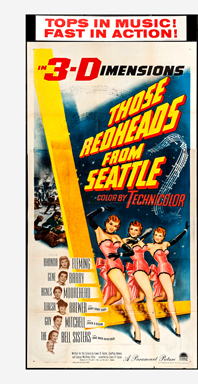
The 3-D Film Archive, a champion for fans of film restoration for home video, take on their toughest assignment with the Paramount musical Those Redheads from Seattle. A picture with a pack of technical problems to overcome, the 1953 show was produced by the Pine-Thomas partnership, which specialized in elevating ‘B’ budgets to soft ‘A’ status. Redheads was the first of two Pine-Thomas 3-D movies starring the statuesque genuine redhead Rhonda Fleming, the second being the next year’s Jivaro. The expert, highly informed extras on this Kino disc tell us that by October 1953, barely a year into the big 1950s 3-D craze, audiences were already cooling on the process, with bad press complaining about bungled presentations and eyestrain.
Sixty-four years later, we have a nigh-on perfect home theater presentation format for 3-D. New productions as well these vintage favorites now look fantastic, with no technical issues. The cruel irony is that, after the studios ran the new 3-D theatrical presentations into ground, the TV industry is beginning to abandon the perfected home video format.
According to the Archive, Those Redheads from Seattle marks a number of firsts: it’s the first 3-D musical, beating MGM’s much bigger show Kiss Me Kate into theaters by a month. It’s also Paramount’s first ‘widescreen’ presentation, in which flat photography is composed for a wider frame and then projected with a matte, cropping picture information from the top and bottom. This is the first time this show has been seen in its proper ratio since it was new. We’re told that many of the film’s 1953 play dates were booked non-3D ‘flat’ as well, as exhibitors were already rejecting 3-D. Audiences can’t have been amused by gags in which objects are thrown at the camera . . . gags that are meaningless in 2-D. Initial audiences also heard the movie in three-channel stereo. When I pick up the tech discussion later in the review, I’ll return to the subject of sound — the disc performs an impressive replication of the original stereo effect.

Those Redheads from Seattle is directed and co-written by Lewis R. Foster, a multi-talent who began in short subjects, wrote stories and screenplays, and earned credits on some big shows like Mr. Smith Goes to Washington and The More the Merrier. Tailored to the budget-conscious Pine-Thomas scale of production, this show has some location work with doubles but otherwise stays rooted on the Paramount lot. Although billed as a musical there are only five songs. The leading lady dances in just one number and the leading man doesn’t perform at all. On the other hand, this is the only movie to see the talented, spirited recording star Teresa Brewer. She could have been a major musical performer, if musicals weren’t on the downgrade — she didn’t want a demotion from pop star to ‘just another starlet.’
Set in Gold Rush country in 1898, the story also wants to be a ‘lusty action tale.’ Saloon owner and all-around swell guy Johnny Kisko (Gene Barry) is upset by reform newspaper headlines in the local Dawson paper demanding his operation be shut down. The real trouble is Johnny’s unscrupulous partner Mike Yurkil (fave thug specialist John Kellogg), who torches the newspaper’s warehouse and then shoots its publisher Mr. Edmonds on the street in broad daylight. Although she doesn’t know it yet, Edmonds’ widow (Agnes Moorehead) and her four daughters Kathie, Pat, Connie and Nell (Rhonda Fleming, Teresa Brewer, Cynthia Bell & Kay Bell) are already on their way to Dawson. The saloon’s new singer Joe Keenan (Guy Mitchell) talks Johnny into sled-dogging the Edmonds women from the seaport Skagway, 400 miles to Dawson (!). They discover that father is dead and the paper shut down only after they arrive, and must adjust accordingly. Ma takes in sewing work, Connie becomes a nurse and Kathie writes letters for illiterate miners. Kathie and Johnny become a potential item until the print press operator Dan Taylor (Roscoe Ates, sans speech impediment) repeats the incorrect rumor that Johnny is responsible for Pa’s demise. The family all but breaks up when Connie defects to the performer Joe, Kathie is wooed by the local Reverend Petrie (William Pullen) and the irrepressible Pat becomes a star at Johnny’s saloon. Pat is drawn to Johnny, Kathie is confused, and Dawson becomes a heck of a romantic mess . . . with more songs.

I think that big studio musicals were popular after the war because of the economic boom and the patriotic feeling that we could do no wrong. MGM’s musicals in particular imagined stable fantasy worlds where a song could cure anything, denying the grim realities seen in those un-American social conscience & ‘negative’ violent thrillers. Audiences were dazzled by color more splendid than the reality outside the theater. The performers were talented and attractive and the music came from the country’s best composers. We were proud that our country was so prosperous, it could afford entertainments on this scale.
The screenplay is credited to director Foster, and also the pros Daniel Mainwearing and George Worthing Yates. It has some weak (very weak) attempts at humor, and otherwise is fairly straight drama. The censors ix-nayed the notion of Johnny Kisco’s saloon also being a house of ill repute, which would have been historically accurate. That the newspaper would conduct a morals campaign against a harmless music hall doesn’t make much sense. The leading ‘bad’ showgirl competing for Kisco’s attention is played by Jean Parker, of the fantasy Beyond Tomorrow and Edgar Ulmer’s Bluebeard. Except for a slightly crooked smile, she’s no less virtuous than the Edmonds sisters.
Those Redheads from Seattle originally went out with Technicolor prints derived from an Eastmancolor negative. As detailed in the disc commentary, some of the songs were hand-me-downs discarded or left over from other musicals. The songs are well motivated, but none are real winners. Guy Mitchell’s “Chick-A-Boom” is the most elaborately staged number, with one blonde chorine consistently given the best angles to kick her legs into the 3-D airspace. But radio singer Mitchell isn’t that memorable. He’d do much better next year, in the oddball Rosemary Clooney western musical Red Garters, again opposite Gene Barry. The Bell Sisters Cynthia and Kay were also accomplished radio stars, with a hit record that didn’t translate into major movie success. Kay is the one non-redhead sister, a fact that the script tries without success to have some meaning in the story. Little Nell is just there to perform two feel-happy numbers with her big sister Connie. The reasonably well-staged musical numbers can’t compete with MGM’s output, but the 3-D makes them pop. The show might have been a big hit if Paramount had given Pine-Thomas the services of their current musical star Rosemary Clooney, who had a great screen presence and of course could put any song across in fine style. But would she have been the right fit for a story that’s mostly a downer? The critics reviewing Redheads weren’t kind, but they did call out Agnes Moorehead’s contribution as the best acting in the picture.

Simply strutting in one musical number is Rhonda Fleming. She is of course a wonder in color, and was possessed of one of the more glamorous smiles in Hollywood. To keep Ms. Fleming from being upstaged, the film’s obvious center of interest has to be pushed aside a bit. I admit that I didn’t know who Teresa Brewer was until I heard her distinctive voice in “Baby, Baby, Baby,” the kind of square-but-catchy novelty song that ought to be on the soundtrack of L.A. Confidential. Brewer is the soul of early ’50s radio pop. Her biggest hit was the bouncy earworm classic “Music Music Music.” Ms. Brewer has a winning smile, bright eyes and a perky attitude that could have given Debbie Reynolds a run for her money, but she gave up on Hollywood after just the one movie. Those Redheads from Seattle is a keeper for the 3-D, and for Teresa Brewer’s number. It comes on at just over the hour mark.
And what about Gene Barry? For some reason Paramount placed the former song and dance man in suspense thrillers like the excellent The Atomic City. Barry isn’t part of Redheads’ musical lineup at all. He instead mushes a dog team, wearing a knit cap that does nothing to hone a macho image. If Johnny Kisco doesn’t fully convince it’s not Barry’s fault, as the script has him hire an obvious dastard for a partner, and then remain oblivious to the mayhem being perpetrated in his name. Gene Barry eventually realized that it’s not so bad to be most remembered for the great sci-fi film The War of the Worlds. Back in 1953 he probably wanted to get that over with so he could make his name in lighter movies, perhaps more musicals. How crazy that he doesn’t sing or dance here!

Lewis R. Foster’s direction makes good use of 3-D depth staging. Most of Those Redheads from Seattle takes place on the old western street on the Paramount lot, the one with storefronts rigged to be interior-exterior sets as practical as any soundstage. The real snow dumped onto the Dawson street looks good too, although it can’t have lasted ten minutes under Hollywood’s high noon sun. At the end of the street is a phony mountain backdrop, that blocks out views of the palm trees in the cemetery just to the North. This backdrop arrangement has never looked particularly good, but since this is a musical, it’s less distracting than in dramas like the tough crime story The Trap, made six years later.
The Skagway dock is staged on Paramount’s fairly tiny, shallow water tank, the one with the large wall with a painted sky. It used to be visible from Melrose Blvd. on the South Side of the Paramount Lot. Cameraman Lionel Lindon makes this look marginally acceptable … for a musical. A rather awkward final act takes Johnny Kisco to a new locale for a shootout with a bad guy, a scene that integrates stage interiors with the snowy Colorado location work. It’s followed by a quick ‘everybody’s happy’ wrap-up.

Lastly, I was surprised to recognize a voice in an early scene. In the first wide interior shot on the boat to Skagway, an excited little girl sitting on the floor speaks just one dialogue line. The voice couldn’t be anybody else’s — it’s an unbilled, twelve-year-old Sheila James Kuehl, who we all know and love as Zelda Gilroy from the old TV show The Many Loves of Dobie Gillis. In 1974 Sheila was an administrator in UCLA’s Ackerman Union, and I recognized her voice there, too. She’s now a prominent Los Angeles career politician.
If my technical descriptions sound critical, I’ll have done the disc a disservice: 3-D fans will want this unique relic from a bygone era. As a novelty release, and for the collectors that will appreciate this ambitious studio ‘depthie,’ Those Redheads from Seattle will be a desirable acquisition.