

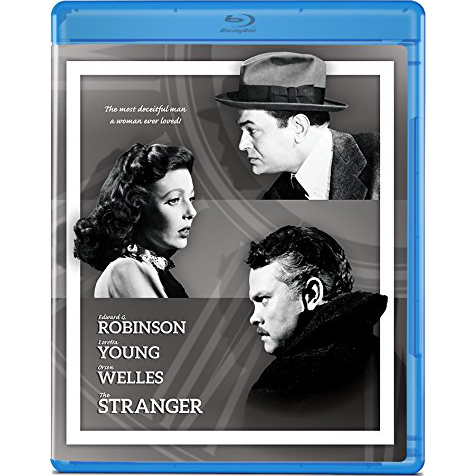

Up pops Olive Films with another Blu-ray of Orson Welles’ impressive The Stranger, for the first time an HD scan sourced from original pre-print elements held by MGM. The quality discussion and comparison are at the end of the review, with the body of the essay rewritten from two previous disc reviews. As is sadly the case, MGM does not have the alternate version of the movie that we read about in Video Watchdog almost twenty-five years ago.
The two most horrible moral clouds over the victory in WW2 were the atom bomb and the revelation that Germany had conducted a mass genocide. To ‘clear up’ doubts about the morality of the bomb, Hollywood soon produced an ideological whitewash docudrama. In line with rumors that the new American intelligence agencies were recruiting high-ranking Nazis, movies that seriously stressed the potential for renewed Nazi threats soon became scarce. The Stranger was released by RKO just before this Cold War freeze on anti-Fascist thrillers. Anthony Veiller’s screenplay emphasizes the persistence of the Nazi menace, as had three earlier shows that involved ex-Nazis regrouping for a possible new Reich in Latin America: Cornered, Notorious and Gilda. Early in 1947 the entire hot-button subject would be abandoned as the U.S.A. geared its propaganda machine to oppose the looming Communist threat. Hitler was out, Ivan was in. As late as 1950, a finished RKO film called The Man He Found was partially re-shot to convert an evil Nazi conspiracy into an evil Commie conspiracy. The movie was re-titled The Whip Hand. Its producer Stanley Rubin asked to have his name removed.
Orson Welles hired on for The Stranger in an effort to resuscitate a directing career that had slowed to a halt after his two initial RKO masterpieces. Welles was intent to prove that he could make a popular thriller without production complications, to show Hollywood that he was neither difficult to work with nor an irresponsible spendthrift. The film was a financial success, and some say the only Welles picture to turn a profit when new.

The suspenseful story is about the cornering of a Nazi monster, not somewhere in Europe or South America but in an idyllic American college town. Nazi mass-murder architect Franz Kindler is unaccounted for, and to track him down U.S. special agent ‘Mr. Wilson’ (Edward G. Robinson) frees Konrad Meinike (Konstantin Shayne), a former concentration camp commandant. Wilson tracks Meinike through Latin America and then to Harper, Connecticut, where the trail suddenly stops. Wilson suspects new citizen Professor Charles Rankin (Orson Welles) until Rankin makes an anti-Fascist speech at a dinner party. But Rankin’s new wife Mary (Loretta Young) becomes upset when first her dog and Meineke turn up dead. Rankin is able to stall Mary with the claim that he is being blackmailed. Wilson must persuade her to accept the fact that her husband is not a romantic with problems, but a dangerous escaped war criminal.
The Stranger is an efficient and impressive production directed by Orson Welles for maximum suspense. He’s also quite good as the lead villain, building Charles Rankin / Franz Kindler into a complex character with several levels of secrets to hide. The audience-pleasing comeuppance conclusion doesn’t overdo some bizarre dramatic effects.
Welles filmed and cut a much longer prologue detailing a trail of intrigue and murders as the sinister Konrad Meineke makes his way to America. Perhaps intended to sell the idea that our South American ‘good neighbors’ were also intent on capturing fugitive Nazis, the prologue isn’t really missed. The existing cut wastes no time getting us to Connecticut, and establishing secret agent Robinson’s crusade to catch his quarry. The details of this fascinating missing prologue were first explained by Bret Wood in the May/June 1994 issue of Video Watchdog (#23). Articles like Wood’s made vintage VW essential reading.
The script divides most of its time between three Harper locations. At the old-fashioned cracker-barrel general store, Billy House’s portly Mr. Potter plays checkers, keeps tabs on all who come and go and in general refuses to move unless absolutely necessary. The New Englanders are scrupulously honest and proud of it. Potter won’t open Meineke’s abandoned suitcase without a witness, and at one point Mary tells us that she feels perfectly safe walking home in the dark because, “This is Harper.”

Mary is proud that her father, an ex- Supreme Court Justice, represents good Liberal America — in fact, Rankin uses those exact words. Wilson finds a friend and early ally in Mary’s idealistic brother Noah (Richard Long), and together they link Meineke’s fate to the slippery Rankin.
The real drama takes place at Rankin’s house, where the wholesome Mary denies as long as possible the awful truth that she has married a monster. The Rankin character is verbally subtler than earlier Nazi stereotypes. In Herbert Biberman’s wartime film The Master Race, the hidden SS fugitive George Coulouris is prone to spout vicious, unprovoked Nazi rhetoric. Welles has Rankin initially hide behind a meek disguise. He shows his true colors only when he inadvertently corrects Wilson in a casual conversation, saying that Karl Marx was not a German but a Jew. Rankin assures Meineke that a new Reich can and will be rebuilt, but when cornered spares us the usual rabid rhetoric. The sharp oratory is instead given to Edward G. Robinson’s highly motivated Nazi hunter . . . another humble move by a director occasionally accused of reserving ‘all the good bits’ for himself.
Rankin turns out to be an old-fashioned dastard, He poisons a dog, strangles a man with his own hands, and even sets up his new bride for a fatal fall. Welles reserves his most baroque visual touches for a tall church tower with a somewhat out-of-place Old World clock, the kind with large animated figures. For Rankin / Kindler, restoring the broken clock is probably a place-filler for getting the gears of the Nazi mechanism working in this new, unsuspecting country. The clock tower becomes the stage for risky confrontations and Kindler’s gruesome last stand.
Welles works well with his small cast, finding a bit for his old Mercury Theater actor Erskine Sanford at a dinner party. Russell Metty’s camerawork is sharp and unfussy. The original story is by Victor Trivas, a German who would later return to his home country to make the rare surgical horror film Die nackte und der satan (The Head).
