
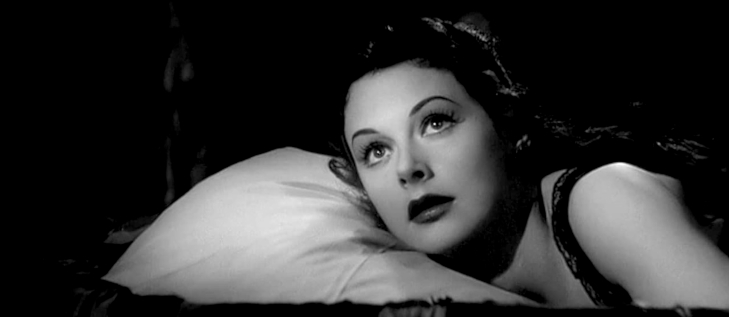


The Strange Woman is one of Edgar G. Ulmer’s most accomplished pictures, which makes it a shame that it’s also one of many Ulmer titles to have fallen into the pit of Public Domain negligence. Undeservedly obscure, it’s a daring independent production that gives the majors a run for their money. Star Hedy Lamarr was then known to the public for exotic glamour vehicles and a legendary racy art film from pre-war Czechoslovakia. Now on her own, Lamarr took charge and put together a show to prove that she was more than eye candy.
In many Ulmer pictures, his directorial presence is the star — his specialty was creating something worthy with minimal production resources. Ulmer proves here that he can handle a fully funded production and get along with big talent. The show apparently did well in its initial release through United Artists, but it didn’t yield a major career boost for Ms. Lamarr. The tragedy is that she’s most remembered for a movie made 3 years later, Cecil B. De Mille’s obscenely successful but mostly ridiculous Bible epic Samson and Delilah.
Back in 2005 we remarked that Hedy Lamarr’s character in this film makes for a good comparison with Gene Tierney in the celebrated noir Leave Her to Heaven. What we didn’t note is both films are based on books by the same author, Ben Ames Williams. Each woman gets away with evil acts, because all that people see is their grace and beauty.

The Strange Woman was filmed almost exclusively on interior sets. In 1820s Bangor, Maine, the cruel child Jenny Hager (Jo Ann Marlowe) pushes a boy who can’t swim into the water. She then takes credit for saving him when an adult arrives on the scene. Ten years later, Jenny is now a devious beauty (Hedy Lamarr), who brags to her best friend Meg (Hillary Brooke) that she’ll break free of poverty and marry a rich man. Fleeing the abuse of her alcoholic father, Jenny manipulates a Reverend (Moroni Olsen) and a Deacon (Rhys Williams) into suggesting that she marry the middle-aged widower Isaiah Poster (Gene Lockhart), the richest businessman in Maine. As Isaiah already lusts after her, Jenny finds him easy to control. Meg shows Jenny how to behave like a refined lady. By putting on a pious front and donating Isaiah’s money to charity, Jenny makes a name for herself as a virtuous woman.
The boy Jenny once tried to drown is Isaiah’s son Ephraim Poster, now a college wastrel (Louis Hayward). When he returns home, Jenny recognizes him as a weakling. Through delicate steps and promises, she entreats Ephraim to murder his father on a river journey to assess fthe family lumber empire. Isaiah does drown, but only because of his son’s fear of the water — he panics in the middle of some rapids. Witnesses blame Ephraim for the accident. Jenny inherits the lumber business, and immediately banishes Ephraim from the family home; he collapses into alcoholism.

Now independently rich, Jenny nominates John Evered, Meg’s handsome suitor (George Sanders) to oversee operations. She succeeds in stealing John for her own. Evered has for years been the actual object of Jenny’s desires, but fate gets in her way. When it turns out that she can not bear children, Jenny comes to believe a revivalist’s Hellfire sermon about the nature of Wicked Women.
The Strange Woman may be Edgar Ulmer’s most lavishly produced American film. It was backed by the experienced producers Hunt Stromberg and Jack Chertok, who gambled on the Lamarr aura. Pretty actresses are often even more impressive in person, but it is said that Lamarr was a phenomenon — her entrances routinely brought large gatherings to a standstill. Her Jenny Hager stands out as an exceptional beauty in a small Maine town just a couple of generations removed from its Puritan roots. The wealthy citizens turn their backs on charity while profiting from a red light district called ‘Devil’s Half Acre.’ As the town has no police department, wild Lumbermen periodically turn it into a lawless zone. Jenny’s friend Lena (June Storey) is victimized by the hooligans, but she is later scorned as one of the town’s prostitutes.

Jenny has used her husband’s money to spread a public relations image of herself as a virtuous soul. Even the lumbermen recognize her as a fine lady. She of course uses that image to demolish Isaiah and control John — nobody believes Isaiah’s claims of Jenny’s wickedness.
Twin movies: same setup, different eras.
This time watching The Strange Woman we realized that it and the previous year’s major hit Leave it to Heaven are not only from the same author, but basically the same story. The 1830s Americana picture presents its essentially evil woman as a near-Biblical Jezebel figure, exploiting her sex appeal to confuse and corrupt susceptible males. The contemporary story leans on the ’40s interest in psychology to make its killer female into a Freudian mystery, an unknowable threat. Directors Ulmer and John M. Stahl turn each movie into a distinctive artistic achievement. A major killing in each show is a drowning. Hedy Lamarr’s treacherous Jenny also goes mad, with fear of Holy retribution for her sins. Both works reshape misogynistic superstition into a new guise: as in folk tales and Bible stories, sexually forward women are the cause of all human misery.
Jenny Hager and Ellen Berent are no different than Alraune or Wedekind’s original concept of Lola — each is an essentially destructive feminine essence. A more nuanced take on a particular ‘female madness’ can be seen in Roman Polanski’s classic horror picture Repulsion.

The accomplished Hedy Lamarr must have recognized the theme in her own life. From a young age she was aware that her looks were an asset; her striking beauty easily led to acting prominence. She was sufficiently ambitious to marry a munitions baron for the Axis, and stealthy enough to break away from him in a brilliant maneuver worthy of any spy drama. She won herself a full MGM contract by arranging contact with Louis B. Mayer in London, and then on a trans-Atlantic ocean liner. She surely knew everything about turning the head of a powerful man.
Hollywood’s censors monitored every gesture and costume change of ‘sexy’ stars like Lamarr, so as to neutralize her ‘dangerous’ sexual power. The 1830s time frame allows Jenny Hager to be seductive but always fully clothed. Lamarr’s performance is always nuanced and believable. Those people that come to ‘understand’ Jenny simply conclude that she is Evil.
But the movie lets us know that she’s the product of an oppressive social environment. Jenny’s future is decided by three men, all acting in pious mode to do ‘what’s best’ for Jenny. Bangor’s church leaders would never openly acknowledge Jenny’s sexual desirability. They all but assign her to marry the old coot Isaiah. With such a Boys’ Club wielding such control, Jenny’s subversive actions almost seem justified.
The acting ensemble supports Hedy Lamarr in every scene. Second-billed George Sanders plays a genuinely good man (a nice change) and is thus perhaps a little less interesting than usual. His decent John Evered is a good match for Hillary Brooke’s equally upstanding Meg Saladine. Jenny and Meg can be seen as less-sympathetic variations on Scarlett O’Hara and Melanie Hamilton.
The lumberman only rings twice.
As the miserly lumber baron, the excellent actor Gene Lockhart reveals flashes of undiluted lust in Jenny’s presence. We wonder whether or not Jenny actually ever sleeps with her much older husband. Louis Hayward is a spoiled college brat outclassed by Jenny’s manipulations. He’s a guilty coward from the get-go, and she knows just how to play him. Jenny’s eventual dismissal of Ephraim is as cold as double-crosses can get.

Edgar G. Ulmer is often praised for his taste in film music. The best example of his style is perhaps Detour, with its ironic use of a romantic pop song to counter Leo Erdody’s doom-laden main theme. We found the classical music track in Ulmer’s Bluebeard to be a major distraction — it’s loud, it’s everywhere and it never stops. Did Ulmer have any control over Carmen Dragon’s music score for The Strange Woman? We find it obtrusive as well, constantly telling us how to react to the character situations. With a little less music prompting, I think we’d find ourselves paying more attention to details in the excellent performances.
Two years later, Edgar G. Ulmer’s equally elusive Ruthless centers on a destructive male personality, a financial scoundrel who lies to the ladies and betrays all that trust him. It’s a second high point in Ulmer’s career, just before a retreat back to micro-budget work in Hollywood and occasional larger films produced abroad. Ulmer became known as the director who could make a releasable movie out of nothing. When he had something to work with, the pictures fared better.


The “equally elusive” Ruthless was released on Blu-ray disc a few years ago by Olive Films.
Really looking forward to seeing this! Thank you for reviewing the Film Masters edition.