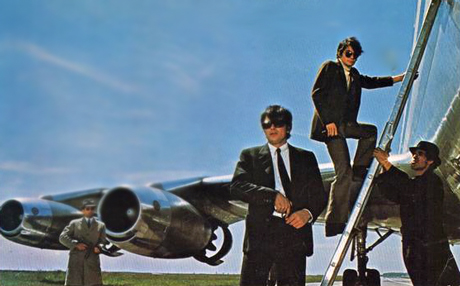
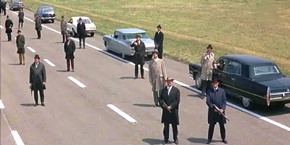
American crime fanatics wary of European imports now have access to a fully Region-A disc of a big-star, big budget French-Italian-American gangster film from 1969, Henri Verneuil’s exciting The Sicilian Clan. It was filmed in two separate versions, a multi-lingual European original and a less exciting, English-language cut for America. A huge hit overseas, The Sicilian Clan didn’t make a ripple when given a spotty release in the U.S. in 1970. It hasn’t been seen much here since, but I’ve been talking it up forever. For almost 25 years the only way I could recall it was to play the soundtrack album featuring the eccentric music of Ennio Morricone. That’s why we bought so many soundtrack albums back before home video, as a way to re-live movies we couldn’t see.
I saw The Sicilian Clan twice when it was new. An Air Force Base theater showed the International version, in French, Italian and English with subtitles, to a fascinated crowd that applauded at least twice during the screening. When I rented the movie for the UCLA dorms the next year, Films Incorporated sent me the American version, in which everyone spoke in phony-sounding English and nothing seemed quite as exciting. Fox produced the English-language version because they knew that American audiences wouldn’t sit through subtitles. But the dubbing robbed the picture of any feeling of authenticity and naturalness.
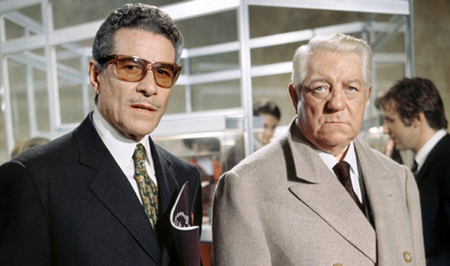
A French disc came out four years ago from Fox-Europa, and happened to be encoded Region-free. Kino’s new release has both versions as well, on two separate discs. Some of the extras are included.
The story is taken from a novel by Auguste Le Breton, the writer of the classic crime story Du Rififi chez les hommes. Notorious thief and cop killer Roger Sartet (Alain Delon) is sprung from a prison truck right in Paris by the Manalese Gang, highly organized brothers following the orders of the family patriarch Vittorio Manalese (Jean Gabin). The Manaleses own a pinball machine company, but Vittorio indulges in profitable crimes to buy land back in Sicily for a glorious retirement. Roger’s cellmate in prison, a security systems expert, has given him the alarm layout for an exhibition of fine jewelry. Interested in a deal for a new heist, Vittorio flies to Rome to check it out for himself, with his New York Mafia buddy Tony Nicosia (Amadeo Nazzari of The Nights of Cabiria). Working overtime to recapture Sartet, the dogged Inspector Le Goff (Lino Ventura) leans hard on Roger’s sister Monique (Danielle Volle), passport forgers and other underworld contacts. Sartet risks a night with a prostitute and is almost caught. But sex causes even more trouble when he responds to the overtures of Jeanne (Irina Demick), the French wife of one of the Manalese sons. What with the Sicilian code of honor, they had better not be caught.

The Sicilian Clan attracted a massive audience in Europe with its star cast: three legends of French thrillers. Jean Gabin was a revered institution, a veteran of some of the greatest pictures by Jean Renoir and Julien Duvivier. Alain Delon’s career was barely a decade old yet he was the country’s hottest male sex symbol, topping even Jean-Paul Belmondo. Not known internationally, Lino Ventura represented the best in French crime and ‘serie noire’ thrillers, having starred in terrific shows like Louis Malle’s Elevator to the Gallows, Claude Sautet’s Classe tous risques and Jean-Pierre Melville’s Le deuxième souffle. Gabin was the grand old man of the three — Ventura’s first role was in a Gabin picture, Jacques Becker’s Touchez pas au grisbi.
Made by the locally popular but uneven Henri Verneuil (Greed in the Sun), The Sicilian Clan is slick, expensive and perhaps a little too conventional. The film’s ambition was to crack the American market. At one point in the excellent documentary included on the disc, the producer says that Verneuil stressed giving the film a snappy ‘American pace.’ He delivers impressive thriller set pieces and dramatic confrontations, but his film retains the tempo of a less-rushed French movie.
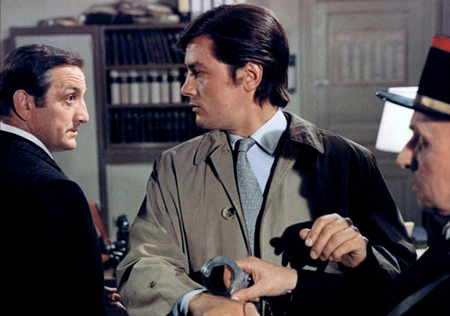
The three stars exhibit different styles of Gallic cool. Jean Gabin stays in his pinball factory, with its apartments above the work areas. He’s the center of all Manalese activity, with his obedient sons on task at all times. The family eats together and watches TV together. As the only outsider, Jeanne can barely take the rigid family routine — it’s like living in the 19th century. Alain Delon’s criminal Sartet faces down the police as he did in his Jean-Pierre Melville pictures, calmly listening to his rap sheet and quietly sticking to his denials. Sartet does have a soft spot for his sister Monique, who suffers under Inspector Le Goff’s constant surveillance. Lino Ventura’s relentless detective is a completely stock character who runs a tight outfit and rarely smiles. The gag of having Le Goff trying to quit smoking is one of the film’s few clichés. Ventura’s presence overcomes all obstacles — he’s an immediately likeable pro.
The movie is lavish by the standards of French genre filmmaking of the time, with many beautifully constructed sets. Art director Jacques Saulnier does overdo the color coordination in a scene where every accent seems to be bright orange, including Irina Demick’s tight outfit. The action ranges from hotels to airports to a large prison and a convincing police headquarters. In the best staged action scene the cops invade a cheap hotel, getting as close as one door away from their quarry Sartet, who is still in his underwear. It’s like the two-gun shootout in Don Siegel’s Madigan, except that it resolves with a hair-raisingly credible stunt.
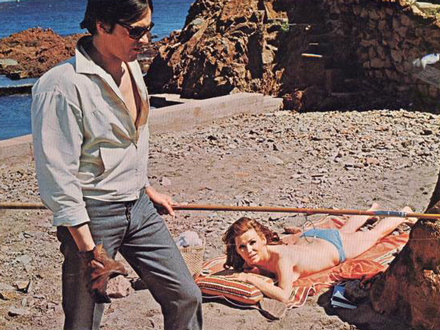
Icing on the cake comes in the form of Ennio Morricone’s slick music score, which alternates between a mournful main theme and an exciting action riff for transitional cues. As with his western scores of the time, Morricone makes use of odd noises, in this case ‘boing’ sounds. The most unusual scoring choice is a dynamic power moment for a seduction on a beach. Delon’s crook Sartet has caught a large eel and kills it by pounding it against a rock. The brutal display is observed by Jeanne, who has chosen to sunbathe nude only a few yards away, an open invitation for sex. Considering the Sicilians’ Old World honor system, Jeanne is making a very big mistake.
The Sicilian Clan’s escapes and violent confrontations are covered in a real-time detail that’s no longer in fashion. Today’s action montage style either piles on layers of incident and jeopardy (to cartoon excess) or dispenses with suspense effects to rush forward to the next scene. The film eventually builds to a major crime that’s spelled out in full detail – the hijacking and robbery of a jet plane carrying a fabulous treasure from Paris to New York. In 1970 the audacious ‘super-crime’ seemed utterly fantastic, and its surprise conclusion beyond credibility. Not any more — our innocence has been overtaken by history in a way that might make some audiences uncomfortable. For those who have seen the movie, this thought thread continues in a SPOILER discussion at the end of the review.