

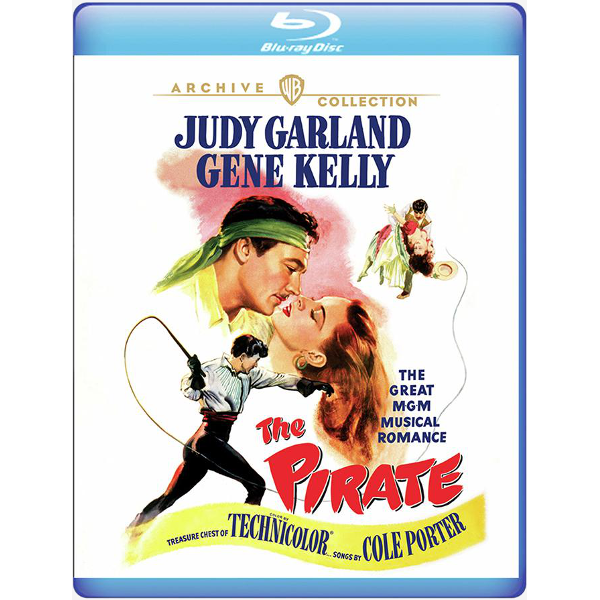

I’m pretty much in denial about The Pirate being a non-hit in 1948. It was an instant hit with me, despite the fact that my first long-ago viewing was on a black and white TV. This new release really rocked me back — whether you’ve seen this one on TV, in 16mm or even on DVD, the Warner Archives’ restored Blu-ray will still be revelation.

Only a continuity jump or two suggest that the making of The Pirate wasn’t smooth sailing from one end to another — we’re told that it ran way over budget and schedule while Vincente Minnelli, Arthur Freed and crew polished rough edges and made it ‘just so.’ Although the industry wags were talking about the threat of TV and a certain oncoming Supreme Court ruling, 1947 had been a tremendous year for Hollywood. Arthur Freed’s musical unit at MGM was possibly the most glamorous outfit working. He had his pick of top stars like Judy Garland and some of the best music arrangers and orchestrators in the world. The melodic, witty music and songs for The Pirate are by Cole Porter, a genuine legend. Director Vincente Minnelli was a stickler for quality and inclined toward high art. The MGM musical would stay strong for only a few more years, but in 1947 it seemed that nothing could dim its popularity.
The Pirate is a comedy farce in period costume for the Caribbean (or Caribbean) tropics in the 1830s. Provincial maiden Manuela (Garland) is set up to marry the stuffy but rich Don Pedro Vargas (Walter Slezak). That outcome is devoutly wished by her matchmaking Aunt Inez (Gladys Cooper) but Don Pedro doesn’t set Manuela’s heart a-flutter. Her romantic imagination is instead captured by the traveling entertainer, ladies’ man and all-around scoundrel Serafin (Gene Kelly). Hypnotizing Manuela in a street performance, Serafin discovers that she’s turned on by dreams of being taken, wooed and ravaged by a legendary pirate called The Black Macoco, commonly dreaded as “Mack the Black.” Since the Macoco hasn’t been seen in years, Serafin sees nothing wrong with convincing Manuela that HE is the murderer and plunderer in disguise. The fantasy role-playing works well until the news reaches The Viceroy (George Zucco) — with Don Pedro’s eager assistance, the authorities prepare to execute the ‘scourge of the West Indies.’
The MGM musical was considered a style-world unto itself, and Vincente Minnelli its most consistent stylist. His guidance catches a good balance between vivid Technicolor (eye-popping), lavish production values (elaborate sets, large crowds, beautiful women) and ribald comedy (the send-up of male vanity and female swoon-fantasy) — all set off by four or five terrific musical numbers. We laugh at Manuela’s attempt to play demure while seeking a lustful love life. Serafin’s show-off number (“Niña”) sees Kelly chasing one woman after another by climbing all over a set designed to accommodate his gymnastics. At one point he kisses a señorita while holding a lit cigarette in his mouth, a trick that suggests other oral talents. The dance in which Serafin ‘becomes’ The Black Macoco begins with him pointing his sword at a cleverly convincing prop of a white mule.

The movie’s devastatingly beautiful sets and costumes are subverted by comedy gags both subtle and broad. Manuela’s ‘Uncle Capucho’ is a powerless twirp, functioning somewhat like Sig Arno’s Toto in The Palm Beach Story. Walter Slezak’s Don Pedro does funny bits of business lampooning courtly manners, such as a little (choreographed) foot-shift when he kisses women’s hands. Don Pedro is the villain, and is shown no mercy at the finale. Yet Minnelli affords him some sympathy in close-ups, that on a second viewing tell a different story. ↑ Seeing that Don Pedro experienced the real ‘adventure romance’ that Manuela dreams about … in a serious telling he would be a tragic figure.

Play adaptors Albert Hackett and Frances Goodrich (of It’s a Wonderful Life) help fashion The Pirate into an odd shape for an MGM musical — it has less than half the usual number of songs and dances. The bulk of the proceedings focus on a witty, tongue-in-cheek send-up of pirate movies, swashbucklers and bodice-ripping costume soaps. And therein lies the experts’ reasoning for why the film wasn’t embraced as the best MGM musical to date: it was considered too clever, too sophisticated and refined for the average moviegoer. Instead of a simple spoof, the farce satirizes its own conventions. The main characters are aware of their own artificiality. Although neither Garland nor Kelly winks at the audience, they often seem to know that they are just actors in a ridiculous exaggeration. In other words, the filmmakers pull off a very difficult theatrical trick for an audience that would prefer things simple and sentimental. Did they resent seeing that cock-of-the-walk Kelly hitting on ten women in a row, in that “Niña” number?
The key scene that delights some and turns off others is when Manuela learns what a callow liar Serafin is, and starts throwing every fancy lamp and item of set dressing at him. It goes over the top, with Serafin protesting even as he’s being hit (for real, even) and squealing in pain. The slapstick rises to a pitch that interrupts the narrative — it becomes an exhibition for its own sake, as if giving Garland an opportunity to really let off steam. But we’re told that some critics found these antics unwelcome.

It’s show-off time for all concerned, of course. I’d venture to guess that the majority of viewers went along with everything Garland does, but that they didn’t react as positively to Gene Kelly’s display of egotism. It didn’t matter that Kelly is acting out Serafin’s outsized vanity and puffery, they just didn’t see him as likable. (Kelly would do the same bit with more success in Singin’ in the Rain, correcting course by making sure that the biggest jokes were at Don Lockwood’s expense.)
Vincente Minnelli later said that they missed the mark because were having so much fun and feeling so clever about themselves. It has also been suggested that Kelly and Garland were out of their range, that the original play with Lunt and Fontaine was indeed more sophisticated, carriage-trade satire. True, the comedy has a manic edge, but I wouldn’t say that it feels forced, just a little broad. This show is apparently where Minnelli and Kelly got into the creative groove that would lead to An American in Paris.

Other critics explain that The Pirate was perhaps not embraced for the same reason some other MGM musicals were not big hits — the audience preferred relatable characters in contemporary stories, and didn’t go for elaborate period confections with their stars in bizarre costumes. I don’t know about that argument — those incredible lace dresses are astonishing to behold. I’d interpret the complaint as saying that the audience was simply more interested in stories about themselves, but idealized and made funny.
But then there’s the music and dancing. Not being a fan of musicals that every eight minutes opt for any song, appropriate or not, I respond well to the killer numbers that pop up in Pirate right where they’re needed. Manuela’s singing explosion during the hypnosis session is so well judged, it could have been an inspiration for Fellini’s The Nights of Cabiria — Manuela expresses in song what she’d not dare say in public, and while dancing in her underwear, too. Kelly’s big dream “Pirate Ballet” is a physical and technical challenge. As an idealized Black Macoco, he leaps about dodging explosions like Douglas Fairbanks, all the while maintaining a piratical grin (all 36 teeth visible). The only real criticism about Kelly’s performance is that it sometimes stops being effortless magic (Fred Astaire) and instead looks too much like hard work.
The extras on the disc explain to what degree The Pirate was re-written and re-shot, over and over again. But the only real sign of questionable judgment comes at the end. The great Nicholas Brothers have already done a terrific musical clown act with Gene Kelly. The movie then abruptly shifts gears, drop all its characters and ends with a redundant Garland-Kelly comedy act “Be A Clown.” The setting is the same but the stars are suddenly in generic vaudeville costumes, playing completely out of character. I guess the show suddenly felt the need for a big duet finish.
Here’s John Landis on The Pirate:
