
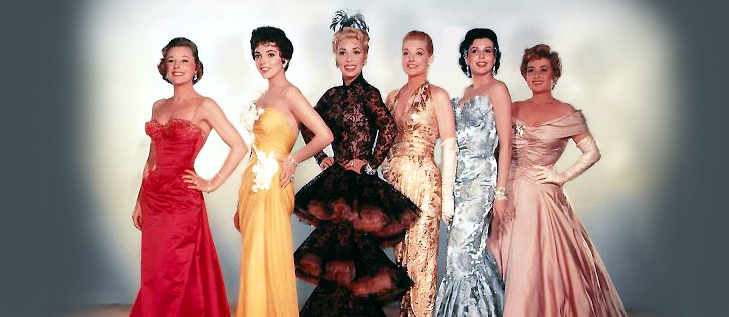


 We review plenty of genre product here, thrillers of all kinds — but CineSavant is just as intrigued by squaresville movies ( → ) even when made by a studio in denial. Who in 1956 still cared about MGM’s ‘tradition of quality?’ In terms of current trends and PC values The Opposite Sex might as well be ‘In The Tradition’ of the Lawrence Welk show. Yet it’s going to fascinate film fans interested in how the Golden Age dissolved into Iron Pyrite. The exciting, fun acting talent was ready to roll in an industry now making half the number of films they did just a few years before.
Vincente Minnelli’s pictures remained the flagships of MGM’s ‘quality’ product but the studio’s in-house producer Joe Pasternak continued to make big-star CinemaScope and Metrocolor entertainments as well. He even found a way to finish Party Girl in the middle of a music strike. The Opposite Sex is more or less the last hurrah, feature film-wise, for a score of name actresses from two previous decades of film fame.

The show is a musical remake of the 1939 MGM classic The Women, a clever, wildly dated comedy soap about a society wife (Norma Shearer) defending her home against a husband-stealer (Joan Crawford). The behind-the-scenes ‘secret’ was that the two actresses hated each other as much as do their characters on screen. The epitome of White Telephone MGM filmmaking, The Women is both easy to admire (the catty actresses are fun to watch) and to resent (playwright Clare Boothe Luce’s politics). Part of the concept was that we never see the men worshipped by these non-working, pampered Manhattan housewives. They spend their days shopping or spreading vile gossip at the beauty parlor. Consensus U.S. culture in 1939 could make working-class women dream about the privileges of these Park Avenue lizards, that live like… like movie stars.
Even with several added musical numbers Fay and Michael Kanin’s adaptation is ten minutes shorter than the original. It also writes the husbands and boyfriends back into the story, to debatable effect. The main characters now have a show biz background. Although the gender politics are no less primitive than in the first version The Opposite Sex is still fun thanks to its parade of lively star personalities.

Upscale New Yorker Kay Hilliard (June Allyson) seems to have everything. Her husband Steve (Leslie Nielsen) produces Broadway musicals. She has a sweet daughter Debbie (Sandy Descher) and spends her days with several close friends. Faithful, principled Amanda Penrose is a novelist (Ann Sheridan), forever-pregnant Edith Potter (Joan Blondell) means well and the nosy Sylvia Fowler (Dolores Gray) is a terrible gossip. But Kay is the last to know when the word gets around that her husband is stepping out with one of his showgirls, Crystal Allen (Joan Collins). Kay ends up in a Reno dude ranch, meeting fellow divorcee Gloria Dahl (Ann Miller) and dodging the advances of cowboy Buck Winston (Jeff Richards). Amanda shows up to give Kay moral support but Steven has already decided to marry Crystal Allen. Sylvia arrives for her own sudden divorce only to discover that her husband’s new flame is Gloria Dahl. Back in New York, Kay rekindles her singing career and withdraws from the social scene — until she discovers the truth about Crystal Allen from her own daughter Debbie. Yes, the dialogue line about new nail polish ‘Jungle Red’ is here, to herald Kay’s catty counter-attack.
I find The Opposite Sex more enjoyable than the original because of its lineup of favorite personalities. These women are still neck deep in oppressive double-standard politics, although some do pursue a profession. It’s stressed that Crystal Allen is motivated not by love but the desire to trade the hard-labor trenches of show biz for the bubble bath life of luxurious Park Avenue. Crystal discusses her economic dilemma with her girlfriend Pat, played by the wonderful Carolyn Jones (age 26). I will watch anything with Carolyn Jones. She’d been getting special attention for several years, always in standout parts but without a real breakthrough. It finally came as TV’s Morticia Addams — an immortal role but a career dead end.

The ‘how to save your marriage’ advice is just as oppressive as in the ’39 version. This new batch of husbands and wives still aren’t open and honest with each other, and suffer the sad misfortune of crossed messages. Steven apparently ‘got out of line’ just once, an episode Crystal exploits to the hilt, refusing to accept Steven’s kiss-off flowers. Just like Lulu Schön, Crystal precipitates a backstage blowup to wreck a home and claim her man.
But the message is that all of this is Kay’s fault for not trusting Steven unconditionally. Amanda warns Kay not to fall into Crystal’s trap, that it is wiser to ignore her husband’s extramarital affairs. I know more than a few women that would see nothing amusing about this paternalistic worldview. Clare Boothe’s original concept is pretty oppressive: the most privileged women in America live in luxurious bubbles, but their mates are mostly absent.
In the first version the husbands were worshipped from afar like invisible gods. The new batch are nonentities. Leslie Nielsen’s Steven is a polite, clueless tower of jelly. The actor’s career was just getting up speed; perhaps some 1956 viewers caught The Opposite Sex on a double bill with Nielsen’s Forbidden Planet.

This appears to be June Allyson’s show all the way. Allyson’s dancing was basic and her voice just adequate, but her bright personality and a winning smile was more than enough for MGM’s wartime musicals. She was distinctive and honest as the ideal postwar wife, the marriage partner poised to help her hubby in business (Executive Suite), show biz (The Glenn Miller Story) or the defense of the country (The McConnell Story, Strategic Air Command). The odd-June-out show is surely the MIA drama The Shrike, in which June’s missus-from-hell would make Lady Macbeth shrink in horror.
For The Opposite Sex Allyson sings and dances in ‘Scope and Perspecta stereo. Her duet with bandleader Harry James for a WW2 USO flashback (‘Young Man With a Horn’), is a nearly exact repeat of their scene in MGM’s Two Girls and a Sailor (1944). Allyson’s voice for a romantic song is dubbed extremely well by Jo Ann Greer, who performed the same task for Kim Novak, Gloria Grahame and Rita Hayworth. June then waxes sexy (?) in the overproduced showcase number ‘Now Baby Now.’ The scaffold set background reminds us a bit of Jailhouse Rock, and the orchestration and choreography seem an unpleasant blend of Dinah Shore poses and burlesque moves. The sultry sex angle doesn’t fit Allyson’s screen personality but it’s obvious that she wishes it did. At age 39, she was only four movies away from the end of her career as a leading lady.

Joan Collins was just 23 at the time and already in the second wave of her career, taking a first crack at Hollywood. She would later re-invent her ‘fabulous star’ brand at least two more times. Joan is great in this role, bouncing nasty one-liners off of Carolyn Jones. Her snappy accent is a big plus as well when she makes certain words drip with hauteur. I think that Ms. Collins’ star cooled due to too many so-so dramas and not enough musical comedies. Her dancing is a highlight of Seven Thieves and her comic skills are still the main reason to see Rally ‘Round the Flag, Boys. She is always dazzling and a great deal of fun.
In the 1939 The Women we like it when Joan Crawford’s evil plan is thwarted. But the moment that Collins’ bubble is burst, we feel sorry for her — all Crystal needed was a few lessons on not being so offensively nasty.
Next up on the favorites list, the class act Ann Sheridan comes with good memories and associations — Kings Row, Nora Prentiss, Woman on the Run. So true friends do exist — Sheridan’s Amanda Penrose is a loyal confidante and advisor who knows when to speak up and when to stay mum. They weren’t kidding about the short working life of Hollywood actresses, as this was Sheridan’s next-to-last feature, at the young age of 41.
The Ann Miller we see is 33. In some shots Miller appears to tower over the other women; she’s likely strong enough to lift any of them over her head. The surprise is that The Opposite Sex is a musical yet Ann Miller doesn’t dance. That makes no sense until we remember the star pecking order — June Allyson surely knew that if Miller were allowed to perform she’d steal the whole show. Ann Miller’s last big-screen dancing may have been in Hit the Deck (1955).
Of the older actresses Agnes Moorehead looks great at 56 and would still look terrific a decade later on TV’s Bewitched. Joan Blondell was a bit younger (49) but her career had cooled at about the same time that Moorehead’s was getting going. Blondell had been Dick Powell’s wife before June Allyson, which gives her presence a parallel with the movie’s Kay-Crystal dynamic. We’re not privvy to the real personality dynamics, but I imagine that the pro actresses were above such petty matters.
Until repertory theaters and DVDs showed us The Gang’s All Here and Flying High we only knew the great Charlotte Greenwood from Oklahoma! This is her final feature, at age 66; taking over the role previously played by Marjorie Main.

In a special category for this viewer is Dolores Gray, a terrific actress-comedienne who starred in four MGM pictures made in a row — It’s Always Fair Weather, Kismet, this show and Designing Woman. Ms. Gray could turn on the glamour or just as easily transform herself into a caricature suitable for a Tex Avery cartoon. The original Sylvia Fowler was Rosalind Russell, who had to strain to seem so slimy; Dolores Gray makes the same malice seem fun, delightful. If Gray had sung more than the title tune she’d have buried June Allyson as well.
I have no idea what exact connection earned Dick Shawn a disposable comedy showcase, but we get a chance to glom Joan and Carolyn again, so no harm done. Elsewhere there are guest appearances by Harry James, Jim Backus and a woefully underused Sam Levene. We’re told that Barrie Chase — Dick Shawn’s later co-star in It’s a Mad Mad Mad Mad World — is one of the dancers. We’re also told that the pair of legs seen behind the main title belong to none other than Leslie Parrish.
The film’s thankless role goes to the skilled comedienne Alice Pearce, whose gossipy manicurist Olga represents the servant underclass that dotes on the scandals of her customers. The beauty spa workers in the 1939 original had their own sisterhood guild with its own cynical code of honor. Olga isn’t even very funny and is presented more as a stupid menace. Pearce was a terrific talent and obviously a very strong personality — how many women could make a career out of so boldly playing ‘awkward’ and ‘unattractive?’

Jeff Richards was an earnest ball player in Robert Aldrich’s The Big Leaguer and able but anonymous as one of the Seven Brides for Seven Brothers. He’s good as Buck Winston, seducer of insecure divorcees. I don’t know if it’s Richards’ own voice we hear but he puts the final song ‘Rock and Roll Tumbleweed’ over well enough to convince as a quasi-parody of Elvis Presley. Some of the most desperate MGM musical numbers in the next year or so would strain to incorporate Rock’n’Roll. But the debut of ‘Buck Winston’ was outshone by Elvis Presley himself: his first movie Love Me Tender opened in New York on the same day as The Opposite Sex.
Richard’s unsolicited make-out onslaught in the canoe would today be classified as attempted rape. The scene never feels right because Ms. Allyson’s nice-nice film persona is the type that would intuit and derail Buck’s intent long before a petting party could commence. Allyson never shed the squeaky-clean image … all those kids she bore in those ’50s movies could have been immaculate conceptions. My bias on this was formed by dating teenaged girls in the late 1960s: more than one mother was the June Allyson type, and could have been cheerleaders in 1949. They were still vivacious and in great shape — and they smilingly scrutinized me as if I were a potential disease. Perhaps those forty-something women intuited that I was more dangerous than I looked.
That’s the legacy of June Allyson, all right, perky crinkly smiles and razor sharp instincts.

