

“Put the Mask on NOW! Put the Mask on NOW!”
Wow! Continuing the quest to bring worthy vintage 3-D attractions to the home screen, the 3-D Archive has rejuvenated one of the big depth titles, a horror shocker filmed independently in Canada. We’ve all heard about the picture, many of us through a highly influential magazine-book from 1985, Incredibly Strange Films.

Then in 1991, the magazine Filmfax printed Craig Hamilton’s in-depth article on the film, which incorporates an interview with the director of The Mask, Julian Roffman. The excellent article corrects some apocryphal stories about the film’s making, while making it seem even more unique.
I wish that the home video industry would take note that independent boutique labels are doing much of the heavy lifting to promote older pictures, and getting good results. Hollywood has already partly smothered the present theatrical 3-D craze by glutting the market with bad fake 3-D presentations, and by doing little to explore the possibilities of the format. They let the press stomp on Peter Jackson’s laudable investigation of higher frame-rate projection. Meanwhile, home video fans with economical 3-D setups of excellent quality, are seeing great 3-D that’s every bit as effective as what’s offered in theaters. I guess we’ll have to wait until James Cameron’s innovative Avatar sequels make 3-D interesting again.
Canadian Julian Roffman spent a lifetime in instructional films, government-sponsored filmmaking and television work. His second attempt at a commercial feature exploits an easily understood horror premise. A precious ancient Mayan mask possesses whoever wears it, turning them into a mad killer ostensibly taking blood sacrifices for some extinct diety. Larry Cohen added a political dimension to this premise for his later Q The Winged Serpent, a bizarre monster-movie critique of organized religion. Roffman’s writers keep things simple.
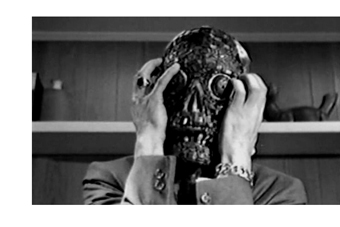
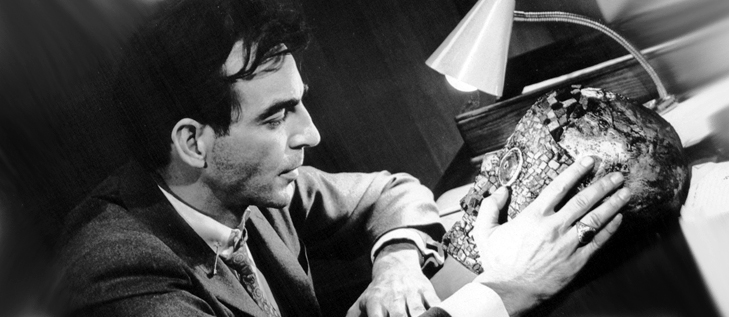
Psychiatrist Allan Barnes (Paul Stevens) is upset when his disturbed patient Michael Radin (Martin Lavut) commits suicide. He feels he could have done more to help the young man. Radin told Barnes about a horror-mask that was compelling him to murder, a claim that Barnes too hastily dismissed. A few days after the suicide, police Lieutenant Martin (Bill Walker) visits Paul, to ask about a real mask that Michael Radin was working on for a museum, an ancient Central American ritual artifact. It so happened that Martin mailed the mask to Barnes just before he died. Barnes ignores the warnings of his fianceé Pam (Claudette Nevins). Instead of taking the strange object to the cops, he tries it on in private, just to see what happens. He’s immediately projected into a parallel dimension of horror ruled by demonic magic and ritual sacrifices. A ‘phantom Radin’ is there, along with other ghostly phantasms.
What follows is a rather schizophrenic movie that alternates between a (now) tame serial killer story, and stunningly vivid dream-hallucination sequences. In the wraparound part of the movie, Radin is shown stalking one victim in a nighttime sequence that predates most ‘giallo’ style murder-machine movies. Roffman even uses wide angle shots to mimic the point of view of the unseen pursuer. The actors, especially Paul Stevens, are more than capable. Dr. Barnes’ transformation into a killer makes him a werewolf-like sympathetic victim, an involuntary monster, at least at the beginning. The framing story obliges us to spend time on extraneous story elements, most distractingly an unintentionally funny police investigation. The detective and Barnes’ fianceé share a couple of overdone, not particularly relevant interview scenes. We’re more concerned that Barnes will murder his secretary Miss Goodrich (Anne Collings), who is in love with him as well.
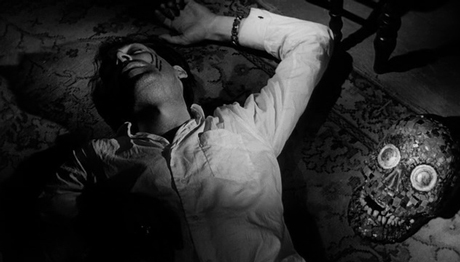
The movie’s thin characterizations do not reduce interest in its central ‘magic’ icon, the evil mask. Whenever Dr. Barnes is in contact with the mask, the movie’s surface tension shoots skyward. The mask is a crude but credible-looking art object studded with tiny mosaic tiles. It just plain looks scary, and when Barnes puts it on it’s even scarier. It reminds us of the masks in a couple of Twilight Zone episodes that become serious bad news for their wearers. Ditto the horrifying demonic mask in the Japanese shocker Onibaba. Roffman’s movie begins with a bogus lecture by a man named Jim Moran, who tells us he collects masks from around the world. Although almost as suspicious as Dr. Frank C. Baxter’s laughably loony opening lecture tacked onto the beginning of Universal’s The Mole People, Moran’s speech does make us think about the function of ritual tribal masks, which are some of the oldest known human artifacts.

Sci-fi author Philip K. Dick wrote stories in which the intake of a particular drug does more than deliver a psychedelic experience — one’s mind and being are invaded and changed forever. In the must-read book The Three Stigmata of Palmer Eldritch, the maker of the drug has complete control over the consciousness of whoever takes even a taste of it. From then on ‘reality’ is never the same. Dr. Barnes goes through the exact same loss of control, a surrender to a malign external power. The mask makes him want to voyage into chaos; he’s a genuine surreal explorer in the realm of the marvelous.
The legendary 3-D sequences in The Mask are more than worth the price of admission. They’re really quite unique. At three places in the story the obsessed psychiatrist is compelled by a phantom voice that commands him to “Put the Mask on NOW! Put the Mask on NOW!” The movie audience follows suit with their 3-D viewers, and participates in a trio of hyper-real 3-D hallucination scenes. Vincent Price’s character in 1959’s The Tingler actually drops LSD in one scene, and communicated the experience through over-the-top acting. The Mask takes the audience right into the acid nightmare. What we see is a great fun-fair spook ride version of a trip to Hell.
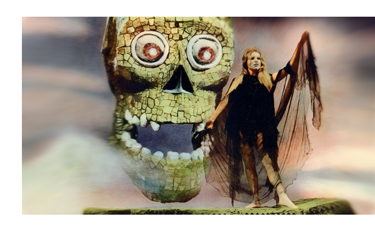
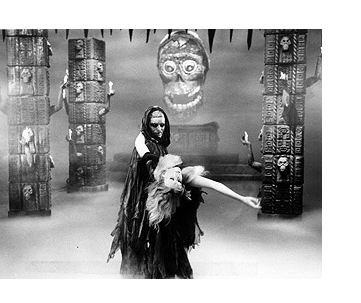
The 3-D dream hallucination sequences have little connection to the framing story, but that doesn’t turn out to be a problem. We’re told that Barnes is exploring the dark secrets of his own subconscious, which sounds like a lot of hooey — he’s transported to an alternate dimension of evil, with spooky forests and hellish rivers, all covered by thick ground fog. The damned souls he finds there wear wax masks that turn them into strange puppet people: a creature that corresponds to Radin, a long-haired blonde woman who becomes a sacrificial victim, and a trio of masked demonic priests.
The 3-D in this Hell is spectacularly effective. Barnes’ first hallucination sees his office transformed into a fogbound passage to a haunted grotto. Strange atmospheric patterns, also in 3-D, are superimposed. The effects are not photo-real, but have a stage magic, Méliès camera-trick quality about them, with plenty of tacky, artificial effects. Eyes dominate the imagery. Floating eyeballs rush the camera and disembodied orbs fill the empty sockets of grinning skulls. Corny rubber snakes strike at us from the eye sockets of another skull. The eye of one demon hangs halfway down his cheek, an unusually grotesque effect for 1961.
Barnes’ adventures in the Demon Zone are broken into three parts, that so dominate the movie that viewers don’t realize that they account for less than fifteen minutes of screen time. We make a dreamlike progression through the underworld to an ancient temple where a giant version of the skull mask hovers over a sacrificial altar. Hands transform into claws that hurl fireballs at the audience. None of it makes a bit of sense but everything is a surprise. It’s like a carnival ride.
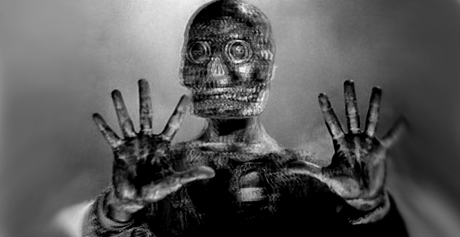
I attended a 35mm theatrical revival of the film about a month ago. The audience was amused by the dated 2-D framing story, and jolted to attention when the 3-D scenes arrived. This was the same reaction we got at a 16mm 3-D screening at a UCLA Halloween marathon back in 1972. Roffman’s hard cuts to and from the nightmare 3-D sections are very well done, and garnered applause every time. It’s like a William Castle gimmick with substance.
I’d class The Mask somewhere between a worthy curiosity and a major kick. There’s nothing else quite like it, although John Parker’s more artful Dementia has a similar extended-nightmare quality. The oddball fun-fair horror visuals exploit 3-D in a way that other 3-D pictures don’t, because the depth environment with its spooky visuals take over the whole show. Everybody’s intrigued by the strange images.
The Electro-Magic sound refers not to an audio format but to the experimental music. The ‘tonalities’ heard in the dream sequences now sound familiar, but in 1961 very little like them had been heard… synthesized music didn’t enter the mainstream for several years. The main composer Louis Applebaum did several scores for big Hollywood pictures, but the electronic music was concocted by Myron Schaefer.
“You will be taken to the hidden recesses of the human mind!”
It’s too bad that Kino Classics’ disc of The Mask couldn’t be released just a month earlier, for there never was a more apt Halloween show. It’s like Disney’s Haunted Mansion but with nightmare visions less humorous/nostalgic and more surreal/campy. It fulfills every huckster’s promises for a spook extravaganza. This is what promoter William Castle should have moved on to, when the studios cooled on his ‘Emergo’ and ‘Percepto’ gimmicks.
Craig Hamilton’s Filmfax article fills in a wealth of detail. The 3-D rig was imported from London, where it was first used to produce a 3-D film for The Festival of Britain in 1951. Prominently billed montage expert Slavko Vorkapich only did some preliminary planning for the picture, little if any of which was used. Roffman said that the concepts were too strange and impractical to achieve on a reasonable budget. Instead, Roffman collaborated with English and Hollywood experts, namely one James B. Gordon, an optical expert who had been laid off by 20th Fox. The movie was pre-sold in a bidding war between Paramount and Warners, and original prints carry a Warners’ logo. Because the term “3-D” meant failure to the industry in 1961 — exhibitors had long ago ripped out the expensive dual-projection systems that saw little use — Warners dubbed the process “Depth Dimension.” Original theatrical release prints were in the red-green anaglyphic system that required no special projection. The Mask was reissued in 1967 and 1971 as Eyes of Hell.
My own snooping at the Academy turned up more information. Variety praised the film for attempting theatrical 3-D at a time when the format was all but extinct. The trade paper’s ’61 review even describes the movie using the words ‘acid trip.’ Actor Paul Stevens was then known only for a role in Otto Preminger’s Exodus; he’s now best remembered as George C. Scott’s aide-de-camp in Franklin Schaffner’s Patton, made nine years later. Jim Moran, the prologue’s ‘mask expert,’ was just a creative publicist. A columnist attributes to him flackery exploits that sound wildly exaggerated. For The Egg and I he reportedly sat on an egg for 23 days, and for The Third Man he claimed to have bought 183 zithers that didn’t sell. For The Mouse that Roared he supposedly attended a diplomatic function dressed as an ambassador from the Duchy of Grand Fenwick.
We don’t need this info to guess that Moran’s padding-prologue for the beginning of The Mask is pure baloney. Art director and designer Slavko Vorkapich had to be paid whether he worked or not, which is why the production used his name in the credits. He’s been wrongly credited ever since with the effects for The Mask. Optical expert James Gordon contributed to the class-act effects pictures Journey to the Center of the Earth, It’s a Mad, Mad, Mad, Mad World, The Fly (1958), and The Great Race. He won an engineering award from the Academy for figuring out a means by which ‘scope movies could be reformatted for flat presentations … which I’m going to guess means the Pan-and-Scan process.