
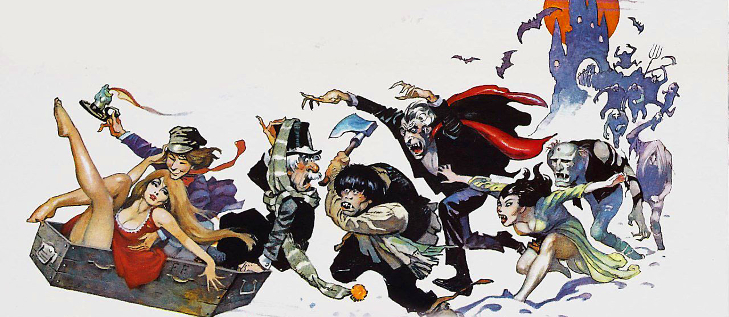


Oh no, not another ‘personal favorite’ review. It’s been a good year for those.
Roman Polanski was the first contemporary filmmaker that this film school student thought was a God, whose pictures were literally perfect. Two Men and a Wardrobe was the perfect abstract student film. The incredibly vivid book adaptation Rosemary’s Baby evoked a serious dread of the supernatural better than anything made before, even Night / Curse of the Demon. Roman Polanski’s Dance of the Vampires was well-received in Europe and especially in France, where he was already regarded as a world-class director for Knife in the Water, Repulsion and Cul-de-Sac. Perhaps Polanski misread the mainstream appeal of horror, but in any case MGM decided that his absurdist sense of comedy just didn’t play. Producer Martin Ransohoff and MGM’s supervising editor Margaret Booth decided on their own to recut, redub and revise Dance of the Vampires into what they thought would be a more marketable item. They changed the title to The Fearless Vampire Killers, adding the line “or: Pardon Me, But Your Teeth Are in My Neck.” Was that done in imitation of Doctor Strangelove, to indicate a comedy?

The chopped-down (by twenty minutes!) American version of The Fearless Vampire Killers blew me away on Halloween, 1970. It was at a midnight screening in Westwood hosted by the Count Dracula Society’s Dr. Donald Reed. With his squeaky voice, the eccentric but amiable Reed made most of the crowd think he was part of a joke. I don’t think many in the audience had seen The Fearless Vampire Killers previously. There was strange vibe in the house. We were all aware of the Sharon Tate murder, and the Manson/LaBianca trial was in session, with the prosecution still presenting its case. When Sharon Tate’s image came up on the large Regent Theater screen, a loud sad ‘ahhh’ was heard. I hadn’t seen any of Tate’s movies, and there she was looking incredibly alive, with red hair and freckles. She first appears opposite her husband — who had been demonized in the tabloids as a satanist responsible for her death.

Film students back then doted on movie books. After the Hitchcock/Truffaut interview book, the next ‘bible’ for me was 1970’s The Cinema of Roman Polanski by Ivan Butler. Halloween ’71 saw me renting Vampire Killers, Mario Bava’s Black Sunday and Roger Vadim’s Blood and Roses to show to a big crowd at UCLA’s Sproul Hall, where we had CinemaScope 16mm projection. But it would be a full seven years before MGM struck and circulated repertory prints of Polanski’s original, full-length ‘Dance of the Vampires’ cut. It was a revelation, like seeing Casablanca for the tenth time, except that it suddenly has six new, important scenes.
Perhaps the relatively expensive The Fearless Vampire Killers never had a chance in the U.S., commercially. Horror films were not exactly booming in 1967, when vampire pictures meant Hammer Films and Christopher Lee. Although popular enough, the theme wasn’t upscale mainstream fare, not at all. Hammer would sell its next big U.S. horror releases (in 1969) with campy ad campaigns. The director of photography Douglas Slocombe complained that his crew thought the movie ‘old-fashioned nonsense.’ This may have been the first time Polanski worked in a full-scale union situation, with crews motivated mainly by a paycheck. But I bet they thought,’why would MGM spend this kind of money on a down-market Hammer subject?’
If you want to understand this movie, just think:
It’s Into the Woods, except minus hope or happy endings. Plus lots of snow.
Tell people they’re going to see a horror comedy and they’ll expect funny-ha ha spoofery, as in Abbott & Costello Meet Frankenstein. Ransohoff’s mutilation of Dance of the Vampires begins with a completely unnecessary animated cartoon sequence explaining vampire lore to an audience that grew up watching Bela Lugosi on TV. The cartoon makes us expect It’s a Mad Mad Mad Mad World– styled slapstick. Polanski’s film has some of that, but in a unique context that’s half fairy-tale, half-nightmare. The quirky comedy gives us gloomy satire and oddly uncomfortable situations.
The show is too faithful to the spirit of horror to be merely a spoof. The plotline is similar to that of Hammer’s The Kiss of the Vampire, if Franz Kafka had decided to make a comedy. The original opening is 100% weird: the MGM Lion suddenly morphs into an un-funny green goblin. An animated drop of blood anoints the playful title credits, which unspool over an icy blue moon, a frozen, dead world. The transition to the first live-action shot is an incredibly beautiful faux-3D graphic effect. From the first frame Polanski demonstrates a full command of the screen.

Professor Abronsius (celebrated Irish actor Jack Macgowran) comes to Transylvania with his disciple Alfred (Roman Polanski) to uncover proof of vampirism. A goofy academic whose crackpot ideas have lost him his seat at the University, Abronsius is delighted to see the inn of Shagal (Alfie Bass) covered in garlic. Although the locals won’t listen to talk of vampires, the monstrous Count Von Krolock (Ferdy Mayne) descends from his castle and seizes Shagal’s beautiful daughter Sara (Sharon Tate). Already smitten by Sara, the timid Alfred is motivated to follow his master to the snowbound castle, and to challenge the horrors within.
If you haven’t figured it out by now, this review is a bald-faced advocacy piece. The fact that some people dislike this movie shouldn’t keep me up nights, except that so few have had the chance to see it properly. Fearless looks amazing — it’s awash in lavish sets, terrific mood lighting and Christopher Komeda music that frequently chills the blood. Fearless tries to be a lot of things. Beyond the Hammer connection, it’s the payoff movie for a subgenre of ‘corridor wandering’ Italo pictures, the kind with Barbara Steele or Daliah Lavi. The art direction is astonishing. Matte paintings evoke a fairy-tale wonderland in a landscape of lifeless snow. Picture-postcard views are accompanied by howling wolves; a tapestry depicts a Brueghel-like vista of an apocalyptic plague, where the dead make war on the living.

Polanski’s genre-highlight moments transcend Hammer at every turn: calm vampire faces suddenly turn feral and distorted when the fangs come out. Ferdy Mayne’s Count Von Krolock doesn’t compete with Bela Lugosi or Christopher Lee but instead strikes forth with an original aristocratic monster. When Mayne is singled out in comic effects –licking his teeth in anticipation of a feast — it’s only another expression of entitled arrogance; he might as well be a billionaire on a golf course. His undead parasite race sees mankind as a free buffet. It’s what we’d have if the 1% had a taste for blood.

I once broke off a friendship over the charge that The Fearless Vampire Killers is anti-Semitic in its depiction of Alfie Bass’s innkeeper Shagal (whose presentation, Ivan Butler wrote, is styled somewhat after paintings by Marc Chagal). I think this part of the movie, with its Jewish jokes and accents, is more affectionate than anything else. Shagal the innkeeper is a less sentimental Tevye the Dairyman. It’s a very Polanski interpretation: poverty and ignorance produce groveling peasants, not poets. Shagal is a crude man but he loves his daughter so much that he overcomes his willful denial of vampires to set out alone to bring her back. That Shagal himself becomes a vampire fiend could well be Polanski’s opinion of the absurdity of sentiment in 20th Century Eastern Europe — the worst of which Polanski experienced personally.
Alfred and Professor Abronsius make a hopelessly defeatist pair of Vampire Hunters. Alfred barely understands the mission and has no stomach for the necessary violence. Abronsius is an enlightened idiot, a genius who intuits the existence of sonar in bats yet can’t see beyond his nose. He is surrounded by superstitious peasants who pay him no heed, and he has zero persuasion skills. Worse, he’s status-minded, eager to fawn and toady before rich nobles like Von Krolock. He’s too easily distracted by Von Krolock’s lavish library. His lousy sense of priorities blows the whole mission: while their precious window of opportunity fades, Abronsius wastes time stargazing through the Count’s telescope. The irony is that Von Krolock offers Abronsius what he wants: an eternity of free time to study in that library, away from those morons at Koenigsberg University. That’s a really cruel vision of academia.

Abronsius waxes poetic over the beauty of a sunset, oblivious to the fact that his assistant Alfred is risking his life to carry him across a snowy castle wall. That single image encapsulates Polanski’s short subject The Fat and the Lean. Alfred’s ineffectual Kafka-like hero shrinks from confrontations. He’s the kind of non-assertive male figure that American audiences won’t abide. He is the one to wander the corridors in search of the source of a Marni Nixon-like wailing voice. By the time Alfred is in a position to rescue his beloved Sara most of his efforts are too little, too late. In some of the film’s funniest material, poor Alfred is too surprised to fully comprehend the interest that Von Krolock’s ‘sensitive’ son Herbert (Iain Quarrier) has for him. Is Fearless also anti-Gay? I hope not.


By now fans realize that Polanski is also quoting imagery from classic horror cinema, something that would go over the heads of 99% of the 1967 audience. Abronsius’ rather crazy appearance is based on Jan Hieronimko’s doctor from Carl Theodor Dreyer’s 1932 Vampyr (→). Alfred’s odd getup with the short pants and frock coat is patterned on Gustav von Waggenheim’s Hutter in F.W. Murnau’s Nosferatu, based on Bram Stoker’s character Jonathan Harker (←).
Polanski adds other visual references as well. In the final chase scenes our heroes flee down some zig-zagging railed castle stairs that remind me of the expressionist art direction in The Cabinet of Dr. Caligari, a view of a fun fair. The bits of sped-up ‘fractured flickers’ action were not added by Ransohoff and MGM, but were part of Polanski’s original film, a nod to Murnau’s use of under-cranking in Nosferatu. As in odd silent expressionist fantasies, inanimate objects seem to come to life. Abronsius’s bag of weapons flees from the grasp of junior Vampire Killer Alfred (Polanski), and even their skis beat an exit after delivering them to the castle gates.
Fearless looks incredible. The beautiful snowbound castle is the opposite of Jon Finch’s muddy, cramped castle in Polanski’s Macbeth, but is just as detailed and convincing. It appears to combine well-chosen locations in the Italian Alps with excellent studio work back in London. The interior appointments include a House of Usher– like portrait gallery of horrid Von Krolock ancestors. One scene involves a doorway blocked by a large wardrobe cabinet, an odd recurring theme in early Polanski movies. A cabinet blocking an unused hallway is a major part of Rosemary’s Baby — and the shock is that it’s in the book, too. Polanski’s masterful Tess bears a visual relationship to Fearless. A ‘gratuitous’ scene in a barn pans slowly over large cheeses hung dripping from the ceiling. The atmosphere imparted is all-powerful: Tess Durbeyfield is STUCK in the 19th century with zero options. The same kind of camera motion in Fearless glides over cobwebbed doorways and arches outside Alfred’s room. The wailing voices of Christopher Komeda’s music seem to say, ‘this is how it is and how it always will be, and you’ll be part of it soon.’

The movie’s wonders continue — a giant minuet ball is executed with exacting grace and style (it’s apparently the content that Polanski’s crew thought was a waste of time), and concludes with a mirror gag that takes us utterly by surprise. That absurd but nightmarish sight cues a vampire riot. There might be precedents, but the closest thing to Polanski’s mirror gag that I’ve seen is in Francis Coppola’s Peggy Sue Got Married, where it’s so slick that it slips by many viewers. Near the finish, Alfred and the Professor finally strike back with some good anti-vampire maneuvers, improvising a cannon and crossing swords to produce a crucifix. Peter Cushing would applaud.

The Fearless Vampire Killers’ odd tone blurs the line between funny and appalling. Shagal sneaks sex breaks with his scullery maid Magda (Fiona Lewis); his luck improves only after he becomes one of the undead: “Oi! Have you got the wrong vampire!” Sharon Tate’s Sara is an innocent comic plaything until bitten, after which she hides her neck wounds to deceive her admirer Alfred. Then she’s given a startling entrance as the Grand Prize in a gothic vampire happening, standing proud before a coven of blood-lusting ghouls. Elsewhere the movie makes us contemplate the horrid existence of undead corpse-vampires. The high-angle shot of an entire graveyard ‘coming to life’ is more expressive than anything in the Universal and Hammer libraries. The uncanny image of Shagal pulling Magda into a grave with him is unsettling on several levels. When we bury our dead, we naturally dream of them lying underground in the cold, asking why they’ve been abandoned.
As is almost always the case, Polanski finds the one exact place for the camera to be for every shot. The camera moves constantly yet feels invisible — it mirrors our curious eye, not the will of a dictatorial director. I only see one tiny editorial misstep in the whole movie. When the vampires come out of the castle at the finish, we see a shot of them backing up slowly, intimidated by something off-screen. A shot of the sun about to rise must have been intended to answer that question, but for whatever reason it’s not there.
The Fearless Vampire Killers again expresses Polanski’s extreme pessimism about the human condition. The representatives of knowledge, goodness and virtue are disorganized, timid, and distracted by self-destructive pride and jealousies; no protective coalition can result. The vampires of this world, on the other hand, are a coordinated monolith with clear goals, eager to plunder and destroy and murder. In Polanski’s view the powerful, wealthy and politically ruthless will always triumph. No scruples prevent them from spreading their evil unchecked.

