

![Viavision [Imprint] 193](https://cinesavant.com/wp-content/uploads/2022/05/6750imprint0522.png)
Massive multi-character action epics didn’t disappear in the 1970s, but they did lose momentum. The Eagle Has Landed is a World War II ‘what if’ combat fantasy in line with pop novelist Alistair MacLean’s stock in trade. This impressive two-disc Blu-ray offers two separate versions of the film, neither of which was apparently what American moviegoers saw on screens in 1976. If our information is correct, the original theatrical cut was 11 minutes shorter than the shorter cut shown here. We watched the much longer extended cut. It isn’t promoted as a premiere, but the 2013 Shout Factory disc appears to have been a shorter version.
Although sometimes listed otherwise, [Imprint’s] disc is Region Free.
It’s not about Apollo 11.
Studios usually want one version of a show, if only to keep inventory-keeping simple and sane. The history of Eagle suggests that the filmmakers couldn’t make up their minds about much more than that, from square one forward. One studio apparently withdrew its finances because the story presents the German insurgents as positive, motivated heroes. The final product doesn’t change that. Mankiewicz sketches some of his characters quite well, and his incidental and expository dialogues are excellent. But he was the main creative talent responsible for turning James Bond into a comedian — he can’t resist awful comic relief with a clownish American commander.

Some roles are glaringly miscast. Nobody insists that every part be played by someone with the correct national identity, or that correct languages be used with subtitles — Fred Zinnemann’s excellent The Day of the Jackal is a terrific success, even with every Frenchman speaking in English. But a couple of the casting decisions just take us out of the picture . . . Quentin Tarantino surely had movies like The Eagle Has Landed in mind when concocting his purposely artificial war movie satire/fantasy Inglourious Basterds.
The Extended version viewed begins with text titles telling us that half of what we’re seeing is true to history. The true half can’t be more than the fact that there was a war going on. In 1943 the Reich is already beginning to lose, and Hitler’s close associates are finding it difficult to follow his increasingly demented instructions. Hitler tells the SS chief Heinrich Himmler (Donald Pleasance of The Great Escape) to have commandos kidnap Prime Minister Winston Churchill.
Intelligence chief Admiral Wilhelm Canaris (Anthony Quayle of Ice Cold in Alex) wants to stall until the Führer has forgotten his crackpot kidnap idea, so Himmler assigns Colonel Radl (Robert Duvall) to do a feasibility study. The ‘covering one’s tail’ exercise becomes a real mission when Radl discovers that Churchill’s itinerary has scheduled a tour of the English coastline . . . where a small group of paratroops could indeed grab him. Himmler gives Radl the okay to proceed in secret.

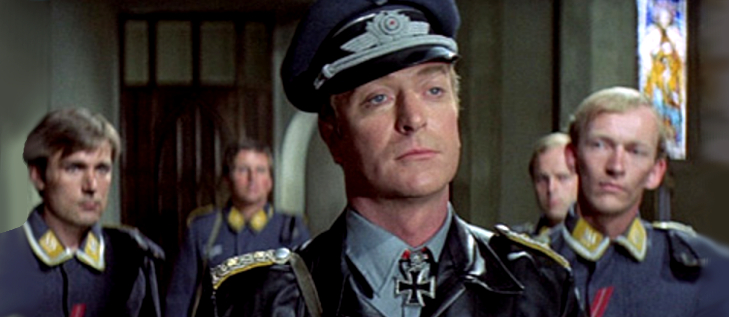
Radl springs 12 commandos from special detention to do the job. They’re led by Col. Kurt Steiner (Michael Caine), whose insubordination in Poland earned death sentences for his entire paratroop unit. Already established in the target English town is the Nazi agent Joanna Grey (Jean Marsh of Unearthly Stranger), whose parents were anti-Brit Boers. Steiner’s closest aide is Liam Devlin (Donald Sutherland), an I.R.A. patriot helping the Germans in anticipation of a united Ireland after an English defeat.
The commandos arrive disguised as Free Polish troops on maneuvers. The unsuspecting locals include Father Vereker (John Standing of King Rat) and his daughter Pamela (Judy Geeson of 10 Rillington Place). A company of American Rangers are stationed not far away, led by the emotional Col. Clarence E. Pitts (Larry Hagman of Fail Safe), and his much more competent assistant Captain Harry Clark (Treat Williams of 1941).

The resourceful Liam Devlin makes no mistakes but can’t stop a frisky local, 19-year-old Molly Prior (Jenny Agutter) from falling in love with him. She almost catches Liam hiding stolen vehicles and reporting to Col. Radl on his wireless; in keeping Molly occupied he falls in love himself. The Germans and English traitors seem to have things well in hand — where will the caper go wrong?

Escapist impossible-mission thrillers like Where Eagles Dare charm us with bright characters, fun casting and entertainingly outrageous action set pieces. The Eagle Has Landed is more realistic, yet some of its characters don’t seem to believe what they’re doing. It ought to generate a lot more suspense.
The cast certainly has marquee value. The celebrated Anthony Quayle is stuck in a fairly minor role, as a not-too-convincing German. On the other hand Donald Pleasance is superb as Heinrich Himmler, a bureaucrat-rat without equal. → Yet clumsy direction and editing muffs the reveal of Himmler’s big double-cross of Robert Duvall’s character.
The excellent but woefully miscast Robert Duvall sticks out like a sore thumb. His Col. Radl has an eyepatch and gloved hand, making him look like a Nazi in a Mel Brooks movie. Duvall is of course not at all bad — Mankiewicz’s script gives everybody good dialogue to say and good business to perform. But we never really believe Col. Radl on the simple action-thriller level that the story requires.

Michael Caine’s Wehrmacht officer carries the movie against all odds. His Col. Steiner begins as an un-accented German. He then assumes the part of an English officer, with an accent shift, and then masquerades briefly as a Yank GI, altering his voice once more. Caine’s performance is of course quite good, but must strain his skills (shouting at a general, etc.) to maintain credibility.
The least ruthless-when-cornered enemy Germans ever.
Caine must have been concerned about his screen image, as his combat commander is established as a ‘nice German’ and is not shown personally harming a single English or American enemy. In an egregious act of Protecting the Star, the screenplay has Caine’s Steiner rescue an escaping Jewish prisoner. He then threatens an SS general, knowing he’ll be arrested and sentenced to death. Later on during the raid, he prioritizes the safety of one child over his mission. Steiner and his paratroops have 4 or 5 successful paratroop raids on their record, yet seem above the ugly realities of combat in the German army. Perhaps they’re from the branch of the Wehrmacht that later became The Peace Corps.
After nicely setting up the daring mission (in the long version, at least) Eagle doesn’t maximize the story’s potential for excitement. The infiltration of the English town feels too casual. The misstep that puts the mission in jeopardy dissipates the tension, and the subsequent counterattack by Larry Hagman’s clumsy Colonel Pitts becomes a slaughter that leaves us rooting for the wrong team. One character discovers that Donald Sutherland is a traitor — but then disappears for most of a reel. We’re left wondering what they’re up to, and worrying that we missed something. The brave woman played by Judy Geeson is positively heroic in her actions — almost all of which are kept off-screen.
In the most blatant example of amateurish storytelling, 30 seconds are devoted early on to establish a tunnel between the church and Father Vereker’s house. Hmmmm — do you think that tunnel might become vital during the battle? It really didn’t need to be shown until the last second, at which point the audience would have applauded the cleverness of Judy Geeson’s heroine.

The German insurgents perform most of Eagle’s heroic, self-sacrificing, above-the-call-of-duty acts. Were the filmmakers instructed to make the story villain-free, so as to insure its marketability in Germany? Caine’s kidnap squad is always humane and honorable; they cover the entire Boy Scout credo save for Thrifty, Clean and Reverent. Eagle even lets Caine’s Steiner succeed in his mission — before the heavy foot of irony intrudes.
I would imagine that German audiences would love this movie, in the same way that Japanese audiences reportedly enjoyed the Pearl Harbor docudrama Tora! Tora! Tora! — in both shows the sneaky aggressors are courageous, bold, and resourceful.
The Eagle Has Landed can’t help but entertain — Michael Caine is always a safe bet. We also have Donald Pleasance to enjoy, along with a nice turn from Jean Marsh. This was Treat Williams’ third movie. His Captain Clark is the only competent armed defender, and he does great considering that his Rangers are up against such an experienced enemy. But John Sturges’ direction doesn’t build up Captain Clark’s valor. Even in the ‘ironic’ denoument, the Captain needs everything to be explained to him.
Sutherland and Agutter can do no wrong.
The real reason I’ll watch the show again is to see the excellent work of Donald Sutherland and Jenny Agutter. Even in the rush of incident, their scenes are tender and convincing, atypical qualities for a Tom Mankiewicz script. Sutherland’s Liam Devlin is no fanatic. He has a poet’s heart but also a total commitment to the I.R.A.. The charming spy has a grin for every occasion, whether joking with Colonel Radl or ingratiating himself with the English locals.

Agutter establishes her ‘ready for the right guy’ attitude right from the get-go, and the script and direction play their mutual seduction with admirable skill. Is the dialogue from the book? Theirs is the only relationship given enough time to build to something. The distraction of an irate local creep doesn’t distract — it gives Donald Sutherland an opportunity to pull off a well-staged fisticuffs scene. Only Sutherland and Donald Pleasance find a perfect fit with the amusing-serious tone of the escapist WW2 caper genre.
Biographer Glenn Lovell points out lapses in John Sturges’ attention to detail, a complaint lodged against much of his work after The Great Escape. The filming was very slow, and when told to fix the problem Sturges reportedly dropped script pages. We believe a story told by editor Anne V. Coates — when the time came to edit Donald Pleasance’s double-cross of Robert Duvall, Coates found that no reaction shot of Duvall had been filmed, leaving no payoff to his entire character arc.
We also wonder if the lack of tension in the film’s final act should be blamed on the direction, or on decisions in the editing room. When time is of the essence, the action slows for character bits, expressions of loyalty, etc.. We don’t see all the continuity problems others have, but there’s a howler at the finale. A rather poor matte painting shows the German escape boat run aground in an ebb tide. Maybe that garbled telegram was supposed to explain what happened to the escapees — again off screen — but it didn’t seem very clear on a first pass.
It’s unfair to judge The Eagle Has Landed by ‘what could have been’ when it’s better than so many other clichéd wartime thrillers. It isn’t aways satisfying, but it is more mature than most. Its intended audience would likely not have complained. The interesting cast gives it their best, even if we can’t fathom anybody thinking that Robert Duvall’s one-eyed German would work on screen.
