
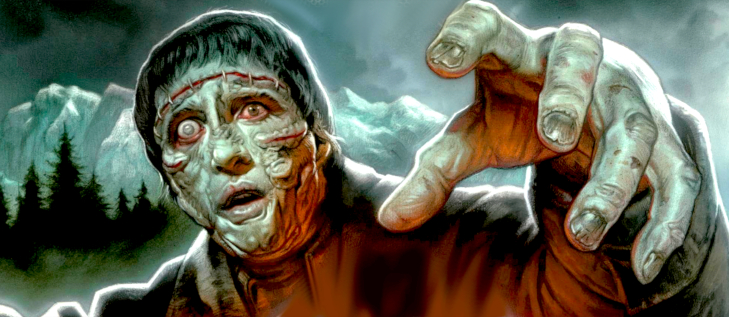


The ‘new’ Hammer Films is busy with pricey monster box releases of various Hammer classics. The one we’ve so far been most enthused about personally is Quatermass 2, but this month brings Hammer’s first smash hit, an historical benchmark for horror. As explained in the disc extras, Hammer shares rights for The Curse of Frankenstein with Warner Brothers, which released it in the U.S. in 1957. WB actually holds the original negative on this title. Rather than dispute the issue, Hammer and The Warner Archive cooperated on a new digital restoration. The film materials for the show, including a set of color separations, were scanned in the U.S. The balance of the work was done in England.
What do I tell people to expect of this Brit movie, made back when 80% of today’s horror fans weren’t yet alive? Well, it’s a very traditional, almost sedate experience … until the screen starts throwing weirdness at us, some of which can still disturb folks not completely dulled by modern ultra-violence. Chris Lee’s pasty-faced Creature is six feet four inches of open wounds. He looks very unhappy, very disoriented. Peter Cushing’s mad doctor is a condescending conniver … but studiously polite. He’s irresistible.
What made this picture seem so fresh in 1957? Horror movies took a ten-year break after WW2, and the few that were made were in B&W. Censorship held back content that had scandalized the bluenoses back in the pre-Code days. Hammer’s colorful horrors thrilled audiences and scandalized critics. They displayed grotesque makeups and bright red blood; they didn’t shy away from extreme violence. The Curse of Frankenstein and (Horror of) Dracula did big business as export items, igniting an international wave of horror production.
This reviewer was too young to even be aware of the very first Hammer offerings, but we saw The Mummy first run and were blown away. Around 1964 we were floored by the Frankenstein-Dracula double bill; regular updates from Famous Monsters of Filmland magazine kept us current on the filmic output from Hammer. For our generation the acting duo of Peter Cushing and Christopher Lee was as powerful as Boris Karloff and Bela Lugosi.

Orphaned but wealthy, the young Baron Victor Frankenstein (Melvyn Hayes) hires a tutor, Paul Krempe (Robert Urquhart) and with him spends a decade exploring science, medicine, and the forbidden secrets of life. After reviving a dead dog Victor shifts his attention to giving life to a man assembled from random corpses. Paul is dismayed by Victor’s lack of moral boundaries. He eventually turns against the obsessive quest, but when Victor’s fiancée Elizabeth (Hazel Court) comes to live in the house, Paul stays to protect her. Thanks to an accident with a murdered professor’s brain, the newly-revived Creature (Christopher Lee) is both ugly and mentally crippled. It escapes and commits more killings before Paul slays it with a shotgun. Returning three months later to celebrate Victor’s wedding, Paul finds that the Creature has been resurrected yet again. Victor has been performing more brain surgery on it, and he intends to continue his vile experiments.
Audiences worldwide loved the new combination of crimson gore in bright Eastmancolor. Severed heads, hands, eyes, and brains drip and ooze on cue. Embellished with choice sound effects, Peter Cushing’s fine physical mime makes us feel every action in his unseen decapitation of a corpse. The cool Hammer Guignol continues as Frankenstein carries the head to his conveniently located acid bath, the ideal lab feature for tidying up unwanted viscera and disposing of potential murder evidence. And everyone knows the rule governing acid baths in horror movies — show one in the first act, and you’d better put it to good use in the third. Someone tell the critics that the movie does show some proper restraint — two male victims are dissolved in Victor’s acid bath, but Hammer drew the line at showing Victor disposing of a woman’s body that way. *

No dialogue, no gallantry, no singing … Chris Lee must really have wanted this role.
Having been made before any partnership between Hammer and Universal, this first Frankenstein picture was careful to avoid similarities with the original Karloff makeup design. Christopher Lee’s Creature is completely different from the jar-headed, electrode-wired ghoul copyrighted by the Laemmles a quarter century before. Phil Leakey’s pasty-white makeup indeed looks like a nightmare, covering Chris Lee’s head with nasty scars from the gibbet crows. Lee’s mime is terrific, adding considerable pathos. He’s killed twice. The first on-screen slaying is a shotgun blast to the face. It still shocks — gun and victim are in the same frame.
The violence is unusually strong throughout the picture. The other I-can’t-believe-I-just-saw-that moment is a fatal fall from a balcony onto a tile floor. It’s done in one cut and shown from an angle that hides nothing — the stuntman falls directly on his head. It gets a big audience reaction whenever it’s shown. We see the floor flex a bit on impact, but we still wonder how the stunt artist didn’t break his neck.

Hammer’s early Gothics gave us a terrific group of heroines in distress. Hazel Court is a fine choice for the first Hammer leading lady in color. Her lovely Elizabeth ignores all the bad vibes in Frankenstein’s Swiss chalet. She idles (for months?) waiting for wedding bells, establishing Hammer’s reputation for abundant cleavage. One or two of Court’s costumes appear to have been altered (or simply had a flower added) to tone things down a bit. Robert Urquhart’s Paul is a wishy-washy Man of Conscience. He never acts on his knowledge of Victor’s crimes. He repeatedly asks Elizabeth to run away with him, but is too gentlemanly (?) to share the information she needs to make such a decision. One hint of the abominations going on in the upstairs lab would have Liz packing her bags in a big hurry.
Valerie Gaunt’s maid Justine is also in for gratuitous sex appeal. She serves victim duty while establishing the Baron as a despicable cad. Her midnight prowl into the lab, perhaps seeking a way to blackmail her employer, is a beautiful bit of Gothic ‘corridor wandering.’ Hammer rewarded the actress with an unforgettable role in their followup Dracula picture.
For the arrogant Victor, the ambition to play God negates the rights of others — he commits murders to obtain a brain, and also to eliminate a troublesome maid. The disc commentators are right, Curse creates tension by never fully condemning the Baron, despite his refusal to accept responsibility for his multiple felonies. Paul persists in believing that his pupil / sponsor is basically sane and fundamentally good. Since Peter Cushing’s performance emphasizes Victor’s scientific brilliance, other vices were needed to confirm him as a villain deserving of punishment.
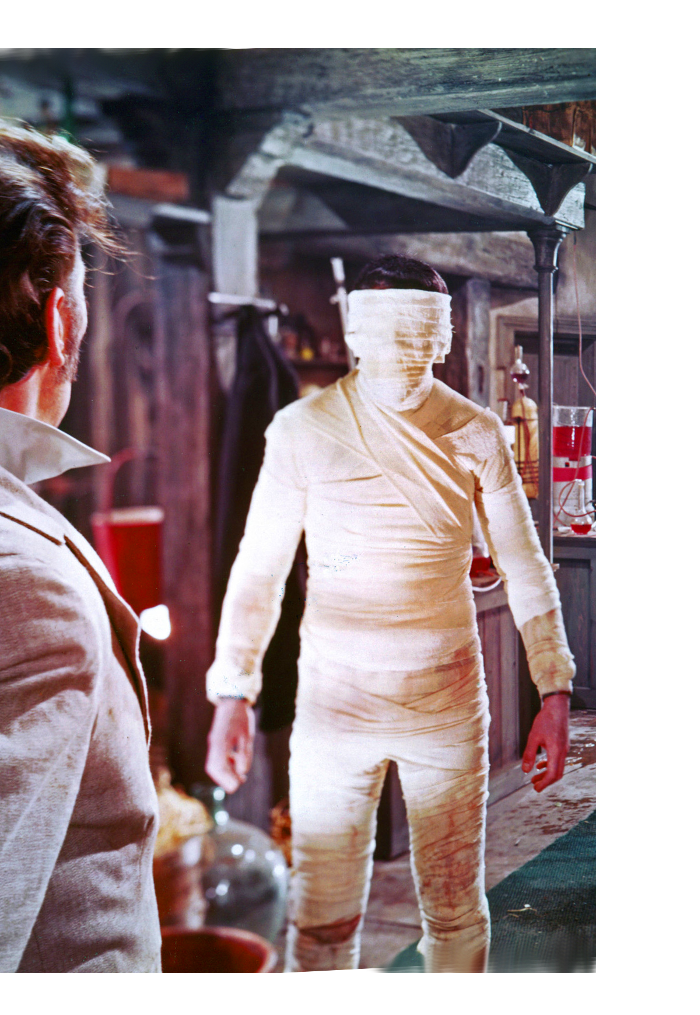
For 1957, these were ‘dangerous ideas.’
Frankenstein’s Creature looks like he was fed into a wood chipper, but his brain is supposed to be that of a kindly professor, just cut up a bit. The Creature’s first act is to attempt to kill Victor — is the old professor taking revenge? After the added complication of a shotgun hit to the head, the Creature seems relatively subdued — until he sees the Baron on the castle rampart. Boris Karloff’s monster was likened to an unloved child, seeking approval. Christopher Lee’s monster is no more and no less than a tortured human guinea pig. He does make a couple of pathetic gestures for help. But when he reaches out to strangle people, he seems to know exactly what he’s doing.
Terence Fisher disguises his lean budget by setting up several well-blocked one-setup scenes. In place of a standard Gothic Corridor, Frankenstein’s Swiss chalet features various stairways to reach his mad lab, high in the attic — everybody climbs it at least once, floor by floor. But Fisher doesn’t rush his core material — we are taken in by Paul and Victor’s enthusiasm, and mesmerized whenever the Creature is on screen. The unmasking scene is a classic, a stunner that never fails to surprise.
The story resolution is a grim puzzle, a cruel joke played on Victor Frankenstein. Up on the roof rampart, Elizabeth never actually sees the Creature — her back is already turned when it grabs her from behind. The odd staging has Elizabeth almost immediately struck by Victor’s bullet. That’s why she can honestly back up Paul’s claim that there never was a monster, that Victor murdered Justine. Elizabeth believes her husband shot her on purpose.
“Keep your spiritual comfort for those that need it.”
Director Fisher’s commitment to the material extends to the flashback bookends in Victor’s death-row cell. Paul Krempe’s final actions are a deceitful coverup to sidestep his personal complicity. He coldly abandons Victor; he has apparently told Elizabeth a false story about their experiments. Viewers forget that The Curse of Frankenstein’s new horror sensations were accompanied by a darker, more adult attitude toward morality — one free of church homilies. Victor begs for mercy, but he doesn’t pray for mercy. Peter Cushing grabs us with his portrayal of the desperate Baron at the end of his rope . . . or blade.
One reason the early Hammer films so impressed us kids is that they took themselves so seriously. The A.I.P. pictures and even some of Roger Corman’s had a sense of self-awareness that eventually lapsed into self-parody. Some titles had jokes in their titles — teenage werewolves and Frankensteins. Even Disney spoofed the trend in his The Shaggy Dog ‘Mainstream’ horror films were in danger of becoming harmless fun.
I certainly don’t believe the heightened violence and blood were bad for us. Remember that us ’50s kids thought that heavy blows to the head only knocked people out for a few minutes. Bullets fired by heroes killed cleanly, while Bad Guy guns produced ‘harmless’ flesh wounds. Hammer’s acknowledgement of pain and trauma threw back a curtain from previously forbidden movie content. Anything was now possible — horror movies no longer had to restrict gory details to dialogue descriptions, or shamefully cut away from their own core subject matter. Hammer’s Gothic thrills were more than just the Latest Exploitation Kick. A worldwide renaissance of screen horror was begun.


To answer your question, Curse is the movie the Hazes and Humbert are watching at the drive-in in Lolita.
Well done! Take anything from the top shelf.