

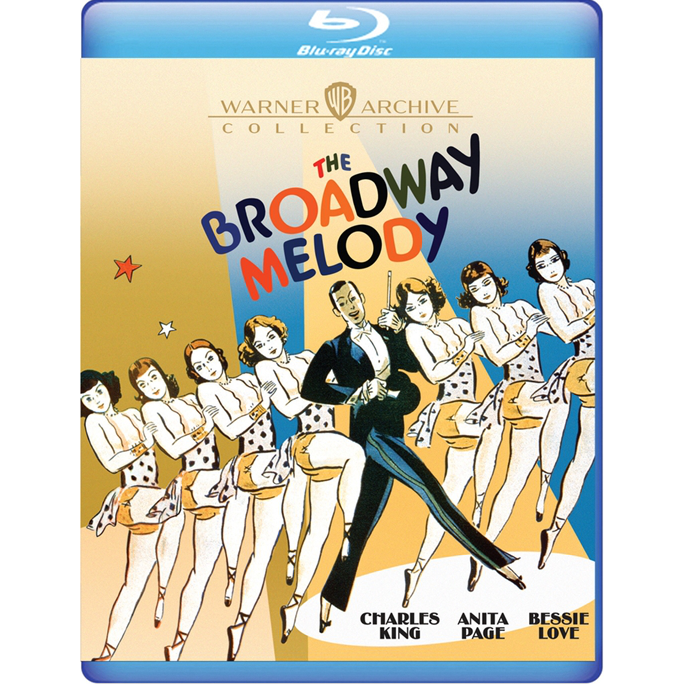

It’s as if somebody peeled 94 years from the calendar and returned us to the birth of musical movies. The Broadway Melody (of 1929) is the genuine article, the first all-talking, -singing and -dancing musical of the sound era … and it won a best picture Oscar as well. The staging and the acting are as creaky as can be, but the film does have the zing of a killer title song. A happy singer pitches it to the mezzanine seats … about four times.
A Warners laserdisc arrived in the 1990s, and a 2005 DVD was a great improvement on it. This new encoding, a 4K scan given a reverent digital brush-up, looks and sounds sensational. More on the video miracle below.
Songwriter & performer Eddie Kearns (Charles King) has a hit new song, and he wants it included in Mr. Zanfield’s new musical. Sensing that the time is right, he summons his girlfriend Hank Mahoney and her sister Queenie (Bessie Love & Anita Page) to audition their sister act for the big impresario. Hank thinks they’re a hit but finds out that Zanfield hired them on the basis of Queenie’s looks. Worse yet, Queenie and Eddie soon realize they’re in love and don’t know how to give the bad news to Hank. Queenie reacts in the only way she knows, by returning the dishonorable attentions of the wealthy ladykiller Jacques (Jock) Warriner (Kenneth Thompson). Will backstage tragedy be averted?

Genuine vintage patter: “Hot Dog!” “Screw!” “Hotsy tot!”
It’s 1929 and we expect the audio recording to be primitive. But the recording (and editing) capabilities have sprung way forward in just two years or so since the part-talkie The Jazz Singer. We see Nacio Herb Brown and Arthur Freed trying out a new song in a music publisher’s crowded office, with various performers raising a racket from all sides. Right off the top, Charles King does an impromptu rendition of the title tune, the classic most of us know from Singin’ in the Rain twenty-three years later. Other songs that were resurrected for the 1952 Singin’ in the Rain are The Wedding of the Painted Doll, You Were Meant for Me and You are My Lucky Star. Starting with some aerials of lower Manhattan and Times Square, The Broadway Melody gives us a peek at the public image of show biz in an enthusiastic era. The Broadway Melody premiered just a couple of weeks before the St. Valentine’s Day Massacre, and just a few months before the stock market crash that plunged the world into an economic Depression.
All of the audio recording appears to have been done live on the sets, putting The Broadway Melody in the minority of American films where the performances are being done live as we see them. Those sets look none too sturdy. Footsteps echo loudly and doors really clunk when closed. All are missing the fourth wall, and the camera always stays on the same side of the action.

Director Harry Beaumont stages most of the film is flatly, but his actors, as they say, ‘give it their all.’ The chorines’ dancing routines are on the tepid side, and with only a couple of exceptions the dances are staged in a very small space. Bessie Love (of The Lost World) is the smart member of the sister act and MGM star Anita Page the dumb pretty one. Their act looks hopelessly corny. It’s hard to tell how we’re meant to take their dancing. Page and Love appear to be doing their best but not naturally graceful. Were both movie-born stars, not transplants from the stage? The exodus of New York stage talent to Hollywood was just beginning.
The sisters’ high point is a cute attempt at the song The Boy Friend. They sing it rather squeakily (with the requisite ukelele), sort-of keeping time together. Then Love goes into a klunkily desperate tap that makes Ruby Keeler look like Ginger Rogers. It’s also fun hearing them speak all the latest ‘smart’ patter, like “Hotsy tot.” At one point Besse turns irately to another character and says loudly, “Don’t be a cheapscake, Screw!” (pronounced “Scah-roo!”). It’s a big surprise — we have to assume it meant the same thing then as it does now. Actually, “Screw!” had a second meaning, “Get lost!”

Most every cliché of the backstage musical is already fully developed. One member of the act falls in love with the other’s fiancée, which remains a source of concern throughout. Queenie gets her big break when the top showgirl falls from her perch to the stage below, with a heavy KA-LUNK! on the audio track. Stage door Johnnies are always there to harass the showgirls. Queenie is given an apartment and a diamond bracelet by her rich lothario, who cooly announces that he’s spending the night.

With his authentic background, vaudevillian Charles King is probably the best thing in the movie. Bessie Love is okay, but both she and Anita Page seem to be overmodulating to register on the mikes. Some of Page’s lines are pretty horribly overacted, but since she’s supposed to be a ditzy showgirl little harm is done. Jed Prouty does a stammering routine as the girls’ agent, and Drew Demorest is the (natch) swishy costumer, fawning over a fancy fur. William Demarest (The Miracle of Morgan’s Creek) was once rumored to be in there too, but Savant didn’t spot him.
The music publisher is played by James Gleason of Here Comes Mr. Jordan and The Night of the Hunter, and he also is given a credit for dialogue. Gleason wrote a number of movies in the 1930s, and also tried his hand as a director. If I’m looking at the right guy on screen, ‘Jimmy’ Gleason was as bald in 1929 as he would be in his later movies.
My producer on a 2001 documentary on Joan Crawford videotaped an interview with the star Anita Page. She was then only 81, and several years before had been filmed for some TCM reportage. It was only on the set that the producer discovered that Ms. Page was in an advanced stage of dementia, perhaps Alzheimer’s. Her makeup was decent enough, and she sat listening with a sweet smile. But once on camera, she couldn’t understand a question or connect three words together. An answer to a question about Joan Crawford, given after a big pause, was one word: “Yundee.” The producer had to feed her phrases and individual words, which I dutifully cut together. But we got to work with the legendary Anita Page!
Now we need to check out the WAC’s new Blu-ray of Our Dancing Daughters starring Page and Crawford. The disc is said to be an even more eye-opening remaster-restoration.

The “Squeezed shot” in the New York montage was lost for many years until found in a 16MM print, and re-inserted into the film. If you watch closely the DVD opening, you’ll hear that the sound is off on the DVD. In fact, you’ll hear a whistle over the skyline of NY which, when viewd on the new Blu Ray, shows it actually comes from a policeman.