



The Bravados is just the kind of western America liked in the late 1950s, a big, bold and violent show with name stars and not too many big ideas. It’s late-career work by Henry King that betters several troubled or difficult productions. It can boast sensationally expressive Mexican locations, even by western standards. Gregory Peck does well in a difficult role, mainly by ignoring subtleties and playing his cowpoke-out-for-vengeance stiff and straight. Joan Collins’ supporting part is respectable; producer Herbert B. Swope Jr. casts the rest of the show from the cream of actors then working for Fox.
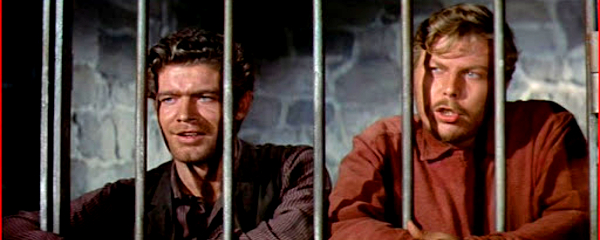
The film benefits from a story with clean lines and some halfway good surprises. After robbing a bank and killing a guard, four criminals have been captured in the small border town of Rio Arriba: the murderous Bill Zachary and Ed Taylor (Stephen Boyd & Albert Salmi), the ‘half breed’ crook Alfonso Parral (Lee Van Cleef), and a ‘shifty Indian’, Lujan (Henry Silva). They’re due to hang in the morning, and the town’s Sheriff Sanchez (Herbert Rudley of Decoy) is afraid that confederates may come to break them out. While Rio Arriba waits for the hangman Simms (Joe DeRita), in rides the grim, taciturn Jim Douglass (Gregory Peck). He says he wants to see the men hang. Jim wins the confidence of the Sheriff and drinks a beer with Simms, and shares an uncomfortable exchange with Josefa Velarde (Joan Collins), a local woman who once turned down his proposal of marriage. Learning that Jim is now married, Josefa excuses herself quickly, but later returns to invite him to attend church with her. The criminals escape during the services, kidnapping young Emma Steinmetz (Kathleen Gallant) on their way out. Her distraught father and frantic boyfriend (George Voscovec & Barry Coe) rush to pursue, and Jim ends up advising an ad hoc posse. The Padre (Andrew Duggan) tells Josefa why Jim is so intent on finding and killing the four men: they raped and murdered his wife, on his ranch about a hundred miles away.

The Bravados indeed delivers what fans want from high-class westerns, the ones labeled ‘adult’ for their emphasis on psychologically complex characterizations. Gregory Peck’s vengeance-seeker is really just a more motivated ‘man’s gotta do’ oater hero, and what critics called inexpressiveness in Peck’s acting benefits a character hiding his emotions and motivations. The four bad-guy bandits are neither self-destructing psychos nor misunderstood martyrs. They make reasonable escape decisions and for the most part stick together. Each even volunteers to stay behind to slow up the posse. Peck’s Douglass knows enough to outmaneuver their tricks, and he of course catches up with them one by one.
The screwy thing is that, when cornered, none of the villains cops to having harmed Douglass’s wife. Douglass waves a cameo watch in their faces, but none reacts as if caught up in a lie. A similar setup was later used in Sergio Leone’s For a Few Dollars More, adding an interesting musical element.

And that’s the trick aspect of Philip Yordan’s script, from Frank O’Rourke’s story. If you haven’t seen The Bravados, skip down to beyond the next horizontal line, because I’m about to go into a series of SPOILERS, while looking at the film’s irrational, sanctimonious and surely Production Code- approved ‘moral’ lesson.
The gag is that none of these men had anything to do with the atrocity visited on Jim Douglass’s wife. Convinced they are guilty, and unmoved by their pleas for mercy, Jim doesn’t stay his killing hand. In a genre that normally endorses vigilante action, because the villains are so easy to recognize, The Bravados makes a big deal of Jim’s anguish and remorse at having usurped The Lord’s prerogative regarding vengeance. It even looks as though he spares the fourth bad guy, on the basis that the man has a wife and baby, the same as Jim.
None of this seems rational. Rio Arriba is set up to be so moral that everybody — the whole place — attends mass at night. The district can’t be a total backwater, because the Catholic church is quite a beauty, practically a cathedral. These upstanding citizens want these bandits dead, and went to the trouble of sending away for a hangman to do the job legally. Although two of the men are likely the actual killers — and one of them surely a rapist as well — ALL are guilty of murder, including Mr. Innocent at the finish. He’s just profited mightily from another killing that he had a hand in. Jim Douglass’s hand-wringing seems either inconsistent or hypocritical, as he’s carried out the lawful execution that a just society has already mandated.
Was he some peacenik who otherwise wouldn’t raise a hand to defend his neighbors? Even if they don’t condone violence, westerns almost never heap criticism on ‘accidental heroes.’ Its mostly a genre of apology, as in River of No Return, when little Tommy Rettig blows away the bad guy about to kill his father, Robert Mitchum. In The Man Who Shot Liberty Valance, James Stewart’s senator feels uncomfortable because he didn’t blow away the notorious title outlaw.

There’s something unpleasantly ‘Hollywood’ about the moral whitewash given Jim Douglass at the finale of The Bravados. Jim ought to be wearing a halo. He goes from cold killer to ‘gee I didn’t mean it,’ and the immediate consequence is being given the Key to the City. Not only is he cheered by the town, he picks up a ready-and-willing new wife, one sexier than anything this side of the Pecos, pilgrim. Joan Collins’ Josefa is a little flaky as well. She preaches peace and maternal understanding until she comes across the aftermath of a rape, at which point she goes ballistic and screams instructions for Jim to kill ’em all, ASAP. Josefa is definitely from the Grace Kelly school of shifting moral positions.
Critic Philip French thought that ‘fifties westerns took very obvious political stands that aligned with trends in American foreign policy. Seen in that light, The Bravados is an apology for whatever violence good Americans need to do, here or across the border, to Keep Things Decent. Don’t worry about messy details or who gets hurt, because You Can Do No Wrong. We like it that you’re a stone killer who strikes first and sorts out the moral issues later; even if you kill for the wrong reasons, your enemies are our enemies, and you’ll be doing no wrong. Your family will always be here for you. Another beautiful woman will be waiting if something happens to the one ya got.

SPOILERS CONCLUDED. Henry King and his cameraman Leon Shamroy clearly enjoyed staging what amount to some nearly perfect widescreen action scenes on a series of impressive, dramatic Mexican locations. Wherever this borderland is, it’s a place of deep gorges and dynamic cliffs, and impressive vistas that stretch to the horizon. The scenes have ‘visual economy’ — we just ‘know’ where people are in relationship to each other, without extra cutaways or expository dialogue. Some of the killings happen off screen, yet their impact isn’t diminished. We aren’t given the impression that anything has been being censored. We even don’t mind the obligatory scene of the imperiled hostage woman spinning to escape her attacker, to show that her back is bare and that her rapist means business. It feels right, not exploitative.
The movie really looks good, but the social setting is a little screwy for a border town in … Texas, likely. Rio Arriba is all Catholic and many of the names are Latino, but most of the speaking parts are played by Anglos. Joan Collins is striking in her black mantilla, but she’s as far from a Señorita of the day than one can imagine, what with her clipped accent.
Another quibble — Jim knows that the fugitives are fleeing in the direction of the Douglass ranch, but he isn’t concerned that they’re returning to the scene of the crime, and that his daughter might be in danger.

With its beautiful Mexican locations, The Bravados doesn’t look like yet another oater filmed on one of the same five western street sets. The drama benefits mightily from the presence of actors cast beneath their abilities, yet applying themselves at full strength. Fox had difficulty getting the handsome, talented Stephen Boyd to click with audiences; he would become immortal as the supporting villain in a massive Biblical epic. The expressive stage actor Albert Salmi never found his movie footing, really, but he’s good in The Brothers Karamazov, Elia Kazan’s Wild River and John Huston’s The Unforgiven. Lee Van Cleef tended to be stiff when he had a lot of lines, but under director King he delivers what might be his most emotionally successful scene.How often do we sympathize with a Van Cleef character? He’d go right back to playing squinting, rattlesnake- like killers.
This show gives us Henry Silva at his best, before he became a charter member of the Rat Pack. The actor also comes across as deeper and more soulful than usual, without histrionic tricks. We suspect that Silva’s Lujan has more bad deeds in his past, despite having that handsome family back home. If The Bravados were really daring, it would allow Lujan to form a bond of trust with Jim Douglass — after all, it’s a wild country, and men sometimes have to kill for different reasons. We’re not surprised that the show doesn’t even show us how Jim and Lujan part company.

Doing rather well in a straight role is Joe DeRita, who is best known, if not celebrated, as Curly Joe in the last phase of the Three Stooges’ career. His casting is particularly shrewd: fans who know who he is will be less likely to question what his character is doing.
Favorite Gene Evens has only a brief role. Kathleen Gallant is great as the hostage but didn’t stay in the biz all that much longer; it looks like the actress can really ride. Andrew Duggan is the most Anglo- looking ‘Padre’ I’ve yet seen. He’s a questionably unethical priest, seeing as how he divulges Jim’s personal and private backstory to Josefa.
The sheriff is the best role I’ve seen Herbert Rudley play. Ten years before in his noir pictures he was usually stuck in some pompous or awkward part. The sheriff comes across as a solid guy, and even performs the best quick draw action in the show — especially so, considering he’s just been knifed in the back. In bits we’ve got The Searchers’ Beulah Archuletta as a waitress, and the familiar-faced Juan García as a deputy. García should strike up memories for those who know Robert Aldrich’s Vera Cruz — he’s the ‘Pedro’ that Burt Lancaster orders to keep playing the guitar, in a tense face-off. María Gracia, who plays Peck’s little girl, would soon star in a series of Mexican films as a cute Caperucita Roja — Little Red Riding Hood.
Here's TFH Fearless Leader Joe Dante on The Bravados:

