
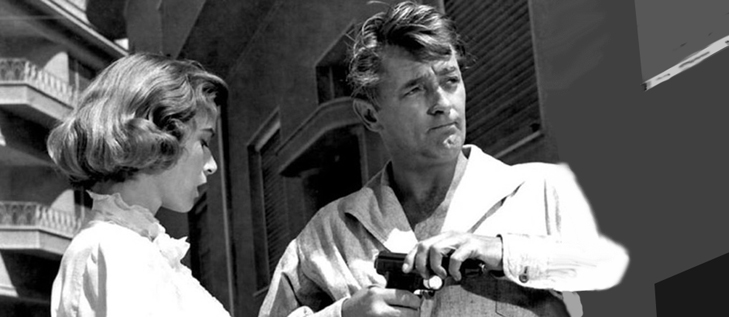


Director Robert Aldrich had come through with successes for Burt Lancaster’s production company (Apache, Vera Cruz) and found modest success with Victor Saville and his own ‘Associates and Aldrich’ company before trying to make the grade as a director for Columbia, under Harry Cohn. But his second picture for Harry Cohn, The Garment Jungle, ran into trouble over arguments about Aldrich’s depiction of the New York mob. Aldrich was pulled from the picture but held to his contract while Cohn would not okay another film for him to direct — he was also pulled from directing duties on the upcoming 3:10 to Yuma. Various biographers emphasize Aldrich’s resistance to Cohn’s orders, while others state that Cohn belatedly discovered that the unsparing depiction of a vile, venal studio chief in Aldrich’s earlier Hollywood esposé The Big Knife, was a direct smear on Cohn himself.

Unable to work in the United States, Robert Aldrich went into the wilderness of English and European filmmaking, which for him was an exile of more creative frustration. Made for Hammer Films on location in Berlin, Aldrich’s ‘explosive’ bomb-disposal saga Ten Seconds to Hell would appear to be a perfect men-under-pressure picture for Aldrich, but it’s a dud marred by overacting. What remains doesn’t make us feel that the director’s much longer original cut would have been any better. Hammer sat on the film for so long, that the next Aldrich picture came out first.
Aldrich went directly into his next picture, for MGM through former exhibitor and independent producer Raymond Stross. From a novel by Leon Uris, The Angry Hills is a wartime espionage thriller set among Greek partisans and Gestapo informers. It sounds like an ideal project for Aldrich, and it also had what sounded like the perfect Aldrich tough-guy hero, Robert Mitchum.

In 1941 Athens, American newpaper correspondent Michael Morrison (Robert Mitchum) wants out of the country fast, as the invading Germans are set to arrive at any time. But the resistance leader Dr. Stergio (Donald Wolfit) tricks Morrison into safeguarding a list of Greek resistance leaders, with the idea that he’ll take it with him back to the spymasters in London. Unfortunately, the collaborator Tassos (Theodore Bikel) tells the new Gestapo leader Konrad Heisler (Stanley Baker) about the list. After a struggle with Tassos, Mike barely escapes the Gestapos agents. He hides out in a little village, where the young Greek woman Eleftheria (Gia Scala) takes care of him. Her brother Andreas (Kieron Moore) accompanies Mike on a raid for weapons, but they’ve been betrayed by a counterspy.

Most of the group is wiped out and Mike is forced to hide in a convent. After missing his target again, Heisler follows the suggestion of his commander Oberg (Marius Goring) and uses his former lover, Lisa Kyriakides (Elisabeth Mueller) to set a trap for Morrison. She has no choice because Heisler and Oberg threaten the lives of her two young children. But Heisler is made uncomfortable, because he knows that Lisa is surely forming a relationship with the man she must betray. Lisa is indeed unable to carry out her mission at first, and sees to it that the American escapes once more. Finally realizing that he’s in a fight he can’t walk away from, Mike gets ready to gun down Heisler in broad daylight, and to hell with the consequences.
What sounds like an exciting movie is something less than that. As reported by Aldrich, this show apparently didn’t excite Robert Mitchum because he walks through it. It makes sense, as the cynical Michael Morrison flubs things from the start and makes what are obviously a stack of bonehead decisions, considering how smart he’s supposed to be. Knowing that he’s a hot target for the Germans, he puts the little village that aids him in harm’s way, with the result that most of the ‘good’ Greek characters die, mostly off camera. After that drawn out massacre, Mike’s flirtation with Lisa back in Athens seems trivial, as does the notion of a romantic triangle between a Gestapo agent, a Greek woman and a soft-headed American reporter. A pair of mutual sacrifices later, the film ends in an altogether unsatisfying way.

Robert Mitchum does seem a little uninvolved in a storyline that would have any normal human being very, very nervous. Sometimes his Mike Morrison sits around in nightclubs looking as if he wants to start playing invisible bongo drums (he was into Calypso around this time). Looking for a hot European cut, producer Stross filmed an alternate cabaret performance with a topless dancer, Marita Constantinou. Mitchum plays this scene as if he knows he’s been roped into absolute junk. He seems more motivated in his second film for producer Stross, director Tay Garnett’s IRA shoot-’em-up The Night Fighters with Richard Harris. Mitchum gets to try out the Irish accent he used in Ryan’s Daughter eight years later.
Elisabeth Mueller (Müller) had a very short shelf life as an MGM ‘discovery,’ and although she’s quite competent she made little impact in this film or the earlier The Power and the Prize opposite Robert Taylor. Although cast with good players, the other roles are stock. Sebastian Cabot, playing a late-coming Allied agent, has a couple of good moments, but Marius Goring and Theodore Bikel are dull and Donald Wolfit looks out of place, like he almost always does. Kieron Moore has a thankless part; the interesting and beautiful Jocelyn Lane isn’t given much to do. The character played by gorgeous Gia Scala just disappears, to be replaced in the romance stakes by Ms. Muller. It’s almost frustrating the way that The Angry Hills refuses to take a pleasing shape. It’s not like it’s telling a true story.

The idea of having the ultra-tough guys Robert Mitchum and Stanley Baker in a movie together is very attractive — but they have no scenes together! Baker seems so English that we never fully accept him as a Gestapo operative. With little or no action, this show muddles along and tries to induce a rivalry between its leading men without a single direct confrontation. Good movies have been made about people forced to make impossible choices during a wartime occupation, but The Angry Hills isn’t the one.
We’re told that during the filming Aldrich brought in writer A.I. Bezzerides, from his cult hit Kiss Me Deadly, to try to kick the screenplay into shape. ‘Buzz’ wasn’t the kind of writer / film doctor to come up with clever commercial solutions, however. Robert Aldrich’s exile would continue for a movie made in Mexico and a mega-Epic filmed at Cinecitté. But he wouldn’t get fully back on his feet until his return to Hollywood, and the blockbuster What Ever Happened to Baby Jane?
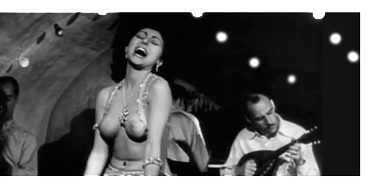
I’m actually watching this movie as I write this, as I was surprised to see a topless scene in a 1955 movie. The part where Mitchum hides his face in embarrassment from the dancer’s beautiful naked breasts was ridiculous and shouldn’t have been included in the film.