

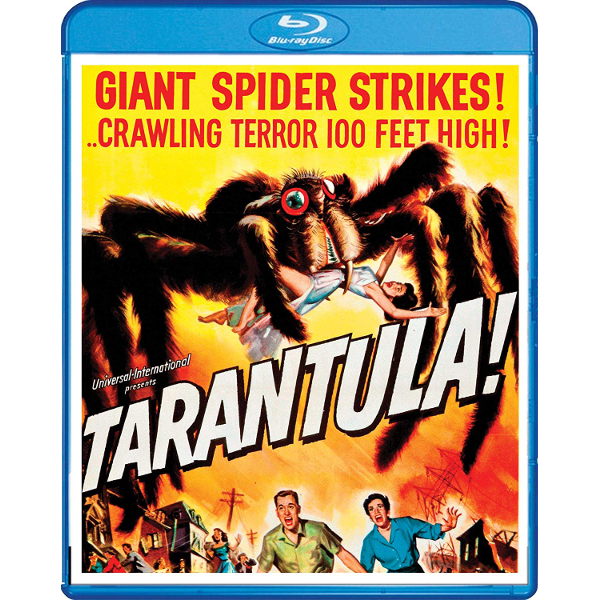

Five years after its debut on a Region B German Blu-ray, Universal’s biggest monster creeps and crawls across the Arizona desert and into the hearts of nostalgic monster fans. Jack Arnold seems in too much of a rush to do anything interesting with his actors, but they make an impression anyway; Reynold Brown’s spectacular poster art (which adds an exclamation point to the title) is one of the top monster One-Sheets of the 1950s.

Producer William Alland purloined the premise of Warners’ giant hit Them! and placed it in a budget version of the desert town from It Came from Outer Space. Thus Universal-International took a flyer in the Big Bug business, and launched a hundred film-school treatises extolling the ‘Arnoldian Desert Motif.’ Yet Tarantula works up its own broth of monster thrills and strange poetic effects. While the human characters exchange small talk, a colossal black arachnid stalks the wide-open desert spaces. As big as a mountain, it nevertheless escapes detection and snacks on various peripheral characters in approved monster-on-the-loose fashion.
There’s Trouble in an Arizona City! The denizens of sleepy Sand Rock are unaware of the caliber of disaster INdicated by the presence of a biology lab in their community. Professor Gerald Deemer (Leo G. Carroll) and his two associates have been toying with a radioactive growth-inducing serum, to combat the expected results of overpopulation — epidemics of starvation are predicted to occur in just twenty years (1955 + 20 = 1975). Through a regrettable sequence of events, all three researchers receive injections of their own super-vitamin, resulting in their disfigurement and death from symptoms that look like the disease acromegaly. Deemer’s new assistant Stephanie ‘Steve’ Clayton (Mara Corday) arrives to find Deemer’s lab in disarray. She and the town doctor Matt Hastings (John Agar) discover that a test spider escaped from the lab has grown to gargantuan proportions. It’s roaming the countryside devouring horses, truckloads of beef and the truck drivers as well.

Let me be clear about this… the thing is much larger than your everyday household spider. Jack Arnold’s movie subscribes to the King-Size Canary formula for ’50s monster entertainment: make sure your monster is bigger than last year’s. Led by effects whiz David S. Horsley, the Universal optical department puts a lot of effort into twenty or so angles showing the giant spider striding down highways, knocking over power lines and sneaking up on unlucky motorists. As with the previous year’s giant ants, the outsized crawling bug is accompanied by a loud signature noise that sounds like sizzling bacon. Unlike Warners’ ants, the only practical full-scale part of the spider we see is one hairy palp-fang that smashes through a roof.
What makes things look BIG in movies? Scenes in older 1:37 Academy ratio pictures often suggest a scale bigger than modern widescreen movies. The design geniuses behind Metropolis and King Kong knew how to cheat the scale of our perceptions to make things LOOK REALLY BIG, a skill unknown to the makers of Beginning of the End and The Giant Gila Monster. Here the Universal optical department succeeds most of the time. The monster shots were done by shooting various spiders high-speed (to get the slow motion) and in deep-focus. Miniature landscapes, possibly made of white plaster, were shaped to conform to the contours of the real desert in the live-action footage. Since the performing spiders could only be guided with jets of compressed air, Clifford Stine’s camera team must have burned up a lot of film to get useable footage, and been grateful whenever an angle matched up at all. Then again, the amount of light poured on the miniature sets to obtain the necessary depth of focus, probably made things so hot that the spiders needed little encouragement to walk.
When carefully matted into the picture the spider seems to ‘fit’ the hills and rocks, and even throws a shadow. Perspective issues remain, as the hairy arachnid has a tendency to appear a mile across in the far background, only to shrink to a hundred feet or so when he reaches the foreground.
After all that effort, it looks as though the optical experts weren’t allowed to finesse each and every shot. Several angles show the spider’s legs disappearing into mattes that cut across the sky. In a few shots, parts of the spider are transparent.

But the effect can be stunning. One pre-dawn moment places Universal’s ubiquitous Southern mansion on the right side of the screen, with a real desert horizon dominating the left. Off in the distance we can see the tarantula advancing this-a-way, an Arizona Highways Calendar gone surreal. It might be crawling into our reality from another dimension. He’s a horrifying menace, but still so far away that it’s a bit too soon to panic. I have nightmares like this.
The sight of the spider stepping over an outcropping two or three miles away is undeniably impressive. The most unnerving effect occurs when the giant spider creeps up behind a pair of friendly prospectors. He makes a wonderfully subtle entrance, with one telltale leg silently peeking over the horizon. It’s a scene Salvador Dalí might applaud.
In its most startling entrance, the spider suddenly reveals itself to the cast as they stand by their cars on a stretch of desert road. It crests the hill and then freezes, as if holding still to evaluate its new dining opportunity. Then it resumes its machine-like crawl, accompanied by Henry Mancini’s menace music recycled from This Island Earth.

Lovely Mara Corday has the task of looking concerned while pretending to be an eager research assistant in designer clothes. She has more screen time here than in her other Universal movies, but Arnold’s attempt to make her seem sophisticated, with a ‘professional’ wardrobe, doesn’t play to her strengths. Ms. Corday remains more arresting in her smaller, more sensual parts, such as the mining-town nurse in the same year’s Foxfire.
Viewers in 1955 might have thought some scenes were meant to be intentionally funny, as when the giant spider (partially in its poorly-matched puppet version, the one seen on the poster) imitates King Kong by peeking into Mara Corday’s dressing room through a convenient giant-sized window. Mara strolls to and fro (and even looks in a mirror) but never notices a thirty-foot glittering monster eyeball ogling her only a few feet away. When the spider subsequently climbs on top of the house and proceeds to batter it to pieces, it really appears to be, uh, aroused. The filmmakers had to be aware of this association; at the drive-ins in 1955, it must have been screamingly funny.
It’s neither Corday’s nor John Agar’s fault that the script keeps Matt and Steve far behind the story curve, looking for answers that the audience already has. Dr. Hastings’ scripted reveries about the desert are meant to echo Richard Carlson’s speeches from It Came from Outer Space, but Agar hasn’t the chops to deliver them. Researcher Leo G. Carroll suffers the yokels’ anti-science bias, as when the sheriff slights him with the remark that all scientists are rude. Deemer is presented as sympathetic, but he also buries a colleague out in the desert, almost like Norman Bates from Psycho. Carroll handles a squirming monkey like a pro. But we never understand exactly why his associates would consider ingesting a drug that transforms bunnies and hamsters into ‘sizeable beasts.’ The penalty for overstepping into the domain of Max Factor God is extreme facial humiliation. Leo G. Carroll’s elaborate, Quasimodo-eyed makeup makes Dr. Deemer into a dead ringer for Tex Avery’s Droopy Dog character. Carroll even talks a bit like Droopy.

The useless data recording sheets on which Deemer keeps track of his experimental subjects are funny but depressing — they really are aimed at 6-year olds. So are the wince-inducing scientific explanations that would play well in the nostalgic satire Matinee. In a category by itself are the large pools of chalky white venom that the tarantula leaves behind at various attack sites… could they be a clue? While the wiseacres in the audience make off-color remarks, John Agar’s intrepid country sawbones dips his finger into a puddle and gives it the taste test. What if it’s the acid stuff that the University expert says the spider uses to liquefy its prey? Matt Hastings could end up looking worse than poor drippy-faced Dr. Deemer.
Back in the early ’70s when magazines like Photon tracked down the Universal contractees that made these fantasy and monster pix, producer Alland and director Arnold sometimes had little to say about them, or tried to change the subject. When Star Wars made fantasy filmdom cool, these same men rushed to reclaim credit for their work, and claim the work of others, too. Jack Arnold in particular spoke as if he came up with the ideas and wrote all the scripts on his own. Tarantula did of course originate with a Science Fiction Theater episode Arnold directed called “No Food For Thought.” But that show was also written by Tarantula’s Robert M. Fresco. Arnold also claimed that Tarantula did not copy Them!, when every kid in America knew better. When trying to get projects going in the 1980s, Arnold had no way of knowing that intense fan scrutiny and the Internet would eventually fact-check every statement he gave to credulous fan interviewers.
Tarantula’s finale could serve as an institutional ad for Du Pont or Dow Chemical. Clint Eastwood (or at least his voice and eyes) is the pilot guiding the Napalm strike that engulfs the spider in an impressive fireball. Unlike other giant ’50s threats, this monster is an easy target. One phone call to your local Air Base does the trick: the bigger they come, the brighter they burn. The movie has always been a favorite of giant monster fans, and fits in there right behind the top ten or so sci-fi offerings of the 1950s.
Here's TFH Fearless Leader Joe Dante on Tarantula:


It might be noted that the makeup design for the disfigured scientist who destroys Leo Carroll’s lab is an economical combo of the mask from Abbott & Costello Meet Jekyll & Hyde and the foreheads from the Metalunans from This Island Earth. See Monster on the Campus for further re-use of this stuff.
For those true fans of the movie, the desert, and Roy Rogers, you can visit those great rock formations by taking Hwy 18 through Apple Valley, CA, continuing roughly seven miles east of town, until it meets Bear Valley Rd.