


Have you never seen real 3-Strip Technicolor used for terrific outdoor photography? That’s a shame, as on a big screen it’s like eyewash. Back in the ‘seventies, after seeing Three Godfathers or For Whom the Bell Tolls, we’d emerge from UCLA’s Melnitz Hall in sort of a state of shock. The rods and cones in our retinas would be so agitated that ‘ordinary’ reality couldn’t compete, and looked desaturated.

John Wayne and John Ford fans will feel that shock again with the new Blu-ray of She Wore a Yellow Ribbon, an Argosy Pictures production released through RKO. The third memorable name with this picture should be cameraman Winton C. Hoch. Like Jack Cardiff, Hoch became a Technicolor ace filming Fitzgerald ‘Traveltalks’ travelogues; he’d end up doing three major Technicolor movies for Ford, plus The Searchers which was filmed in VistaVision and printed in Technicolor.
Everything that John Ford is, is right here in She Wore a Yellow Ribbon, the second of his Cavalry Trilogy filmed in Arizona/Utah’s gloriously epic Monument Valley. After his strangely ambiguous endorsement of the historical cavalry in Fort Apache, Ribbon places its fort in constant peril from marauding Indians, yet stresses how the U.S. Army retains its social cohesion and special traditions no matter what. The Technicolor is dazzling, John Wayne is exceptionally good and sentimentality takes precedence over action.

Make that a lot of sentimentality. Captain Nathan Brittles (John Wayne) is the spiritual commander of Fort Stark as well as its second in command. Brittles’ retirement date is approaching but events keep cropping up to motivate or force him to stay in uniform — mostly warnings that the Indians are going to stage a new uprising. Brittles is the most respected man at Fort Stark, and he plays the gallant with the fort’s two lady residents, played by Mildred Natwick and second-billed Joanne Dru.
The story begins immediately after the defeat at the Little Big Horn. In 1948, that Indian Wars hadn’t yet done a political one-eighty in the history books. The words, “Custer is Dead” are the first heard from a reassuring narrator (Irving Pichel). In this version of events, all the tribes of the plains are forgetting their petty differences and banding together under Chief Sitting Bull. Although seldom seen in hostile action, the Indian menace is constantly reinforced. Indians killed Brittles’ family, and we see the aftermath of several raids. Large groups of warriors are on the move. We’re told that ‘the Indian nations have declared war on the U.S. Cavalry’, and that’s all the politics we’re offered. The ongoing struggle is a given and there are no issues to be debated. The warrior society that Ford celebrates in She Wore a Yellow Ribbon is a never-ending fight. The film may be more about the gearing up of the Cold War than it is about soldiers and Indians.
Ford sees the Cavalry as a social Utopia for Army officers. A class of faceless dog soldiers does all the work and most of the dying, while we enjoy the adventures and problems of the privileged stars. John Agar’s Lt. Cohill character is a dashing poster boy for Army enlistment. Cohill’s personal mission is to make the spoiled rich kid Lt. Pennell (Harry Carey Jr.) see the true Army spirit. Civilian values — Pennell wants to get back to Delmonico’s in New York — are trashed.

The enlisted men are divided between comedy relief and savvy professionalism. Sergeant Quincannon (Victor McLaglen) goes in for the usual barroom fights and Irish jokes. Sergeant Tyree (rodeo star Ben Johnson) is a Southerner who is not only the best rider but knows more about Indians than anyone. Brittles gives him his due, indulging smart sass rejoinders like, “That ain’t my department” and “My Ma didn’t raise any sons to second-guess no Yankee Captains.” Brittles also allows the aged Trooper Smith (Rudy Bowman), in actuality a former Confederate General who joined the Cavalry anonymously to serve the Union, to be buried with Confederate honors. Thus the Army is shown to be a noble institution that tolerates all points of view and brings all Americans together in a consensus of common purpose. ‘Southern honor’ is still celebrated through the character of Sgt. Tyree. The South’s defeat is treated as an unfortunate technicality. Military tradition and honor is placed before most other concerns.
The main subplot is the minor rivalry between Cohill and Pennell for the affections of the commander’s niece, this time played not by Shirley Temple but by yet another young Howard Hawks discovery. Actress Joanne Dru stole big pieces of the previous year’s Red River. Along with Mildred Natwick, Dru accompanies the troop on the show’s major journey, providing both a chance to show the Army’s limitless gallantry and also an excuse for avoiding any major battles. The film advances the notion that the military provides a welcome home for the soldier’s wife, a situation which may have changed in the last forty years, but certainly wasn’t the case then (See Savant’s comments in his reviews for The Right Stuff, Blue Sky and Sayonara.
Since the emphasis is on relationships over fighting, She Wore a Yellow Ribbon has a number of charming touches, which Ford and his writer Frank Nugent lean on quite heavily. Nathan Brittles is given a watch by his troop in a drawn-out sentimental scene. His exchanges with McLaglen’s broadly drawn Quincannon character reflect Ford’s fondness for Irish relationships. These sometimes become the entire content of a film, as in the gentle The Quiet Man and in the somewhat less charming The Long Gray Line.
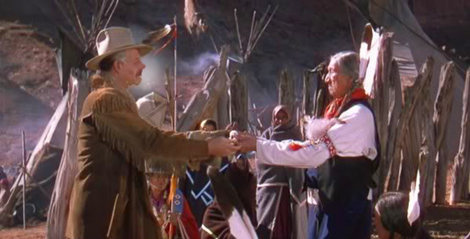
The best scene in the movie is Brittles’ visit to a hostile tribe to float a peace overture with old friend Pony Who Walks (Chief John Big Tree). On the way in Brittles takes the insult of an arrow shot into the ground by a younger brave: Wayne yanks the arrow out, spits on it and throws it in the brave’s face. Audiences invariably cheer this gesture of bravado and defiance in The Lion’s Den, and it’s simply a terrific scene for John Wayne. The confrontation promises violence, but the movie studiously sidesteps any showdowns. It’s a lot more satisfying than the lame rescue mission in the final Ford cavalry film, Rio Grande. Were kids in 1948 a little disappointed?
The old warriors meet with honor and respect, and openly lament that they will be pushed aside by the younger warrior hotheads. This would be a great statement if it actually applied to the situation we see. In Yellow Ribbon the violent renegades are all Indians, and Pony Who Walks is an authority figure only for a bunch of infantile savages. Neither the the U.S. or the Cavalry have done anything wrong, and have no need to reassess their position. John Ford’s foggy patriotism comes up with some head-scratching messages. The final narration declares, “Wherever the U.S. Cavalry went, that became the United States.” If that makes any sense, it’ll have to be explained to me. The real explanation is that it’s 1949, victory is ours, and we’re writing the history books our way.
Like I said, the Brittles-Pony That Walks meeting is the high point of the movie. Pony That Walks is something of a ‘Gunga Din’ figure, an amusing non-white token character, a ‘good injun’ amongst the barbarians. Hank Worden would later create an even more loveably exuberant ‘domesticated’ Indian ally in Howard Hawks’ superb The Big Sky. Worden would then serve a strangely similar function as the addled, awkward Mose Harper in The Searchers — a frontier mental case, yet definitely on the side of the angels. It would have been fun to see Ford’s face if some imagined interviewer ever asked him about issues of diversity and inclusion.

For a cavalry picture with no major battles, She Wore a Yellow Ribbon has excellent action scenes. Ford’s horsemen, rodeo experts and ace wranglers make every shot with horses a real winner. Just watching the expert riders do simple things is exciting — ‘kids’ like Harry Carey Jr. are great, and of course, every move Ben Johnson’s Tyree does in the saddle is something to be cheered. We see wagons going over fairly ridiculous hills, and one river crossing is an extended single take where the troop approaches from the far distance, crashing through the shallows like a freight train. In the Indian camp, the hostiles’ braves make their mounts bump up against Ben Johnson’s horse, trying to spook it or provoke a fight. Johnson holds steady. The biggest action scene is a pony stampede through an Indian village, covered in serveral perfect angles. No fast cutting is needed as the perfectly staged action plays out in a few optimal angles. In a key view of the stampede, one of the movie’s many troop dogs zips ahead of the racing horses, running like hell afire to keep from being trampled. It’s a throwaway bit of action in a great sequence. Staging these things is surely one of the reasons Ford liked to make Westerns. Organizing them to look natural made him a regular filmic Admiral, in command of his own battles.
Quite pleasantly, the movie undergoes two or three false climaxes. Without the expected bloody battle ever happening, Brittles finally leaves, a civilian at last. Little else in the story has been resolved, except that one callow Lieutenant has won the girl. The other undergoes a total change of character. Previously a snooty elitist, being able to command troops has made him choose to continue his army career. With the country in the hands of a new generation of properly initiated officers, the war against those terrible Indians can continue.

John Wayne is just great. He builds on his Tom Dunson of the year before with this portrait of an older, far more mellow westerner. The rest of the cast goes through their familiar John Ford stock company moves without any surprises. Joanne Dru is expressive and efficient in her by-the-numbers role. The standout is Ben Johnson, who Ford had just promoted to star status in Argosy’s Mighty Joe Young. Johnson has a natural, melodic line delivery to go with his great horse riding. Being part of the Ford stock company seems to have been a privilege and some kind of duty. Few of his chosen actors graduated to better roles although most had continuing careers. Even Joanne Dru, after a few big parts, spent most of the rest of her movie life in second-rate Westerns.
[ Joanne Dru’s last husband C.V. Wood was one of the geniuses behind the construction of Disneyland. He was also the man behind the dubious relocation of London Bridge to Lake Havasu City, Arizona. In the early 1970s, we used to see Ms. Dru at bridge ceremonies in Lake Havasu. ]
Ford gave Johnson and the son of silent star Harry Carey a fairly big push. Harry Carey Jr. was ‘introduced’ in Ford films at least twice, maybe three times. Carey remained a supporting player, but Johnson eventually found bona fide stardom 23 years later in Peter Bogdanovich’s The Last Picture Show.
