

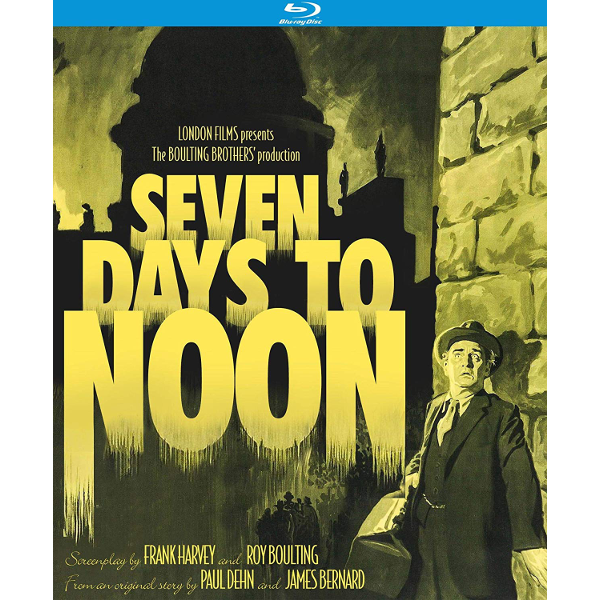

The no-nonsense techno-threat thrillers that we know today began right here, with a crackerjack story dreamed up by Paul Dehn (Goldfinger) and James Bernard (Hammer’s go-to music composer). Something distressingly out of the ordinary happens in a top secret government establishment and within hours Scotland Yard is turning London upside down trying to locate one man, to prevent an unthinkable disaster.

Seven Days to Noon makes use of the ‘protocol noir’ pattern of docu realism. The narrative has the requisite suspense sequences of nervous policemen watching clocks, and the Prime Minister holding special sessions to deal with the crisis. Ordinary civilians as well as experts are dispatched to address a problem so pressing that all other considerations civil and personal pale into insignificance. Is this the first movie to use the suspense technique of superimposing Days of the Week on dawn shots to count down the days to doomsday?
Roy Boulting’s films didn’t lack for thrills but their cautious approach tended to dampen the high-adventure situations of Sailor of the King and Run for the Sun. In this case the methodical Boulting mindset works like gangbusters, emphasizing the difficulty in saving London without resorting to comic book heroics or techno-gimmickry. Seven Days to Noon got attention because it is utterly believable. Certain thrillers around 1950 were beginning to show artistic shadings toward apocalyptic themes, like Raoul Walsh’s White Heat. But nothing like Seven Days had been seen before.

The Prime Minister (Ronald Adam) receives a letter from a man who threatens to detonate a nuclear weapon in the center of London in one week’s time, at noon on Sunday. Scotland Yard inquires at a bomb plant just North of London — and its security men discover that a portable device has gone missing, along with Professor Willingdon (Barry Jones of Brigadoon, Demetrius and the Gladiators and Return to Paradise), a meek scientist who previously worked on the Manhattan Project. With the crank letter now an instant national crisis, Inspector Folland (André Morell) rounds up Willingdon’s assistant Stephen Lane (Hugh Cross), his daughter Ann (Sheila Manahan) and Willingdon’s friend the Reverend Burgess (Wyndham Goldie) to figure out what to do. The government puts into motion a full evacuation of a large part of London while the manhunt continues. Meanwhile, Professor Willingdon wanders the city streets unnoticed — until his photo is duplicated in every newspaper and plastered on every billboard in the city. Realizing that his new landlady (Joan Hickson) will have guessed his identity, Willingdon allows himself to be picked up by Goldie (Olive Sloane of Thunder Rock), an overaged entertainer eager for male companionship.
The stakes are higher than ever before in the Boultings’ terrific thriller. When the crisis is still a secret, detectives scour London with the help of Prof. Willingdon’s daughter and prospective son-in-law. It appears easy for the professor to hide in a city of millions — he’s smart enough to alter his appearance, and so innocuous that nobody gives him a second glance. Rumors spread that trains, trucks and busses are being corralled en masse, which the hardy Londoners immediately interpret as a sign that war evacuations are on the way, just as had happened in The Blitz.

It at first seems wildly unlikely that Seven Days to Noon could exist — it was obviously produced and released with plenty of government cooperation, at a time when the U.S. and the U.K. were downplaying the nuclear threat in the media. But when the evacuation begins, the pro-status quo message becomes clear. This isn’t a hysterical anti-Nuke message movie but a demonstration once again that LONDON CAN TAKE IT. The public response isn’t panic or chaos, the cornerstone of Susan Sontag’s famous ‘Imagination of Disaster’ theory of filmed Sci-fi. An orderly process instead safely empties the city in just a couple of days. This civilized & sane image of Civil Defense would hold until Peter Watkins’ The War Game came along fifteen years later to break the news that England had no defense and no recovery plan in the event of a nuclear attack. Even as it proposes a new kind of nuclear terrorism Seven Days assures us that England’s clear headed, all-wise authorities have a good chance of dealing with it.
The picture doesn’t go cheap with its scenes of evacuations — we get impressive, well written and directed looks at neighborhoods emptying out, with flotillas of busses and trains heading for the sticks. When they’re gone we see what might be the first appearance of a key icon of apocalyptic Sci-fi: impressive images of an empty city, a civilization become a tomb — the eerie effect that chills our spines in everything from the dime-store epic Target Earth! to the lavish On the Beach.
Minus traffic and pedestrians, huge public spaces might as well be lonely Roman ruins. This is no ‘clear a block and a half for twenty minutes’ deal — it’s filmed on a scale equal or bigger than similar scenes in The World The Flesh and The Devil. The only activity are the squads of soldiers searching every block, every house, every roof and attic for the elusive Willingdon. Writers and filmmakers must have been stimulated by these potent visuals. Val Guest re-used several shots from the night search for his The Quatermass Xperiment. For that matter, the name Willingdon sounds a lot like ‘Winnerden,’ the name of the town overrun by alien invaders in Quatermass 2.

Although it uses sensitivity and finesse, Seven Days casts its political lot with the conservative Sci-fi mainstream:
The real problem isn’t the nukes or official incompetence, but a rogue, lone wolf scientist who becomes religiously obsessed with guilt for helping to invent the bomb. Willingdon thinks that nuclear blackmail will persuade 10 Downing Street to dismantle its atomic arsenal, an option never for a moment taken seriously. After all, it would be madness to comply — England’s nukes are its vital defense. Everybody agrees that Willingdon means well, but what do such things matter? He’s a menace that must be neutralized.
This of course falls in with the official smear of science that started with the discrediting of Oppenheimer, et al.. Dissenting atom scientists were marginalized as untrustworthy, subversive. Movies of the 1950s would invent a numerous Willingdons, guilty scientists that sometimes blame themselves for building bombs. For the official viewpoint I can recommend a once-classified 1952 film called Operation Hurricane, which is presented as an extra on the BFI Blu-ray of The Day the Earth Caught Fire. It’s about preparations for a Brit atom test in Western Australia. Its narration applauds the fact that possessing nukes will give the U.K. a say in the competition for global power.


↑ Seven Days to Noon is a pleasure to watch. After seeing the unflappable André Morell overcome all odds in horror and sci-fi favorites, it’s a treat to find him looking so young — and without a mustache — as everyone’s notion of the perfect Scotland Yard operative. Inspector Folland NEVER becomes overly emotional; his dogged investigation treats everyone involved with respect and consideration. Folland knows when to press and when to sit and wait. The other supporting players are more than adequate, even if most are plucky good folks or slightly stoic stiff-upper-lip types. The final reckoning is particularly well done. We end up wanting to cheer Folland/Morell — he’s the most civilized, self-effacing hero in ’50s Sci-fi.
→ Actor Barry Jones has a real soulful streak. When his Willingdon quotes the Bible to justify his actions he’s sympathetic, not bonkers. One shot shows him posing behind the bones of a prehistoric animal, associating him with extinction, I suppose. If Willingdon’s one-man crusade succeeds, what’s left of London will be uninhabitable.
I’m surprised that nobody questioned the idea that an atom bomb could be small enough to tote around in a hand satchel — even the ‘small but dirty bomb’ in Goldfinger rolled around in a bulky cart. But there must be hot radioactive material in that satchel, right? How could Willingdon be shielded from its radiations? Wouldn’t the satchel be suspiciously heavy?

Olive Sloane’s ditzy ex-showgirl Goldie serves as light comedy relief; her seedy frivolity is a nice contrast to the melancholy Willingdon, who doesn’t realize that she’s taken a shine to him. Her complaints also stand in for the ‘average on-the-street East-Ender.’ The lovable, some what dim Goldie is perhaps modeled on Dora Bryan’s soulful good-time girl in The Fallen Idol. Thora Hird in The Quatermass Experiment would seem to be cast from the same mold. Goldie is pretty funny when nobody listens to her pleas to be evacuated to Aldershot with her dog.
The show leaves us knowing that we’ve seen a real milestone picture — the dawn of filmic attempts to deal with the nuclear threat. I can think of only one earlier movie that addresses somewhat similar techno-terrorism content. Curiously, it was co-written by another future James Bond scribe, Jack Whittingham. The minor film Counterblast (1948) stars Mervyn Johns as an escaped Nazi who impersonates an Australian scientist so as to infiltrate a biological weapons lab. He’s already concocted an unstoppable ‘Cardiac Plague’ and is perfecting its vaccine-antidote so that immunized Nazis will be spared while the rest of humanity succumbs. The mass murder theme is paramount. Strangely, it looks as if Alistair MacLean leaned on Counterblast for his novel The Satan Bug; the United Artists film adaptation follows the earlier movie even more closely.

guess after 5 years that nobody even read this…