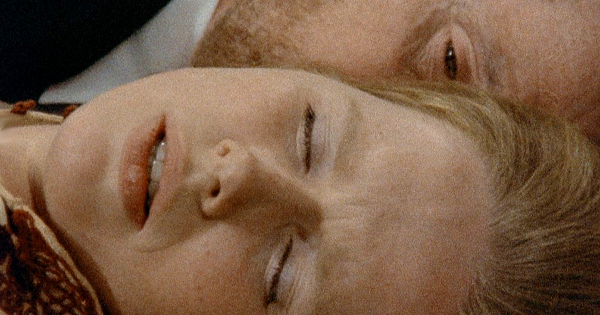
We long ago found out that fifty million Frenchmen could be wrong when the experts claimed that the whole country loved Jerry Lewis movies. Some of us also assumed that Ingmar Bergman was Sweden’s most popular filmmaker, but historians now tell us that Bergman was never a smash box office performer in his home country. His career went through several slumps, at which time he returned to the theater or producing for TV — or tried something completely different.
Of course, he’s still a powerhouse, with a style that’s not been tarnished even by Woody Allen’s slavish imitations. At several career junctures Bergman felt the need to re-invent himself, and each time he found an interesting direction forward. In the early ’70s when some of his biggest stars were making Hollywood films, he found it difficult to put together another big theatrical show. His solution was to do a television miniseries on an exceedingly small scale. 1973’s Scenes from a Marriage was written for his close collaborators Liv Ullmann and Erland Josephson, actors that had worked together so much, they already looked married.

The original show consists of six one-hour segments that Bergman called ‘scenes.’ Each has been given an intriguing title: 1. Innocence and Panic; 2. The Art of Sweeping Things Under The Rug; 3. Paula; 4. The Vale of Tears; 5. The Illiterates; 6. In the Middle of the Night in a Dark House Somewhere in the World. The overall tone can be judged from episode Five, which refers to emotional-relationship illiteracy, the notion that most people never really learn how to properly relate to one another.
The movie was filmed in 16mm color by Bergman’s collaborator Sven Nykvist. The camerawork is simple and straightforward, mostly recording long dialogue sequences between the actors. Most of the six hours have at least one break from the talking heads format, to show a bit of other people in the characters’ lives. The even more intimate 3-hour version retains another couple seen in the first episode, and part of an autobiographical ‘slide show’ of the wife’s childhood and early life. Everything else is a concentrated two-person show.
And intense it is. After having misgivings that his show would appeal at all, Bergman was stunned when Scenes from a Marriage became a must-see ritual on Swedish television. Being locked in a room with two people’s marital problems might seem unpleasant, but much of the nation projected themselves into the situation on screen. The interpersonal conflict translated to other languages and cultures as well.
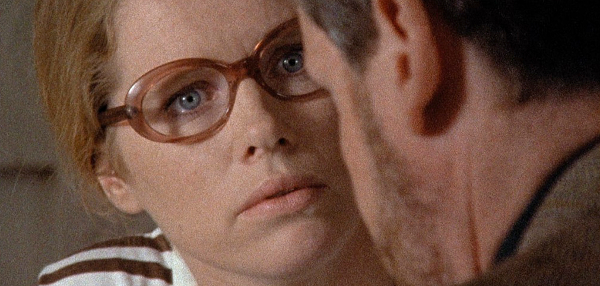
Marianne and Johann (Liv Ullmann & Erland Josephson) appear with their young daughters on a TV program, where Johan proudly speaks of his success. They’re both professionals, he a researcher and she a divorce lawyer. At a home dinner party they are appalled/amused to see their guests launch into a bitter marital fight right in their living room. Johan is smug and overly confident, even when talking at work with an associate (Gunnel Lindblom of The Virgin Spring). He doesn’t seem particularly attached to his children, and he definitely takes Marianne for granted. He bristles and gripes about their extended family holiday plans, as if he’d like to just drop all family commitments for good. For her part, Marianne has found herself a protected space where she’s convinced herself that she and Johan are happy and their marriage permanent. She jokes about them growing old together and allowing themselves to eat all they want and to be happy and contented. Johan is not amused by the observation either. The marriage blows up like a bomb in episode three, which leads to more years of emotional discord.
Depending on one’s personal situation the experience of Scenes from a Marriage can be self-illuminating — or grueling. Johan and Marianne are respected ‘winners’ that have met the criteria set for success in their society, and yet they’re wading in the same interpersonal quicksand that we all must. Bergman has remarked that he put a lot of himself into the show, and it helps to note that he was married five times and kept up numerous love affairs. Although not in Bergman’s league, the film’s Johann is a selfish egocentric, hungry for praise and dismissive of his wife, who he foolishly compartmentalizes and dismisses. Exaggerating his professional status and career accomplishments, Johan feels comfortable hurling terrible insults and hurtful criticism at her. Marianne has little choice but to absorb all this abuse. She’s been conditioned to persevere through interpersonal conflict, coming out on top by simply waiting for Johan’s immature hostility to burn itself out.
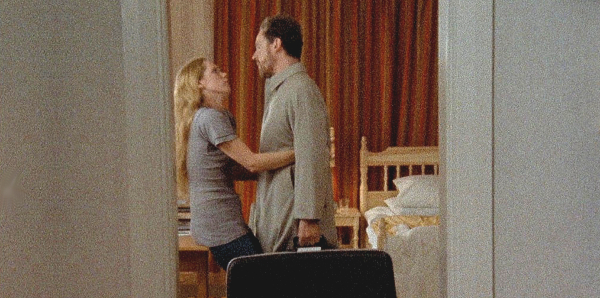
The scenes in the second half of the show are spread out over five or six years. Separating and evolving, Marianne and Johan each change, but the conflict stays the same. For all of his bluster and self confidence Johan turns out to be a typical male idiot-in-love, unprepared for his conquests to reject him and his self-imagined brilliant career to taper off. Although he’d deny it, he’s still emotionally dependent on Marianne. When not dishing out abuse, he whines and begs for sympathy, as if the tragedy is his and her role is to play the comforting mother. Some men never learn, and never stop being children, the show seems to say.
In what was likely as revolutionary a step in Sweden as it seemed here, Marianne’s post-breakup evolution seems entirely positive. That ‘slide show’ sidebar slips in when Marianne reads from a self-help diary she’s been writing about her life, in which she re-evaluates the way she’s suppressed her individuality all of her life. She early on learned the lesson of getting along with people, and not disappointing others’ expectations, which made her feel a sneak when she did anything not pre-ordained by her parents, like have a love affair.
This self-revelatory sequence is much longer in the TV version. It uses photo images of Liv Ullmann’s own childhood, so we have to remind ourselves that Marianne the character is not the same as Liv the actress. Ms. Ullmann strikes me as perhaps something of a Norwegian Olivia de Havilland. The public image of each actress is all softness, grace and generosity, leaving out what must have been a fierce determination to succeed at all costs. It takes an uncommon force of will, I should think, to survive a relationship with a genius who considers you his ‘muse.’ [Interestingly, both actresses were born in Japan.]

In the TV version, Marianne later hears her mother vouchsafe a series of personal secrets, among which is the revelation that she has partly shared Marianne’s same experiences — she didn’t love her husband, and was no more lonely when he died than when he was living. Marianne’s self-understanding deepens.
Marianne’s freedom is not a declaration of independence. She’s fully aware that she has a physical attraction for Johan completely separate from his horrible treatment of her — viewers likely became angry when she suddenly decides to allow him to stay the night. But Marianne doesn’t believe in a hard break for her marriage — Johan is also the father of her children and therefore important to her vision of family continuity (as opposed to stability). His behavior later on is pathetic in its predictability — he’s Mr. Wonderful until he hears a discouraging word, and he becomes enraged at the idea that Marianne would dare take on a lover of her own. Marianne has at least a partial ability to accept others as they are, even as she realizes that Johan will never fully accept her as an independent personality. This dynamic becomes obvious when the frustrated Johan, incapable of facing the truth about himself without self-destructing, turns violent. It’s utterly convincing.
Even when Johan comforts Marianne in the last episode, reassuring her in the night that all is okay, we’re thinking that she’s the one playing both mother and lover to him. Do we think she might have exaggerated her nightmare, so as to elicit some kind words and consideration from Johan? I’ve found that intelligent women have roundabout ways to obtain pleasures that men are unwilling or incapable of giving them.
Bergman insisted that solicitations of divorce lawyers in Sweden went up after his show premiered. Male viewers watching Scenes from a Marriage will not be rushing to identify themselves with the boorish Johan, but only the saints among us have not experienced his egocentric love alignment at some point or another. The show challenges male viewers to ask whether they grew out of Johan-like behavior as they learned how to relate to women. Here in America men tend to dread the words, ‘We need to talk…’ I can readily see the show initiating ‘relationship discussions’ that turn into emotional minefields.