
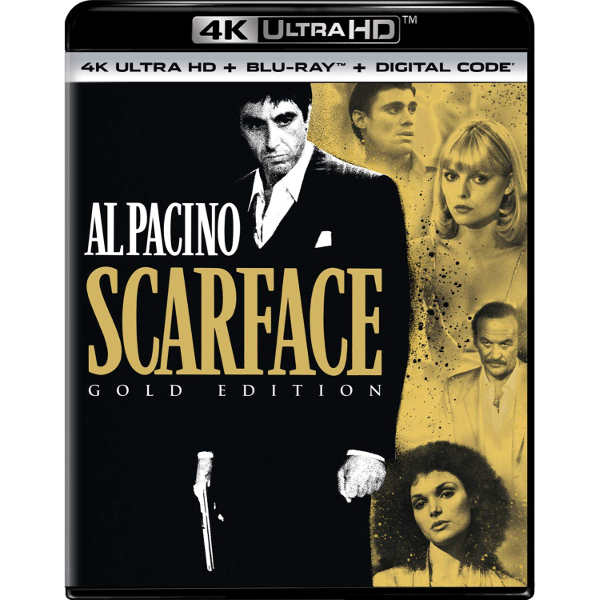

In 1982 Brian De Palma took a break from oversexed Alfred Hitchcock retreads to remake a genuine classic, the most shocking of the first wave of great gangster talkies. Paul Muni made film history as an iconic gangster in the original Howard Hawks / Howard Hughes 1932 Scarface, fascinating cinema that all but gives the middle finger to the Production Code. It’s included as an extra on this deluxe gift set of the De Palma picture, positioned as a prime gift item for Christmas 2019.
Scarface does indeed update the Ben Hecht original for a new world of outrageously violent and profane drug crimes. In the early ’80s the immensely profitable drug trade grew so big that its organizers in the U.S. and Latin America took on genuine political power. They’d eventually coalesce into autonomous cartels Too Big To Fail, and terrorize several countries with impunity. The misery is charted in movies that range from the conservative Sicario pictures to Steven Soderbergh’s Traffic to John Sayles’ mournful Men with Guns, which honestly confronts the hell on Earth created by the lawless militarization of Central and South America. I suddenly turn conservative when this subject comes up — everyone cries for the souls of drug addicts in the U.S., when the real victims are the innocents to the South, dispossessed and slaughtered by the guns so easily purchased by foreign killers of all stripes. Entire populations have No Future, thanks to our recreational drug decadence.

Oliver Stone’s update interpolates Ben Hecht’s character dynamics into the new reality of incredible profits and hoodlums so vicious, the saga of the Corleone Family plays like Father Knows Best. If Stone’s image of excess and decadence seemed exaggerated then, it certainly isn’t now, with Cartels enforcing terror by brazenly advertising atrocities beyond traditional images of horror.
The big hit Scarface ’83 was truly influential — it’s likely that a generation of disgusting drug vermin modeled themselves after Al Pacino’s Tony Montana. With its flood of profanity, any idea that the movies (or our language) would become more civil vanished as well. The one disputable element of Stone and De Palma’s concept is tying the drug trade into Fidel Castro’s Cuba, which was more interested in exporting revolution and fending off U.S. aggression. Tony is asked if he’s part of a ‘Cuban Crime Wave,’ a slur that white supremacists use to typify Latins as killers and rapists.

Havana criminals Tony Montana and Manny Ribera (Al Pacino & Steven Bauer) make it to the U.S. on the controversial Mariel Boatlift, sidestep the oversight of law enforcement and soon earn their Green Cards by performing an assassination for the Miami drug kingpin Frank Lopez (Robert Loggia). Tony and Manny survive their first horrendous drug deal experience with some Columbians (think execution by chain saw) and are soon in Frank’s inner circle. No more dishwashing, but instead fine clothes, cars and women. The unusually ambitious Tony impresses everybody even as some hoods fear his recklessness. But he consistently prevails in hairy drug deals and money laundering gambits, and becomes too big and too corrupt to be stopped. He builds an empire, and marries Frank Lopez’s mistress Elvira Hancock (Michelle Pfeiffer), a material girl with no illusions. Tony also has a possessive, unhealthy relationship with his own sister, Gina (Mary Elizabeth Mastrantonio). The pervading corruption includes key lawmen and especially cooperative banks. When things begin to fall apart, Tony’s fractured relationships go sour as well. The conclusion is both classically tragic and horrendously violent.

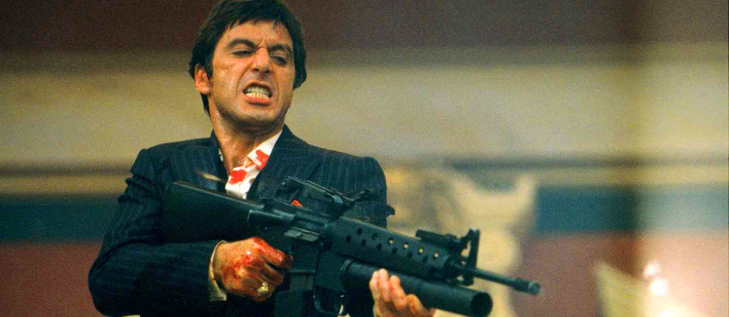
After Scarface, frat boys and workplace jokers had a new vocal impression to finesse. The guys that bored us with impressions of Marlon Brando (“Make them an offer they can’t refuse.”) and Robert De Niro (“You talkin’ to me?”) had a new accent to master (“Say hello to my little friend!”) Screenwriter Oliver Stone gives the film a solid construction and new twists, but his big contribution is the obscene dialogue, which had its effect as well — Tony’s colorful way with words goes right along with the narcissistic greed that pundits say ruled the moneyed folk of the 1980s.
There’s quite a contrast between the Tony Camonte of ’32 and the Tony Montana of ’83. The remake has practically no police presence, save for Harris Yulin’s corrupt narc. The old Tony went power-mad with greed and hubris. He had a hot temper and was too crude to carry on normal negotiations. When he made his big mistakes, it was because he was just plain crazy-stupid. Tony Montana can be charming, but his ambition will not tolerate dissent. His undoing comes about when he breaks Frank Lopez’s rule about using his own product: at one point we see Tony with a full kilo of cocaine on his desktop. The drug screws up his judgment beyond all recovery. Through movie logic alone, the powder helps make him semi-invulnerable to pain and gunshots when his villa is invaded by an army of gunmen. They’re not cops delivering a moral reckoning, but nasty South American drug assassins. In the original, Paul Muni’s Tony was just too dumb to avoid killing the only friend he ever had — “I didn’t know!” he wails in apology to his sister Cesca (the immortal Ann Dvorak). In the De Palma remake, Al Pacino’s Tony is too cocaine-deranged to stop himself from making the same mistake. Oliver Stone pays off the lurid brother-sister conflict in a typically ugly ’80s confrontation, with Gina screaming at Tony to F___ her while firing bullets at him.

As De Palma movies go, this is directed in classic fashion; the A+ production makes it into quite a spectacle. The Babylon Club is a gigantic disco for the ultra rich, where the ladies’ man Manny can pick up fantastic women — the ones the movie would have us believe spend their afternoons parading near the ocean in string bikinis, looking for handsome Latins to pick them up. Al Pacino’s powerful presence makes credible the outrageous tantrums Montana makes in fancy restaurants — shouting insults and expletives at the clientele around him… swells apparently sufficiently aware to stay quiet and unfazed. As big performances go Pacino’s is a real show-stopper. Some of Tony Montana’s behavior, if performed by an actor with less gravity, would come off as a bad Sid Caesar skit.
Even De Palma refrains from really depicting the chain saw violence up front, a scene so jarring that we remain on edge without further demonstrations of cruelty. We have a couple of shocking executions and the ‘Wild Bunch’ shootouts at the finale, but in terms of straight body count the Scarface remake is actually less lethal than the ’32 original, corpse for corpse. It’s just that most of Montana’s killings are not handled with anything like discretion.
I call De Palma’s direction ‘classical’ because he sees no need for experimentation with his sub-Hitchcock cinematic tricks. Ever the super-film-student, De Palma enjoyed constructing entire suspense sequences around security camera cinematics. Scarface has no split-screen effects, flashback tricks or bizarre dream sequences. Tony Montana has a battery of security cameras around his villa, but De Palma only shows how worthless they are, when the boss is doped up on white powder.

Steven Bauer is terrific in the George Raft role; he’s so good-looking that he doesn’t need to flip a coin to draw attention. Looking at Michelle Pfeiffer’s filmography, I don’t see anything that would have gotten my attention before her Grease 2 of the previous year. The role doesn’t ask Ms. Pfeiffer to make with the devastating smile that would be so effective in Demme’s Married to the Mob — Elvira spends the entire picture in a sullen mood, if not outright furious. But this job certainly paid off, as she immediately became a front-rank attraction.

For film fans, the always-good Mary Elizabeth Mastrantonio → also came out of nowhere with Scarface, with her daring & unrestrained Gina. The character is barely sketched but Ms. Mastrantonio makes every moment pay off. It works, even when the show has to follow the template laid down by the ’32 original.
De Palma clearly distinguishes his few main characters — with fine input from Robert Loggia, F. Murray Abraham, Miriam Colon, Harris Yulin, etc. Paul Shenar is a Bolivian villain with a deceptively civilized personality, and favorites Pepe Serna and Richard Belzer have featured, brief parts. (Sidebar: somebody please explain to me the strange nightclub performer wearing a full body costume… what the heck is he supposed to be?)

Perhaps Scarface ’83 performed a service by depicting the reach and rot of big-money drug culture, or simply the limitless corruption possible when ‘free market’ commerce goes unrestrained. How much of America is this lawless? The restaurant waiters would likely play dumb if they witnessed Tony shoot somebody. The banks Tony frequents are international criminal enterprises that in themselves justify a reform revolution. Even the Porsche dealer just smiles as Tony orders his new car to be beefed up and bullet-proofed. Al Pacino’s Godfather dialogue line, “We’re all part of the same hypocrisy” seems more true than ever.
The most interesting scene for me in Scarface ’83 has no counterpart in the original — Tony muffs an assassination, along with his relationship with his South American partners, when he balks at blow up innocent women and children. Wow, the man has moral limits after all … even if he doesn’t mind making them widows and orphans. Does this help make Tony a tragic hero, and was the scene suggested by Al Pacino for that purpose? Such sentimentality is almost quaint compared to the elevation of violence both on the screen and in reality in the intervening 40 years — Tony will stupidly shoot the only people that care about him, but then jeopardize everything by showing some Catholic restraint. In the end, he doesn’t have the right stuff to follow the motto of material greed, ‘The World is Yours.’ Cartel druglords and cutthroat politicians need to be bigger monsters than that.

