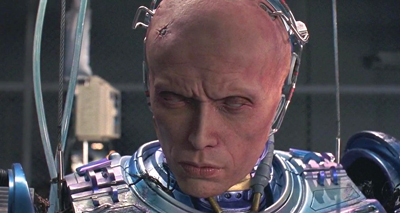
I wish I could say that 1990’s RoboCop 2 has been reassessed and proclaimed a top-rank Sci-fi show. That just hasn’t happened — it’s still a loud, violent epic with a nihilistic Frank Miller streak that wants to be uncompromising but just seems mean-spirited and thin. After 27 years viewers are more likely to be impressed by the sensational pre-CGI special effects — as a stop-motion animation film this is a major achievement. I’d also make a case that RoboCop 2 is the best film ever about what is called ‘The War On Drugs.’ Sure, drug lords are a big problem, but they’re nothing compared to a curse that may finally have arrived in America: the runaway privatization of public property and services.
The original RoboCop is the best science fiction film of the 1980s, a stunning action movie and a sharp social satire. Writer Ed Neumeier’s acidic takedown of the greedy, war-on-drugs Reagan years is still 100% accurate. Neumeier, director Paul Verhoeven and producer Jon Davison chose to make RoboCop exceedingly violent, which dampened its box office take: if the story of police officer Murphy had been rated PG-13 instead of a rather hard ‘R,’ a younger audience could have flocked to the show. But I’ll take the hard-edged adult political satire any day.

About ten years later the same production team made Starship Troopers, an equally brilliant (and courageous) critique of modern militarism as seen through a future in which the entire planet has been united under a corporate state and is actively conquering other solar systems. Troopers’ mixed messages were widely misunderstood, but in the post-9/11 world its reputation has been almost entirely redeemed. A similar rebirth hasn’t come to pass for the first RoboCop sequel, RoboCop 2, which missed the mark despite a satiric script that now seems like a blueprint for America’s future. ‘Thinking’ sci-fi has become popular again — Children of Men, Gravity, Arrival — and this show pushes its dangerous ideas to their logical extreme.
Instead of giving Orion Pictures more of the same, only different, Ed Neumeier’s unfilmed sequel script jumped ahead to the future for a sort of “robot politics to come” show that would require the depiction of an entire future society. When Orion nixed that option, producer Davison obtained a violent, serviceable script from comic book & graphic novel star writer Frank Miller that pushed the original’s corporate depredations a few notches further, into privatization outrage. The script also showcased a new robot monster that would give special effects wizard Phil Tippett’s stop-motion artistry free rein. Finding an appropriate director proved to be a major problem. The show finally settled on Irvin Kershner, the former director of sensitive dramatic films (The Luck of Ginger Coffey, 1970’s Loving) who had scored with the much more high-profile Sci-fi sequel, The Empire Strikes Back.

RoboCop 2 sees Omni Consumer Products, still led by The Old Man (Dan O’Herlihy) closing in on a much bigger corporate takeover deal: rather than going for Detroit’s police department, they’ve signed the foolish Mayor Kuzak (Willard Pugh) to a security contract that all but guarantees that the city will default, at which point OCP will own everything — and ‘take Detroit private.’ As part of this scheme The Old Man’s mistress Dr. Juliette Fax begins searching for a human subject to ‘volunteer’ to let their brain be used in a Mark II police robot to be called RoboCop 2. The still-effective first model Robocop (Peter Weller) is now considered a liability, especially because his human identity as officer Murphy keeps reasserting itself. The Old Man’s ruthless lawyers Holzgang and Donald Johnson (Jeff McCarthy & Felton Perry) entreat Robo to lie to his ‘widow’ Ellen Murphy (Angie Bolling) that he is no longer her husband but an unfeeling cyborg.
RoboCop goes after the crime kingpin / drug guru Cain (Tom Noonan), a venal visionary whose new designer narcotic Nuke has taken the country by storm. Trapped by Cain’s minions, including the pre-teen mob enforcer Hob (Gabriel Damon), Robo is cut into pieces and dumped on a precinct doorstep. When OCP reassembles Robo the devious Dr. Fax floods his program with hundreds of conflicting, PC-ridden Prime Directives, turning him into an ineffective public relations moron. Robo fries those circuits with high-voltage electricity, erasing Fax’s confusing programming. Raiding a Nuke warehouse, RoboCop faces off with Cain, who ends up in the hospital. Dr. Fax then decides that Cain’s psychopathic brain has the ideal personality profile needed for RoboCop 2 — and his addiction to Nuke will make him easy to control. Cain’s brain re-awakens in the twelve-foot chrome steel monster, outfitted with mechanical claws and a left arm that carries an aviation-grade machine gun cannon. The Old Man sends Robo 2 out to prevent Mayor Kuzak from raising the cash needed to keep Detroit in public hands. Little does OCP realize that Cain isn’t exactly thrilled to be transformed into a metallic Golem: the monster cyborg has its own violent agenda.
As a production RoboCop 2 is a quite a show. Made just a few seasons before Spielberg’s game-changing Jurassic Park, it is the last major organic stop-motion giant monster epic. The team of animators working under Phil Tippett, combined their skills with animation effects by Peter Kuran, futuristic matte shots by Rocco Gioffre, and Rob Bottin’s improved Robo suit effects. Peter Weller’s new robotic costume has more freedom of movement, although he still cannot enter or exit a car in one shot. Tippett’s large animation crew includes many stop-motion specialists whose art form, given a ten-year renaissance after Star Wars, would again go into decline with the advent of CGI effects. Most adjusted well, in some cases leveraging their refined animation experience to become expert CGI animators. Some notable names in Tippett’s ‘robot monster crew’: Harry Walton, Don Waller, Mark Sullivan, Tom St. Amand, Eric Leighton, Peter Kleinow, Paul Gentry, Rick Fichter, Randy Dutra, Jim Aupperle.
The movie is packed with violent action, from a trio of failed Robo 2 prototypes to a final fifteen- minute rampage wherein RoboCop 2 slaughters perhaps a hundred innocent bystanders. The name of the game with RoboCop was always violent overkill, but in this sequel the mayhem never seems to stop, and dulls the excitement. Robo 2 needs a large truck to follow him around, to carry all the ammo he must be expending.

Frank Miller’s script intensifies the macabre aspects of the first movie, with an emphasis on medical horror. The young Hob is forced to watch a criminal doctor slice open the chest of a crooked cop strapped to a hospital gurney. The ‘organ harvest’ team that extracts Cain’s brain (still attached to his eyes and spinal cord) saws through his skull with sickening machine noises, while the head surgeon laments that his latest affair has become hospital gossip.
“So. The war on drugs. You wanna win it or what?”
The cynicism continues with Omni Consumer Products’ newest evil schemes. Instead of the first film’s dog-eat-dog executive rivalry and intimidation of the rank & file police, here the arrogant OCP shysters are also abusing RoboCop as a company asset, and plotting a criminal conspiracy to seize control of Detroit. The OCP plan is essentially the corporate dream of replacing democracy with privatization: turn all citizens into ‘subscribers,’ with unelected, dictatorial private enterprise in control. Dan O’Herlihy’s Old Man has a photo-op picture of Ronald Reagan on his desk. He doesn’t care who lives or dies as long as his corporate goals are achieved. After witnessing the ending slaughter, the Old Man orders an underling to, “Assemble the best spin team we have.” But RoboCop 2’s most iconic line, as the two cyborgs lock horns in futuristic knock-down drag ’em out combat (exactly what we came to see) has The Old Man shouting at the top of his lungs, “BEHAVE YOURSELVES!”
Unfortunately, RoboCop 2 didn’t go over well with audiences. Its Media Breaks and faux commercials are just as elaborate as those in the first film, but they aren’t as funny. The human element has been grievously short-changed. Frank Miller is not interested in the personal angles that made the first RoboCop so compelling. Nancy Allen’s Anne Lewis is present in this sequel, but has little meaningful interaction with her robotic partner. In the first film, even insensitive viewers were moved by the beautifully handled flashbacks of Officer Murphy and his wife. In act one of RoboCop 2, after the wife is sent away in tears, nothing particularly compelling or novel remains of Murphy’s personal dilemma. I always thought that the encounter with the wife should have come later in the picture, when Robo has his ‘own mind’ back again. Besides maintaining the tension of Robo’s wife holding out hope for his return (thereby sustaining at least one human interest thread), it would show Robo-Murphy making a more pointedly conscious choice to set her free, so he can pursue his destiny as an asexual cyborg.

Robo’s Prime Objectives processor overload makes for some aptly cynical yet unpleasant jokes, robbing Robo of his basic dignity. The humor is too wickedly cruel to be particularly funny. To be fair, Frank Miller’s script gives the show many interesting ideas, but few are exploited well. The electric shock that erases Robo’s programming essentially frees him to become Alex Murphy again. This should be a big deal — he’s regained his original personality. But most of the big conclusion, with its extended bloodbath, only sees Robo absorbing and dishing out abuse, just as usual.
Finally, too many scenes simply don’t make their intended impact. Irvin Kershner and cameraman Mark Irwin’s blocking, camera angles and general stylistics can’t hold a candle to the precise, graphic novel- inspired visuals of the first film. Robo often looks like a guy striding around in a costume, whereas the careful angles of the original convinced us that he was an unstoppable robotic juggernaut. Standard coverage makes many scenes look ordinary. When the film’s violence kicks in, the movie is less futuristic-exotic than annoyingly repetitive. After the first twenty people are mercilessly machine-gunned the gross-out bullet effects lose their shock value. Adding insult to injury, Willard Pugh’s Mayor Kuzak will surely be recognized by most viewers as a 1930s-style darkie stereotype. It just seems unnecessary.
Yet RoboCop 2 is a technical marvel to behold. The film’s stop-motion effects sequences, presumably directed from storyboards, take the giant metal robot mayhem to giddy extremes, and elicit the grandeur and power of classic Harryhausen and O’Brien. The imposing Robo-Cain monster looks like an armored mass of pistons and rotary-mounted weaponry, with a Nazi helmet for a head.

Powerful moments:
Cain’s tour of his portable Nuke lab reveals him as a capitalist in the most basic sense, developing products for a waiting customer base. RoboCop pushed corporate culture to its logical extreme (murder), but RoboCop 2 erases the distinction between corporate America and organized crime.
The film proposes an erotic meeting of flesh and metal when Robo-Caine greets his former mistress Angie (Galyn Görg). The queasy implication, at least for a moment, is that she’s going to have sexual relations with one of the cyborg’s enormous steel claws.
The sight of the under-aged gangster Hob bleeding atop a pile of money, playing an “Is this the end of Rico?” scene, is strangely disturbing. For 1990, this was a dangerous but illuminating image — the war on drugs has turned children into materialistic killers, not unlike the child soldiers in Africa and Central America.
The gala introduction and reveal of RoboCop 2 is done in King Kong– like grand style. Robo 2 seizes his own remote control, to arm his mini-gun weapon. The whole central irony of Colossus, The Forbin Project is contained in one smooth gesture. (only in HD can we see the little “armed” LED light come on.) Instead of being infuriated by the sight of Fay Wray, Robo-Cain goes nuts when he sees The Old Man brandishing a canister of Nuke. Engorging the drug, Robo-Cain has his own Bigger than Life attack of megalomania, and sets out to destroy everything he sees.
Another brilliant design detail — who thought of this? — is having vehicle license plates display not numbers but bar codes, presumably readable by scanners in squad cars.
Peter Weller’s final line “We’re only Human” falls entirely flat, because we are hungry for Robo to reassert his identity with something more than a throwaway line reading. With his programming erased Robo should now be simply “Murphy”, but he instead seems a less interesting generic crime fighter.
Three years later, the financially stricken Orion put out a second sequel, a budget conscious, kid-safe concoction. I never was able to sit through it, so if it becomes a brilliant work of art in the last act, somebody let me know. There is also a millennial remake that I admit I completely ignored. The RoboCop franchise has morphed from a hard- R to a TV show to a cartoon for kids. I wonder what happens when seven year-old Bobby pulls out one of the original two movies and discovers the original Robo agenda of radical Urban Overkill.
Addenda: Several odd things happen in RoboCop 2 that make me wonder if they were meant to be subliminal or had explanations that got lost in the rush of filming. During the big fight, Robo sustains a big “S”- shaped welding burn on his helmet-like head, right across his vision plate. It’s literally a “Mark of Cain.” Six years later in Starship Troopers Denise Richards receives a similar scar across an eyebrow after a space battle.
Fun to look for: When Dr. Fax searches a computer database for potential brain donors, the photos of hardened criminals are the film’s crewmembers, including producer Davison and effects man Tippett. The movie seems to be nobody’s idea of a great success, but like other Jon Davison productions it contains a wealth of politically daring, worthwhile ideas. Recommended along these lines is the Davison / Sam Fuller White Dog.