



Space adventures set on the planet Mars scored one big hit in 2016 with Ridley Scott’s The Martian, but earlier efforts didn’t fare as well. Fifteen years earlier, Antony Hoffman’s expensive Red Planet tried and failed to find a giant audience. Its chances are said to have been dulled by the flop performance of Brian De Palma’s Mission to Mars earlier in the year. We’d bet that millennial moviegoers were drawn to the escapist, upbeat fun of the Star Wars prequels.
The movie industry has changed a lot in 25 years, and a look back at Red Planet reveals a picture that’s not bad at all on its own terms. Great science fiction, no, but it’s not part of the trend to make the next big variant on Ridley Scott’s Alien, adding to the mix zombies and other ever more gooey monsters. Kubrick-like space movies were stalled as well. 1995’s Contact proposed a marvelous concept for a Voyage To The End Of The Universe, but all of its fuss and bother boiled down to an insulting homily about ‘make room for Daddy.’
Red Planet begins rather shakily, with expository voiceover narration by the mission Commander Bowman (Carrie-Ann Moss of The Matrix). We then meet her five male crewmembers. All have with specific mission functions, all of which we forget except that of Gallagher (Val Kilmer). He’s dissed as ‘the janitor’ because he’s in charge of making everything function, but he’s also the main star and the one who gets cozy with female mission Commander. When trouble comes, the crewmen are as true-blue as the astronauts of the (fictional and real) Apollo 13 mission. Burchenal (Tom Sizemore) is a macho joker and Pettengil (Simon Baker) less aggressive and thin-skinned. Astronaut Santen (Benjamin Bratt from TV’s Law and Order) seems to have a latent hostile streak. Standing apart from this rough bunch is the older Chantilas (Terence Stamp), who tries to inject a vibe of philosophical calm.
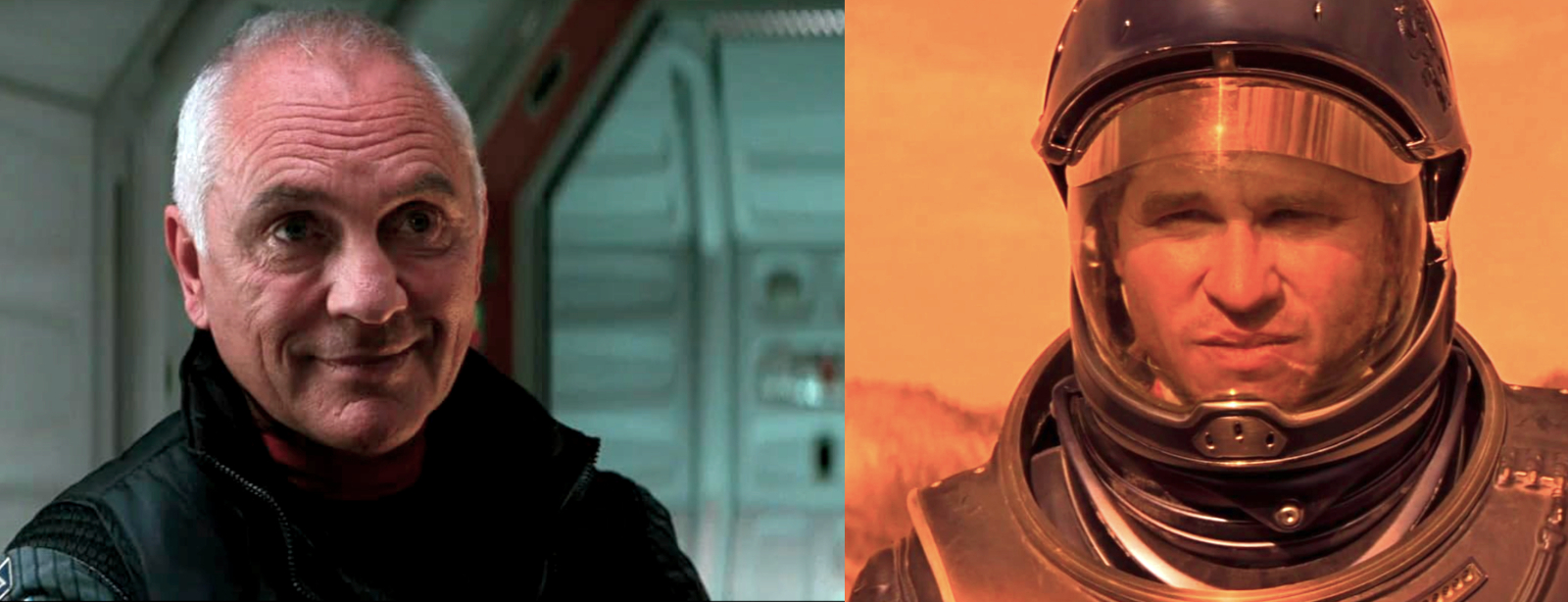
The Earth is becoming uninhabitable, but the world is doing something about it. Instead of sending a forest into space, robotic space missions are terra-forming Mars. Decades-ago missions nuked the Martian icecap, causing a global warming trend; the Martian plains were seeded with algae, which is expected to convert CO2 into Oxygen and make the air breathable. The present mission is to check on progress. The team will live in a survival lab already landed on the planet.
The mission is supposed to be taking place in 2025, but the technology we see looks more like 2125. That’s okay as not all of the tech miracles are impossible. The spacemen certainly come prepared. At one point Kilmer’s technician is able to interface with old Mars probes from the 1970s, both U.S. and Russian.
Why do all space movies have to become Space Disaster movies? When the ship reaches Mars orbit, the noble mission dissolves into a cascading series of survival crises. A blast of gamma ray radiation fries much of the ship’s circuitry. This forces Commander Bowman to stay on board while the other five go down the surface. Bowman must work like mad to restore full power to the main ship. Down on Mars, an injury in landing reduces the landing party again. They find no trace of the expected masses of algae, and the survival lab they need to survive has been destroyed … not blown up, more like shredded. They don’t have much oxygen in their space suits, and at first have no way to communicate. Bowman has to assume that they’ve died.
The complications that follow are pretty interesting. Another astronaut dies, and the only witness doesn’t tell the truth about what happened. An old Russian probe provides a chance to get them back to orbit, but their long hike to reach it is slowed by an ice storm. In the middle of all this, they find that the Martian air has enough oxygen for them to breathe. Where is it coming from if there is no algae?
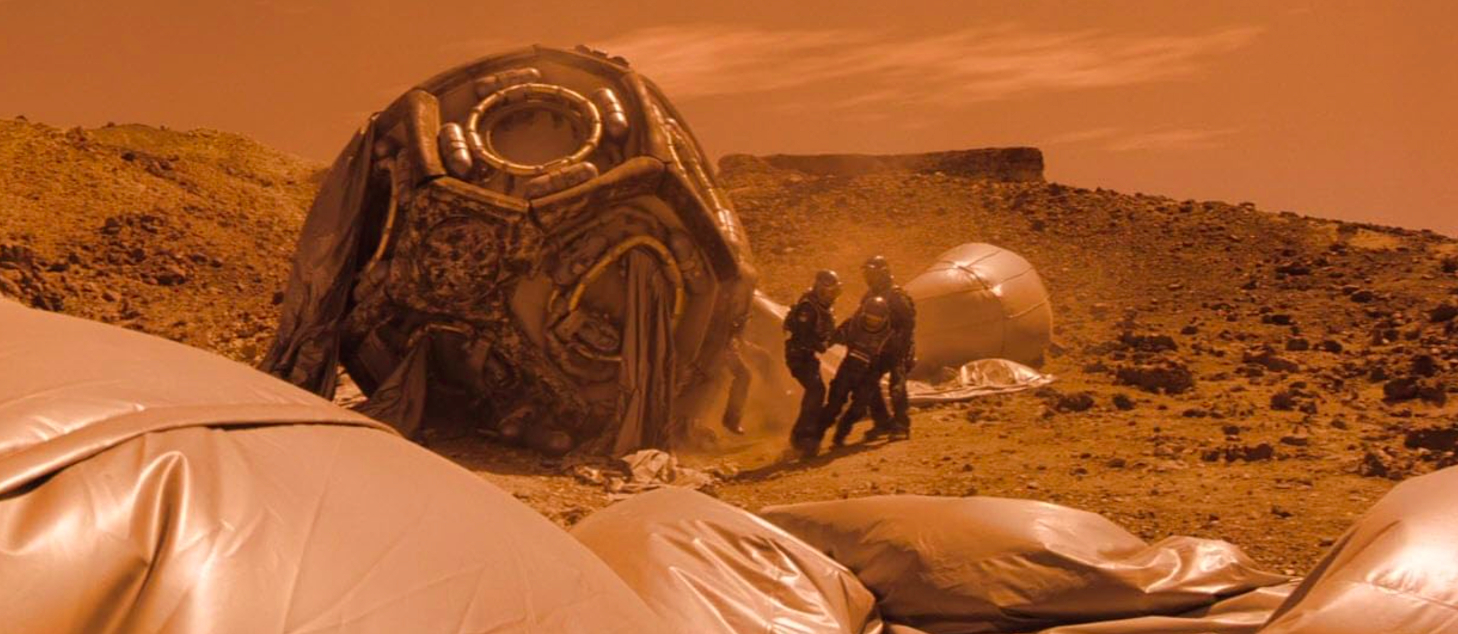
One complication is perhaps one too many. A robotic helper on the mission called AMEE is damaged in the crash. It reminds us of today’s robot dogs, with an added ability to reconfigure itself like a Transformer toy. Its programming scrambled, AMEE reverts back to its initial function as an autonomous killing drone for the Marines — and decides that the astronauts are its enemy. Thus we have a survival saga like Apollo 13 or The Martian souped up with a mini- Terminator that reminds us a bit of Screamers.
The survival stuff is absorbing, even when scientific realities are stretched. That gamma-ray storm had no effect on the Earth? The harsh, cold conditions on Mars are not very convincing; neither is the fact that observation from Earth or more probes couldn’t determine how much terraforming had taken place before the costly manned mission. So it all depends on how much fantasy one wants in one’s ‘realistic’ space drama. Why didn’t the ‘gamma radiation storm’ also affect electronics on Earth? The gamma spike appears to burn out every circuit on board the ship … but pushing some buttons and rerouting power makes all the electronics pop back to life, better than new.

The movie caters to Val Kilmer’s star image, letting us know that Gallagher will prevail and ‘get the girl.’ His laid-back attitude and crude behavior with Bowman are hardly professional, even if she welcomes it. Knowing how Kilmer forced filmmakers to alter movies to favor his star prerogatives, we bristle a bit at his macho grin. Things get better on Mars, when Gallagher (and Burchenal) face no-win, slow-death problems by exhibiting heroic Right Stuff qualities.
With so many Sci-fi films opting for irrational, sentimental finales — The Abyss, Contact — we are happy that Red Planet doesn’t go totally soft at the finish. Will Val Kilmer effectively kick his heels and return to Kansas? Script foreshadowing prepares us to expect that our desperate astronauts will be saved by an ‘act of God.’ This worry arises only because Terence Stamp’s character brings up the subject more than once, which seems to be his only story function. Did Chantilas have a purpose beyond being a nice guy? He does have one good line, saying that the astronauts must operate on Faith, because they’re entrusting their lives to the hope that all their delicate space technology will bring them back alive.
True, Red Planet is far from a masterpiece, but it is entertaining. It also very attractive. The film was largely shot in the deserts of Australia and Jordan. The dozen digital effects companies named in the credits helped make the locations look very much like authentic photos from the surface of Mars. The huge volume of digitally generated hardware is decently designed, and the action is well staged. The filmmakers do not abuse the script’s multiple countdown-to-disaster deadlines.
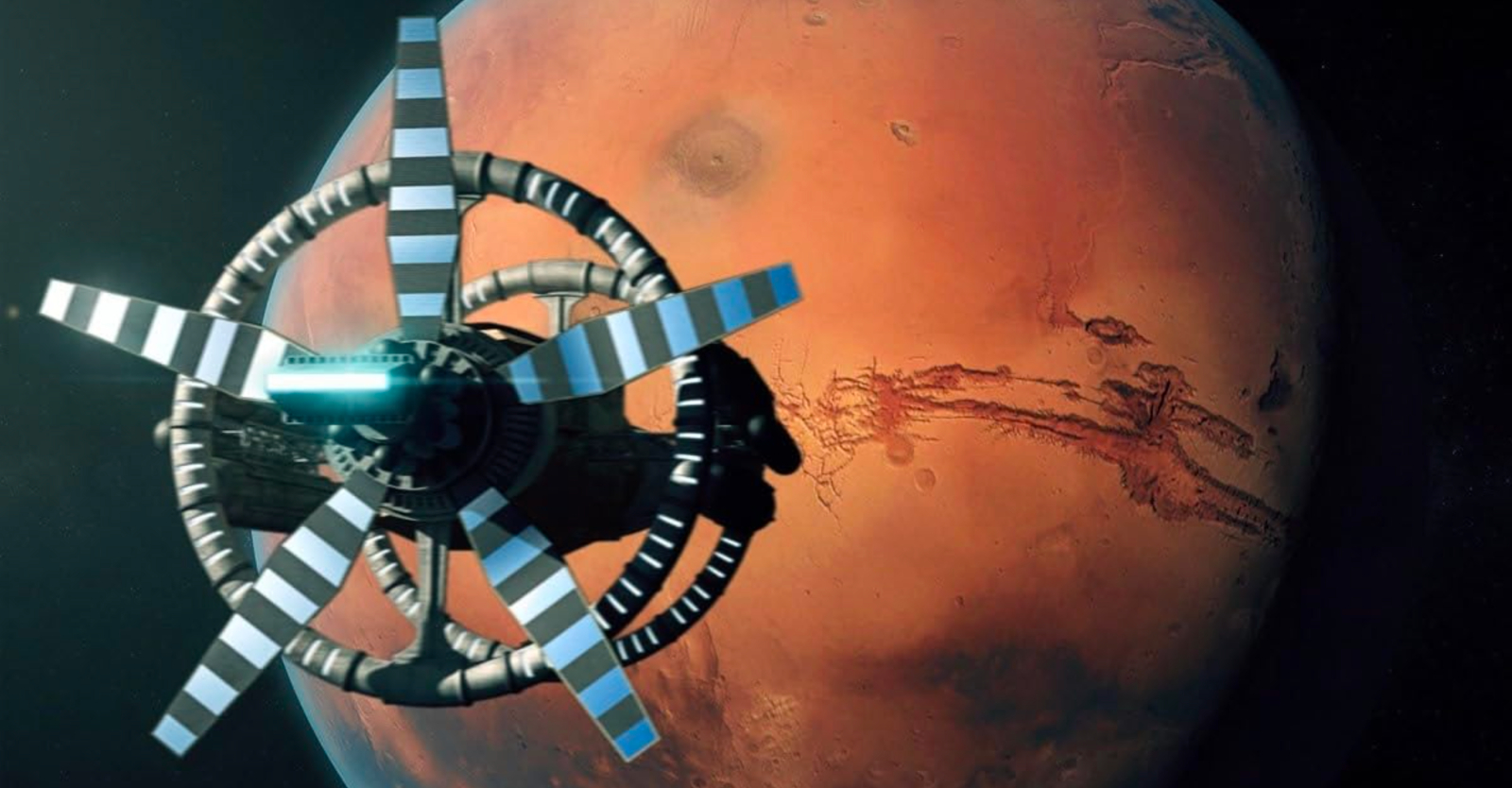
Excellent visuals help us stop thinking about the iffy science and accompanying implausibilities. The finale is not too grim, and the possibility of saving the Earth just enough to leave things on a positive note.
True, somewhat unwelcome things like the robot dog are an irritant, even if it is beautifully designed and depicted. That dog really seems chosen by a committee, or a computer making recommendations from ‘what has worked before.’ Do ‘studio memos’ explain the crew’s gym-locker dialogue, or Ms. Moss’s shower scene? When her Commander Bowman strips to a revealing top to work on the spaceship’s power problem, we’re convinced it’s due to some focus group’s happy memory of Sigourney Weaver on board the Nostromo.

Much of ‘Mission To Mars’ was shot here in Vancouver. It includes one of my favorite (local) tropes: the backyard BBQ scene, clearly filmed in November.