


This reviewer doesn’t review most foreign discs, but with major studios licensing out their libraries, there are now more reasons to think about getting an all-region Blu-ray player. One is extras. Akira Kurosawa’s Rashômon is already available in Region A from Criterion, but companies like Arrow and BFI produce discs with alternate special features. I’m considering going after a foreign disc of Eyes without a Face, just to catch up with a Georges Franju short subject I’ve always wanted to see.
In the case of Rashômon, the UK disc gives us authoritative and entertaining new extras from author and Japanese film authority Stuart Galbraith IV.
Rashomon was one of the first Japanese movies to crack the U.S. market, in ‘specialty’ art theaters. Critics tagged it as a hands-down masterpiece from day one, a judgment that has never been challenged. The film is a deceptively simple investigation into the ‘know-ability’ of truth, as seen in a trial following a deadly forest encounter between a Samurai, his wife and a notorious bandit. Much of it consists of speeches delivered to the camera, yet it is wholly cinematic. Kurosawa’s international breakthrough offers real insights into the nature of cinema storytelling. Its ‘testimonial flashbacks’ are just as daring, and perhaps more faithful to human nature, than the flashback structure of Citizen Kane. Rashomon is of course a boiler plate film school syllabus screening item.
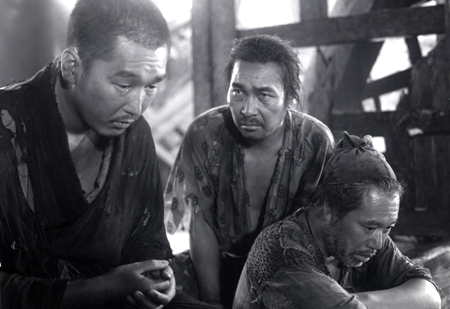
The flashbacks to a tragic incident are framed as eyewitness testimony, and the testimony is itself related as a second framing story. Waiting out a torrential rain under the ruined gate called Rashomon, a woodcutter (Takashi Shimura) recounts shocking recent events. Three days before, a man was killed and his wife attacked in the forest. The bandit presumed responsible has been captured. But during the trial, each of the participants and witnesses tells a distinctly different version of events. How can justice function when establishing simple facts is so difficult?
Rashomon is too entertaining for the narrow confines of film school. The story has action, intrigue, mystery and sex, not to mention excellent characterizations from its stars. Toshiro Mifune plays a somewhat less lovable variation on his familiar rascal bandit. In the spate of Kurosawa remakes that followed The Magnificent Seven, Martin Ritt transposed Rashomon to the American West as The Outrage, with a woefully miscast Paul Newman as a Mexican bandit. The remake took place on phony interior sets, a change that makes Kazuo Miyagawa’s great location photography look all the more magical.

Most of Rashomon plays out in a verdant forest, under a canopy of high foliage that bathes the actors in moving patterns of dappled light. With the shadows of leaves always in motion, there’s no such thing as a static shot. Whether or not the truth is altered by memory, the unchanging setting insists that the witnesses cannot alter nature. The truth is in the trees somewhere — perhaps there are higher powers that will remember. Kurosawa softens his vision of humanity as a hell of selfish mendacity, with a closing gesture towards loving charity. It’s a satisfying coda.
The film-school lesson of Rashomon can be found in any textbook. The cinematic experience is different from a literary one because films always present an immediate reality, always in the present tense. Movies can fracture time with flashbacks, but they can’t express ambiguity the way a book can — a tree is either there, or it’s not. By and large, psychological complexity must come from the written script or the director must use symbols and allusions — in effect, become more self-consciously arty.
Rashomon’s memory-flashbacks seem simple enough until the accumulation of conflicting testimony trips us up. From the empirical evidence, it’s not easy to evaluate who might be telling the truth. If these flashbacks lie, is any testimony or memory reliable? Hitchcock tried a single false flashback in Stage Fright, and only caused problems for himself — audiences decided that he was ‘cheating’. Rashomon’s conflicting testimony innovation saw frequent use for comic effect in later shows, like the farce Les Girls.

The film poses an obvious emotional puzzle. Characters that are reserved or stoic in one person’s testimony-episode are assigned completely different personalities in another episode. As the wife, Machiko Kyo shows a wide range of emotion, but Mifune’s contrasting interpretations of the bandit character are surprising as well. Finally, Takashi Shimura, later the leader of the Seven Samurai, provides a solid spine in the moralistic framing story. The movie has the effect of a basic psychology test — viewers come away with different ideas of what the intended “truth” might have been.