


A.I.P. released some tacky movies in its day but none were respected less than those cobbled together from foreign imports spiked with new filmed-in-Hollywood storylines. The one that holds up best is Curtis Harrington’s creative and well-judged Queen of Blood, a micro-budgeted production that comes out looking very good on Kino Lorber’s new Blu-ray. And for once the special extras are indeed special.
The otherwise disparate filmmakers Curtis Harrington, Francis Ford Coppola and Peter Bogdanovich all took charge of adaptations of Soviet science fiction films for A.I.P. and Filmgroup, transforming them into propaganda-free entertainment for American kiddie matinees. Always interested in Sci-fi, producer Roger Corman bought the U.S. rights for a Goskino movie by Mikhail Karzhukov, Nebo zoyvot, to which Coppola added some monsters and a new name, Battle Beyond the Sun. Bogdanovich shot scenes with Mamie Van Doren as a telepathic Venusian ‘space nymph’ to add a bit of cheesecake to a sex-challenged ‘Leningrad Popular Science Film Studio’ epic called Planeta bur. The result is a fairly forgettable turnip called Voyage to the Planet of Prehistoric Women. But the most elaborate retrofit of a Russian space epic for American screens occurred with Queen of Blood. Experimental director Curtis Harrington and his producer George Edwards didn’t just augment Karzhukov’s Mechte navstrechu, they filmed an entire new story to sandwich between the original’s spectacular special effects scenes. The original Mechte navstrechu was a flat 1:33 ratio production, so some compositions are compromised by the cropping to 1:85.

I’ve seen the original 1963 Mechte navstrechu, a title that translates roughly as A Dream Come True. Unlike earlier Soviet space films that concentrate on Cold War conflicts, Karzhukov’s show is about a deep space civilization that sends emissaries to Earth. Their spaceship looks like a globe girdled by an Arab crown. When it crashes on Mars, Earth’s united space scientists send one ship and then a second to rescue the survivors.
Harrington re-imagines Mechte navstrechu for some very fast filming on just a few sets with name actors John Saxon and Basil Rathbone. The visionary/futurist original theme is gone and in its place is a commercial Sci-fi-horror hybrid. The new footage is cleverly designed to match expensive special effects scenes from the Soviet original. An unbilled Roger Corman served as a silent partner producer. In some ways the movie is a color successor to his B&W Sci-fi efforts of the late 1950s — the main title sequence uses similar abstract artwork. The most expensive item in the budget is said to have been the manufacture of a couple of space helmets to match the props seen in the Russian footage. Harrington must be careful with his angles when a scene requires three helmets to be in use at the same time. By replacing the helmet’s light-colored crown with a dark alternate, the two props are made to represent four or five separate items.
Harrington’s matching is remarkable. Both movies begin with groups of eager-beaver space cadets lunching at an interesting modern building that fits in well with the original film. Space establishment chief Doctor Farraday (Basil Rathbone) delivers a speech from the foot of a colossal (and very Soviet- styled) statue. Farraday announces that contact has been made with an advanced star-faring civilization that will be sending voyagers to Earth.

When the aliens crash-land on Mars stalwart hero Allan Brenner (John Saxon) volunteers to stay behind while his girlfriend Laura James (Judi Meredith of Jack the Giant Killer) and best buddy Paul Grant (Dennis Hopper of Harrington’s Night Tide) take the first ship.
The original Russian footage provides odd visuals of life on the distant planet, represented by strangely designed machinery and space hardware. The Soviet rocketry effects fit in nicely with Harrington’s re-shoots, even with the 1:85 matting. The center section of the film shows the first rocket getting stuck on Mars. The daring Brenner lands a smaller rocket on one of the Martian moons and then continues to the Martian surface in a smaller shuttle. Again, the matching is just good enough to give the impression that the show is an organic whole. Although nowhere near the visual masterpiece of Mario Bava’s ‘space gothic’ Planet of the Vampires, Queen of Blood is filmed with taste and style.
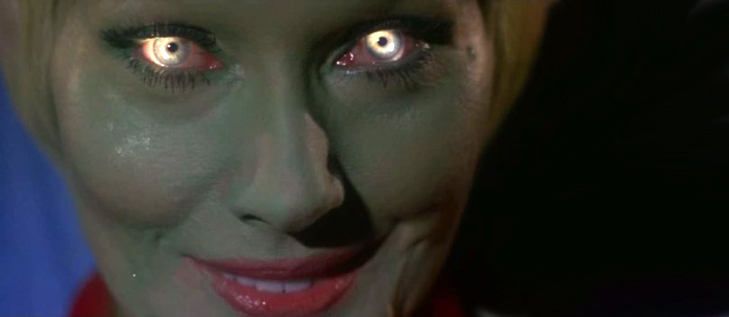
The show hits its stride when the spacemen rescue an unconscious female alien survivor who neither talks nor eats. She has green skin and piercing eyes. She wears a strange beehive hairdo and a clinging leotard-like costume. The alien is played by Florence Marly, a Czech beauty who starred in a Sci-fi film from a Karel Capek novel about an ultimate explosive called Krakatit (1948). She’s also excellent as the greedy girlfriend of a Nazi general in René Clément’s superior submarine movie The Damned (1947). Marly was one of many European actresses imported to Hollywood in the late ’40s that didn’t make a big impact. Her Alien Queen with the enormous white hairdo would seem to have been an inspiration for the Martian Assassin played by Lisa Marie in Tim Burton’s Mars Attacks! Several of Curtis Harrington’s later movies would star ‘mature’ actresses in unusual roles, which puts Florence Marly in the same company as Simone Signoret, Debbie Reynolds, Piper Laurie and Shelley Winters.
Harrington and Ms. Marly take pains to make the Alien Queen into a memorable character. Her mysteriously smiling face is framed in carefully chosen close-ups, using precise lighting to make her eyes appear to glow. She hates Laura but stares hungrily at the men with a gaze that turns out to be telepathic. As the title suggests she’s really a space vampire. Doctor Farraday instructs the astronauts by radio to keep Marly’s Queen Vampire alive with blood from the medical locker, which is a very bad idea. Who will get back to Earth alive, and how will they stop the Queen of Blood from feasting on Earth’s entire population? Harrington’s show takes itself seriously, unlike American-International’s original trailer. It drips with campy taglines like, “Turns the Milky Way into a Galaxy of Gore!”

Veteran Basil Rathbone was reportedly unhappy that a major star such as himself could be forced to work under such reduced circumstances. It looks like Rathbone’s services might have been needed for only a couple of days — Farraday typically enters scenes, makes his mark, and then exits to allow the younger actors to carry on. A non-speaking assistant is played by Forrest J. Ackerman, a personal friend of Harrington whose Famous Monsters of Filmland was then at its peak of popularity. His casting is another instance of A.I.P. coordinating its publicity campaigns with Ackerman’s magazine.
Dennis Hopper’s gentle, passive space man becomes the first earthling to be seduced by the mystery woman from beyond the stars. As with his unassertive sailor in Night Tide Hopper’s character appears to be a Harrington surrogate. It’s difficult to connect this meek ‘Harrington’ Hopper with the anti-establishment rebel the actor would play just a couple of years later in Easy Rider.
Future Star Wars producer Gary Kurtz was Harrington’s production manager, and the spaceship interiors constructed by his reported crew of ‘hippie carpenters’ are attractively designed. Even taking into account a nagging problem with a batch of silvery contact paper, they are far less tacky than was the A.I.P. norm for marginal productions of this kind. The final act on the rescue ship relies on Harrington’s expressive direction and cameraman Vilis Lapenieck’s creative lighting for the close-up character work.
Queen of Blood is easily the best of the A.I.P. import-recuts and the only one that hangs together as a fully satisfying drama. It was in active second-feature release for several years straight and I remember it playing on television at the same time that it showed in theaters. Several alternate titles have been assigned to TV versions but I’ve only come across the one it bears now.
