
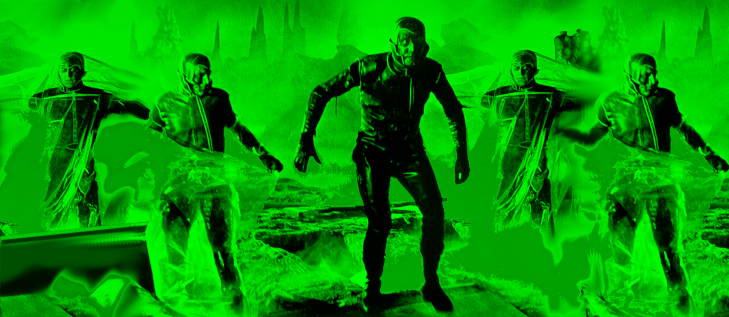


Kino Lorber improves on the 2014 Scorpion Releasing/Kino Blu-ray release with a Special Edition Blu-ray that touts a new transfer. That’s good news, although we’re still talking about the standard A.I.P. cut of the film as released in the United States; we’re told that foreign versions differ slightly in content. Kino adds a new commentary to sweeten the mix.
We’d be wrong to call Planet of the Vampires Mario Bava’s first foray into science fiction. Back in his ‘take over for other directors’ days, the cinematographer reportedly directed most of Paolo Heusch’s 1958 La morte viene dallo spazio, aka The Day the Sky Exploded. And it was established early on that most if not all of Riccardo Freda’s Caltiki, il mostro immortale is Bava’s show too. Planet of the Vampires is notable for its genre ambition. No scenes take place on Earth. For a full 90 minutes we’re either in space, on a completely weird nightmare planet, or within the interiors of spaceships that needed to be designed from the ground up. That’s the same ‘gotta do list’ that MGM tackled for Forbidden Planet. Sticking a photo blow-up in front of the camera just wouldn’t hack it.
Mario Bava’s fanciful lighting style is so diverting that it can be fairly considered a special effect on its own. Most every shot applies the in-the-camera trick film techniques that made Bava the go-to guy for fantastic visuals in ’50s Italian cinema. The continuity of style led to Planet being tagged as a ‘Gothic’ Sci-fi, especially in America where the title identifies its resurrected astronaut corpses as vampires. In 1965, with the Italo horror cycle on the wane, an alien planet inhabited by undead spirits was a novel idea.

The nightmare begins when the twin spaceships Argos and Galliot alight on the volcanic and foggy planet Aura. Soon after landing, Argos’ Captain Mark Markary (Barry Sullivan) and Sanya (Norma Bengell) of the Argos can barely restrain members of the crew from maiming each other in inexplicable fits of violence. Worse, when they trek to the Galliot they discover its entire crew dead, with evidence pointing to an orgy of killing. While the Argos is being repaired some crewmembers report seeing strange lights. Mark and Sanya then investigate a derelict alien craft nearby. It is littered with the skeletal remains of grotesque alien creatures. When the astronauts’ hastily buried casualties begin returning from their graves, a terrible secret finally becomes obvious: spectral Auran beings can possess their dead bodies and turn them against the living.
Had it been released a couple of years later, Planet of the Vampires might have become a noted ‘trip’ film — its atmosphere of colored smoke, weird lighting and the strange costumes are more expressive than the the psychedelic exploitation films that would follow. Bava could toss off these delicate visual effects and complex lighting schemes at a dizzying pace. The dreamlike atmospheres he creates are not the outer space of Stanley Kubrick. The spaceships could belong to Buck Rogers, and the planet Aura could be a mythic Hell from Bava’s Hercules in the Haunted World.

Science fiction is the only genre in which success is routinely measured by the ‘realism’ of the special effects. Most of us are biased against giant space ships that look like toys, yet readily accept obvious miniatures in Japanese fantasies. Bava’s in-the-camera composite illusions do have their limitations. His planetary vistas often have a sharp foreground and background, but a fuzzy mid-ground, a photographic impossibility that unmasks many faked flying saucer photos. But Planet also features shots too clever to yield to easy analysis. When the film was new we certainly didn’t realize that Bava had filmed some spaceship shots underwater. Tim Lucas’s careful explanations for other Bava effects point out things I had never considered, including an errant finger caught holding a miniature.
And who wants realism, anyway? Bava’s alien phantasmagoria is more interesting than the Death Valley scenery and fake studio caves of Robinson Crusoe on Mars. Bava approached his films as personal art craft. He kept them small-scale to avoid surrendering artistic control to producer oversight. In the middle ’60s before the visual effects boom, this autonomy made Bava a one-man effects artisan-genius. Nobody confuses Ray Harryhausen’s animation with that of anyone else, and the same goes for Bava’s work. We know a Bava picture as soon as we see the way scenes are lit. As Tim Lucas points out, even an insert of a hand picking up an object is immediately recognizable as Bava’s. Nobody else sculpted such attractive blends of color and shadow.

Planet of the Vampires does have drawbacks, mostly related to some story and production simplifications. The Argos was meant to land intact and the Galliott was to be wrecked, but it was too tempting to keep both spaceships in good repair so that one studio set could serve for both ships. The result is that we can become confused about which ship we are on at any given time — they are identical. Both the ship interior and the smoking, foggy landscape outside are largely assembled from modular units — sliding doors and blank wall panels inside, interchangeable rocks outside. We never get a good idea of the geography of either area. The spatial dislocation that results is good for eerie atmosphere but not good for building a strong narrative.
Barry Sullivan’s captain and to a lesser extent Norma Bengell’s assistant stay clear in our heads, but most of the the other astronauts are a blur lacking distinct personalities (or distinct voices). They fight, shoot ray guns, and run from one place to another incessantly — yet we quickly lose track of who’s who. It’s more rewarding to concentrate on the impressive designs and especially the excellent costumes. The leads are even given two styles. The black leather space outfits look like warm-ups for the next year’s Diabolik. Their high collars look great — and also look like they might chafe. The stylishness pre-empts any question about ‘pressure suits’ — even the helmets are great designs.

According to Robert Skotak’s excellent book on Ib Melchior, director Bava skims over the finer points of the screenplay, some of which sound very difficult to visualize. The most novel is the idea of ‘peripheral vision’ Auran phantoms, which the spacemen glimpse only out of the corners of their eyes. Bava offers no visual representation of this beyond flashing some lights across the frame. I can imagine an “Aura-Vision” in which something can be seen only in the corners of the frame … but knowing how theatrical projection varies, any effect seen at the screen’s edge would often be masked off, and go unseen.
These ‘dreamlike’ details contribute to Planet of the Vampires’ status as a movie that de-emphasizes the narrative experience in favor of pure visual delirium. We instead soak up the heady Auran atmosphere. The rising of the ‘Vampires’ from their impromptu crypts is certainly eerie, despite the slow motion achieved with optical step printing. Did A.I.P. impose that? We know that Bava avoided optical work whenever possible.
The film’s defining, fully original sequence is the investigation of a derelict alien spacecraft. Inside its chambers, Markary and Sanya find giant skeletons that look like spiders with human skulls. Good sound effects add to a claustrophobic effect, as Captain Markary and Sanya work to free themselves before an ancient mechanism pumps all of the oxygen from the alien ship interior. Back in 1965 we assumed that the skeleton was the remains of an Auran. Only after Ridley Scott’s Alien came out did we pay closer attention to the dialogue in these scenes.
Tim Lucas notes that the skeletons outside of the wrecked ship are posed much like the dead human bodies found back in the Galliot – the Aurans forced both races to destroy themselves using mental control. A more focused screenplay would have made Markary point out this similarity for the benefit of clueless thirteen year-olds in the audience (me). Not since Forbidden Planet were we invited to contemplate an alien race based on archeological evidence. Planet of the Vampires succeeds as a spacey spook show, but it also touches on some very good ideas.

