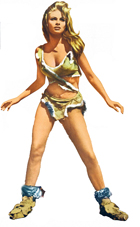
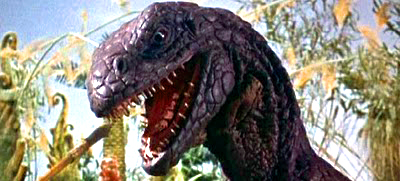
Here’s a title we haven’t seen in a while, and that we’ve never seen at this level of quality. Hammer Films’ most successful release ever One Million Years B.C. launched a new film star. I count myself among the zillions of kids that pinned her poster on my bedroom wall. At age fifteen, the release of a new Harryhausen film was so important to me that I begged my slightly older neighbor to take me to the drive-in, the only venue in San Bernardino where it could be seen. Little did we know that the U.S. version we saw was a full reel shorter than the U.K. original.
Hammer Films was at the top of its form in 1966, at least on the ledger books. Its product was exported everywhere and the Hammer brass were still enjoying lucrative deals with the big American studios. Thanks to the cultural observations of Susan Sontag, the notion of ‘Camp’ joined girl watching and dinosaur fandom as reasons to see Hammer’s sober foray into the prehistoric caveman genre. British critics were beginning to see hipster value in genre films outside the New Cinema movement. Despite having not a single joke this caveman picture was written up optimistically in the U.K.’s Monthly Film Bulletin as a tongue-in-cheek quasi-comedy of substantial wit. Of course, so was Joseph Losey’s only intermittently coherent Modesty Blaise, made the same year.
I don’t know what the critics saw or what condition they were in when they saw it, but Don Chaffey’s turgid saga of cavemen foraging, feuding and battling dinosaurs is difficult to take very seriously. For the most part it’s a straight remake of the old Hal Roach oddity that had made a star of Victor Mature, the one from 1940 that surely has been raided for stock footage more than any other Hollywood movie. Hammer’s remake has a bigger claim to movie history: it was the showcase starring debut for Raquel Welch, the blonde cave girl with the perfect ‘sixties fur bikini.
After a ponderous opening alluding to the creation of the world, One Million settles into an examination of savages at the dawn of time. A power struggle for leadership results in the banishment of young Tumak (John Richardson) from the Rock people tribe. After wandering through the wilderness Tumak comes upon the more civilized beach camp of the Shell people. Enchanted by Shell maiden Loana (Raquel Welch) he learns to relax, live less aggressively and enjoy life more. Tumak momentarily becomes a hero by defending the Shell tribe from an invading Allosaurus. Only a little while later, his uncivilized behavior results in his ouster from the beach tribe as well. But this time Loana decides to go with him.

The movie is at least different than the average Hammer film. The studio had been mired in formulaic, under-budgeted horror offerings for at least four years. Along with the previous year’s She this dinosaur epic is a much bigger undertaking. Spectacular location work amid the volcanic beauty of the Canary Islands lends an otherworldly quality lacking in any previous caveman tale. Instead of going its usual cheap route Hammer recruited the top effects expert Ray Harryhausen for the prehistoric scenes. It was perhaps the first time that a stop-motion animator was actually courted as star talent for a major film assignment.
One Million Years B.C. is one of Ray Harryhausen’s most attractive pictures, and it gives him a big opportunity to animate good old-fashioned dinosaur monsters. But the caveman genre never won a great deal of respect from audiences, even when mined for laughs in silent comedies. The screenplay has a dialogue vocabulary of about fourteen words. More than half of the picture is concerned with motley groups of Rock people hunting wild goats, or our ragged lovers wandering amid the admittedly breathtaking scenery. Thanks to the attractive casting, we do feel for the lovers cast out into the monster-infested wilderness. Each has left behind an ex, who is none too happy. It’s just another story in the saga of Bedrock 90210.

Director Don Chaffey went for a ‘big’ look, with all those eye-popping landscapes to exploit. Much of the film’s appeal was lost when seen on small TV screens. But there was always Raquel Welch’s fur bikini to admire between samples of Harryhausen’s sophisticated dinosaur imagery. Welch is quite a vision — a poised and proper beach girl with hair to die for and makeup to match. The role of Loana was a potential career kiss of death, but Ms. Welch accepts it as a challenge — a starring part was not easy to come by back then.
John Richardson is handsome, yet his Tumak comes off as too dull-witted to win our full approval. The sight of his beach bunny girlfriend carried off by a hungry Pteranodon stirs vaguely civilized notions within Tumak’s savage breast. There are hints of possible insights about mismatched cultures, which mostly amount to table manners and learning to share, Kindergarten-style. The plotting continually reverts to Hal Roach logic: whenever some business threatens to become a real scene, a dinosaur or a natural disaster will interrupt it. Some cannibalistic monkey men appear for decorative purposes but the lack of any scientific basis for what we’re seeing pre-empts any musings about the Dawn of Man. Stanley Kubrick would address that issue a couple of years later. If it weren’t for the film’s ‘immoral’ emphasis on Raquel Welch’s perfect body, the show could have been a fave of creationist fundamentalists, who preach that man and dinosaurs co-existed just a few millennia ago. [Note — the disc’s inside package image is a shot of Raquel Welch, in her Years costume, crucified. It doesn’t bother me but in today’s climate I think an objection or two might roll in.]

Percy Herbert had been in Harryhausen’s Mysterious Island. He returns here to play Tumak’s greedy brother, and this time doesn’t try to do a Southern accent. Teenage James Bond fans immediately recognized Martine Beswick from From Russia with Love and Thunderball. Hungry eyes, athleticism, and an aggressive sex attitude were Ms. Beswick’s credentials — she should have been cast as Modesty Blaise.
Not counting the rather patchy segment from Irwin Allen’s The Animal World, Ray Harryhausen had only made one straight-out dinosaur feature, The Beast from 20,000 Fathoms. Since then he had animated a score of fantasies featuring monsters that appeared at regular intervals, like vaudeville routines. The biggest dinosaur battle is the least interesting, because it’s almost a replay from the 1925 The Lost World, where monsters fight and kill each other while the humans look on from the sidelines. Harryhausen added his impressive illusions of contact via spears and rocks, and manages many illusions in which the miniature ground below his monsters matches the live-action ground nearly perfectly. In the technically near-perfect sequence with the pleasantly benign Archelon sea turtle, his trick of simulating contact by replacing spears and rocks in mid-flight is just terrific. The turtle is given a rare privilege for a Harryhausen monster, in that it is not killed. When they first saw the movie, my kids applauded this reprieve.

A brief stop motion sequence with a brontosaurus is unaccountably composited in such a way as to make it look half a mile long. A live-action lizard and an unlikely spider were possibly substitutions for animation scenes Ray didn’t have time to complete. Although Ray is on record giving other reasons, I wouldn’t be surprised if Hammer just couldn’t wait for him to finish his usual months of post-production work.
Among Harryhausen’s best sequences ever is the Allosaurus attack on the Shell camp, a situation lifted straight from the 1940 original. Tumak is beginning to acculturate himself to Shell ways when the Allosaurus barges in, threatens a child in an Edenic apple tree, and proceeds to chomp down on a luckless caveman. Above and beyond his technical skill, the miracle of Harryhausen is his ability to imbue his creations with personality. The monster is alert, mean looking and spry. In one nice moment, the Allosaurus nimbly lifts a spear out of an attacker’s grasp, as if saying, “This thing hurts. Let’s just put it over here where you can’t reach it.” An impressive trucking composite shows the cavemen forcing the dinosaur to back-pedal to the right, away from the points of their spears. The fight is more dynamic than normal because the Allosaurus isn’t all that larger than the cavemen — it’s a fair contest.

The Allosaurus moves like Harryhausen’s Gwangi, but the model is more detailed — this creature has nicely sculpted fore-claws instead of Gwangi’s floppy flippers. I like to think that Ray wasn’t able to get the dinos out of his system, and that the work-for-hire One Million Years B.C. whet his appetite to go do a Dino-Rama spectacle of his own.
After the fairly soporific volcanoes and earthquakes in Harryhausen’s Mysterious Island, this saga wraps up with a truly good eruption. Rocks stab up out of the ground, rivers of lava gush out of a mountain, and cavemen topple from a landscape that’s breaking up like an ice floe. An iguana is dumbly included in the proceedings, but the travelling matte insertion of foreground action into miniature sets is terrific. One shot of some cavemen clobbered by falling boulders was cribbed by Stanley Kubrick and repurposed for a montage in his A Clockwork Orange. In terms of technical polish, the movie is a high point for both Harryhausen and Hammer.
The final shots show the volcanic survivors staggering together in B&W images that look almost sepia toned. Director Don Chaffey must have dropped the color to give us a style change for the curtain, but the effect is rather ironic. The monochrome makes it seem that man’s prehistory is ready to advance to the next step – B&W silent comedies with Laurel & Hardy and Buster Keaton!