

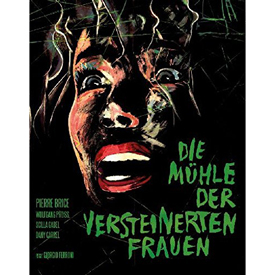
2016 is shaping up as a banner year for horror Blu-rays; I only wish that this year’s violent political horrors could be confined to harmless vintage movie offerings. Savant is crazy about early Euro-horror, and the English-language version of the ground-zero gothic Barbara Steele offering The Horrible Dr. Hichcock will arrive come September. But an appetizer is here now, in fanatic-friendly multiple versions.
1960 was a boom year for horror internationally. In America came the first of the Corman-Poe pictures and Psycho; in England Hammer was running strong and Michael Powell brought out (briefly) Peeping Tom. On the continent Mario Bava’s Black Sunday made its influential debut, and Roger Vadim released his bizarre Carmilla story …Et Mourir de Plaisir (Blood and Roses). An exotic runner-up among these attractions was Giorgio Ferroni’s Mill of the Stone Women, a shocker that made a successful European run. It didn’t show up in the United States for three years.
Twelve years ago Mondo Macabro made one of its debut releases a Region 1 DVD of this title. Before DVD all we had been able to see of Mill of the Stone Women were faded, flat VHS transfers of a cut-up and badly dubbed version. Of the people I knew who had actually seen it, none could remember it clearly except to say that the original Technicolor was stunning. Now it looks even better, in Blu-ray.

Outside Amsterdam, Hans von Arnam (Pierre Brice) comes to a small village of Veeze to work for Art Professor Gregorius Wahl (Robert Boehme), documenting Wahl’s old windmill that serves as a famous wax museum. Hans re-encounters his old sweetheart Lisolette Carnin (Dany Carrel), one of Wahl’s students, but is seduced by Wahl’s mysterious daughter, Elfi (Scilla Gabel). Told to stay away from the young lady, Hans nevertheless is drawn to her room, and into the horrible secret shared by her father and his ‘guest,’ Doctor Loren Bolem (Wolfgang Preiss). Elfi may indeed be dangerous, but her twin father figures are far more malevolent.
Mill of the Stone Women is an artfully contrived horror concoction, that like at least a score of early ’60s thrillers was clearly inspired by the previous year’s Eyes Without a Face. While Italians Bava, Margheriti and Freda were making underfunded B&W films, Giorgio Ferroni got to work with color, beautiful sets and elaborate art direction. This mad doctor hybrid rethinks a fairytale-like story about a moritiferous young woman, in a setting reminiscent of The Mystery of the Wax Museum.
Hans arrives in the moody canal town and finds only trouble in Dr. Wahl’s creepy windmill-house, with its rooms strewn with art bric-a-brac and morbid statuary. Rigged to the windmill’s clockwork is a carillon display of female mannequins that parade on a track for the amusement of visitors. They represent ill-fated women from history: Joan of Arc, Cleopatra, etc. One is a graphic hanging victim and another lies ready at the head-chopping block.
But the weirdest woman in the mill is an elusive pianist who first appears holding a dog on a leash, just as did Barbara Steele in Black Sunday. Beautiful but strange, Elfi is that woman whose attraction hides secrets we’d rather not know about, the one who appears in stories from the Bible forward to inspire men to foolish decisions. Hans is honest but vulnerable, and gives in to Elfi’s enticements. After succumbing to The Way of All Flesh, I’m surprised that Hans doesn’t have more romantic trouble with Liselotte. At least he doesn’t try to weasel out of his predicament with a typically evasive male argument: “I slept with her but it’s okay because in the process I discovered I love you. So you’ll forgive me, right?”

The next day Hans has learned the difference between lust and love and guiltily declares himself to pert Liselotte. But Elfi overhears them. Although professor Wahl entreats Hans to stay away from Elfi — her health is precarious — Hans meets with her to honorably break off the affair. Elfi appears to die on the spot from some kind of seizure. After wandering the night in a disoriented state, Hans returns to the mill where the sinister Dr. Bolem gives him a ‘tranquilizer.’ The young man proceeds to hallucinate a number of strange phenomena: missing pendants, bloody knives, a redheaded beauty bound and gagged in the doctor’s basement laboratory. He briefly sees Elfi both alive and dead in a cobweb-filled room.
It’s at this point that Mill of the Stone Women drops its supernatural tone to become a medical horror picture. Professor Wahl and Doctor Bolem’s morbid secret requires the blood of young women, and the thriller resolves with a kidnapped heroine and a last-minute rescue. But there are decidedly macabre touches: corpses being fashioned into statues, a dummy buried in place of a body.
All of this would be exploitation trash if it were not for director Ferroni’s well-developed morbid aesthetics. The basic “save one woman by exsanguinating another” idea had been done to death in films like She Demons before Eyes Without a Face suggested that such trashy pulp could become surreal art. Mill of the Stone Women sets a fantastic stage with the strange architecture of the Mill interior and the carillon. Expressive lighting adds to the excitement. There’s nothing crude about the delicate use of color to support the performances.

The bright cinematography exhibits touches of classic horror expressionism. Professor Wahl makes an entrance through a narrow aisle of carved emblems and religious sculptures, with a blast of unmotivated blood-red light on the floor. Elfi stands holding a crimson rose (much like Annette Stroyberg in Blood and Roses) or lies draped across her bed awaiting the arrival of Hans, bathed in chroma contrasts that heighten her sensuality. In a two-shot embracing Hans, she moves from rim-lit backlight to a careful composition with a Joan Crawford-like eye light across her otherwise dark face. This is more than ‘pretty pictures,’ it’s the kind of careful lighting abandoned by most genre efforts of the 1950s. The ‘aesthetic delirium’ has an impact similar to that of Vertigo. Elfi’s appearances are also heralded by a melancholy violin motif. In horror, only Freda’s The Horrible Dr. Hichcock and Bava’s Black Sabbath front a more compelling color atmosphere.
Mill of the Stone Women takes place sometime around 1912 and has a good sense of period decor. The canal-side exteriors are hazy and overcast. To get to the mill, one rings a bell for the ferryman, like the one in Dreyer’s Vampyr. It’s been pointed out that some of the set dressings are familiar from other Italian horror films, so it’s likely that the Dutch exteriors were all matched with interiors shot in Rome. Now that we can see the title sequences for the European versions, the credit for Cinecittá confirms this. The musical score veers from a creepy carillon tune, to that lush romantic theme for Elfi’s seductions. The only production disappointment is an unconvincing miniature of the mill used for night exteriors — it weakens the film’s ending.
Ferroni’s relaxed pace might seem too slow for modern viewers. The acting is all fairly formalized. The two mad doctors behave in an expressionist manner, one obsessed with saving his daughter and the other obsessed with bedding her. They’re gentlemen scholars yet function as kidnappers, murderers and mutilators of young women, not to mention the bizarre regimen of transfusions they’re putting Elfi through. Herbert Boehme is intimidating as the father, an artist who repurposes beautiful women to serve as figures in his crazy clockwork attraction. Sinister Wolfgang Preiss (The 1,000 Eyes of Dr. Mabuse) mixes his surgical villainy with an understandable lust for the heroine.

Scilla Gabel is the focus of all this mayhem. The ravishing Italian served as Sophia Loren’s stand-in before using plastic surgery to find her own look (more thoughts of Les Yeux sans Visage). Gabel’s full body contrasts with a face that’s all bone structure — her skin seems more tightly stretched across her cheeks than that of Barbara Steele. She’s a lean vixen with hungry, haunted eyes. Between Gabel, Steele and Dahlia Lavi (The Whip and the Body) the ‘sixties gave us a full spectrum of exotic horror heroines.
Our handsome hero Pierre Brice is a good enough actor to lend Hans some needed complexity. Brice is better known for playing Winnetou the Indian in a series of German Westerns. His Hans can’t resist Elfi’s invitation and feels that he has betrayed both women. He looks suitably frazzled when given Dr. Bolen’s tranquilizer — what is it, LSD? — and is outraged to discover the full depth of the medical conspiracy.
At the time the biggest name in the picture was Dany Carrel, a sexy contender for stardom with an interesting face. She’s mostly decoration here, providing the slight bit of nudity that puts the film on the transgressive edge where it needs to be. Marco Gugliemi serves as the gee-whiz best friend. Liana Orfei is the beautiful victim to fulfill the Eyes Without a Face formula quoted by Raymond Durgnat: one girl is sacrificed, and another saved in the nick of time.
Foolish Professor Wahl forgets Rule Number One when dealing with a mad surgeon: allow the genius sawbones to revive your daughter before you stab him to death. Although the mad doctor machinations provide a fiery ending, what we remember most from Mill is our hero’s seduction by a strange woman who asks him to throw caution and responsibility to the wind. The doom she represents is difficult to separate from society’s double standard, the rule that encourages young men to take what they can get while they can get it. Elfi is neither a vampire nor a madwoman, but she is a prejudiced image, an example of the ‘mysterious female’ representing the notion that Sex is by definition evil. She’s a Lorelei, a Siren, the woman with the skull face that represents lust and vanity in the old engravings. She’s also the skeletal seducer that symbolizes War in archaic political cartoons. Mill of the Stone Women is an excellent example of an undefined misogynistic myth.

