


James M. Cain’s 1941 novel Mildred Pierce offers a venal and self-destructive view of America not with a story of respectable bourgeois society, not the criminal underworld. A de-classed, suburb-dwelling nobody fights her way onto the social register by using men and by hard work… and then watches as her obsessive goals blow up in her face In Cain’s worldview it’s every woman for herself. He drags in an odd personal theme, opera, but otherwise tells a scathingly credible story of Southern Californians preying on each other like fish in the sea.
Cain put the lie to America as a classless society. When Mildred Pierce needs a snooty school to send her spoiled daughter Veda, she has her driven all the way to Marlboro in Hancock Park, where all the ‘right’ girls go. That’s five blocks from my house. The yearly tuition for this (very fine) school now rivals that of an Ivy League College.
Criterion is finally making inroads in the Warner/Turner library, which we associate with big studio, big star titles commonly billboarded on TCM. Michael Curtiz’s Mildred Pierce is first-rate film noir, despite its Hollywood prestige pedigree. The timing of this particular show is also good for author Alan Rode, who has announced that his long- awaited biography of Michael Curtiz will debut later this year.

Michael Curtiz was in top form in the 1940s, and the clever adaptation of Cain’s novel turns what might have been a sordid soap into the queen of Domestic Noir sagas. Released right after the victory, Mildred Pierce outlines American themes that would become more pervasive in the next decade. The desperate search for identity and property as the key to happiness, and maternal love misplaced on a grand scale, are the twin engines of this lightning-fast entertainment machine. Star Joan Crawford was a holy monster of Hollywood whose career wouldn’t stay dead. Her determination was a major factor in making this carefully- chosen story her vehicle back to the top. The title role fit Crawford so well that she would more or less repeat it throughout the rest of her career.
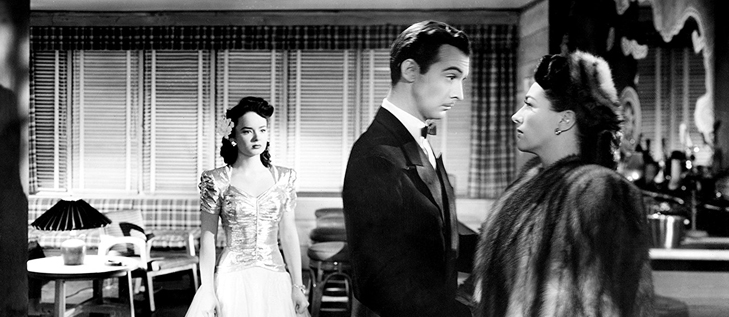
The original Depression-Era story seems equally relevant in the postwar recovery period. Newly divorced housewife Mildred Pierce (Joan Crawford) is desperate to raise her daughters in style, especially her precociously sinister teenager Veda (Ann Blyth). Mildred secretly becomes a waitress for restaurant manager Ida Corwin (Eve Arden) while dodging the passes of her ex-husband’s unscrupulous ex-partner, Wally Fay (Jack Carson). A soaring business success, Mildred opens her own chain of restaurants by correctly judging the needs and tastes of middle-class people like herself. But she strains her bank accounts to satisfy the growing desires of Veda, and to associate with the ritzy moneyed set in Pasadena. Mildred finds herself attracted to the high bred but penniless Monty Beragon (Zachary Scott), a mistake that leads not to happiness, but multiple betrayals and murder.
When a single movie turns out as good as Mildred Pierce there’s a tendency to simply list the unpredictable but hindsight-obvious factors that made it a classic, and then fold one’s hands. James M. Cain’s novels The Postman Always Rings Twice and Double Indemnity were considered too raw for the page, let alone the screen. Mildred Pierce captures precisely the book’s quiet vision of Los Angeles rot, the stories one hears about new neighbors, about how some people become successful while others do not. The book’s Mildred is A Woman Alone, stranded not in a dark mystery but in the middle of suburban reality. Emotionally destroyed after throwing her husband out of the house for taking up with Mrs. Biederhoff, Mildred realizes that the break gives her a freedom to pursue her own path. As if embarking on an adventure, the book’s Mildred beds and discards the callow Wally Fay, just to see what all the fuss is about. Her husband couldn’t avoid being cheated by Wally, but she can. In the book Mildred is amoral yet principled as she finds her way through the minefield of free enterprise in a man’s world.

The movies favor heroes, and Joan Crawford’s Mildred gains our admiration for escaping poverty through determination, hard work, and honest fair play. That’s still possible in America, and it’s the nation’s true religion. Mildred wins the unswerving loyalty of her gal pal Ida, but, like a flawed Greek heroine, she’s cursed by other components of her personality: misplaced ambition and a blindness to those closest to her.
After ten years of Production Code- mandated fantasies, the film’s depiction of a broken home and unyielding economic problems was a dose of reality. Mildred of course doesn’t sleep with Wally Fay, but the possibility is always there. She instead focuses on the big problem of nurturing her brood. But Mildred has grave faults – she’s blind to the personalities of her daughters, and favors one over the other.
The fate of little Kay hit audiences as a shock. When a child’s life was threatened in earlier melodramas it was almost always in the context of a desperate emergency confected to reunite a troubled couple: can the needed serum be flown from Omaha in time? Killing off a kid — usually by car, truck, or other handy vehicle — was reserved as the last straw in out-of-control morality plays like Boys Town. In Mildred Pierce little Kay’s death is accidental, but it has all the earmarks of negligence, Hollywood style: when she should be making sure that Kay wears her raincoat, Mildred is instead out at Malibu being promiscuous with lothario Monty Beragon. Whatever you do, young parents, don’t let your daughters go out without their raincoats. George Bailey trusted a teacher and was almost left with nothing but Zuzu’s petals.

The tragedy becomes Mildred’s excuse to become obsessed with winning all the advantages she can for her other daughter Veda, a female reptile like none seen before. Veda is a contemptuous User for whom any gift is too shabby. She greedily consumes high-toned luxuries, pretending to love their source while constantly angling for a better deal. In the book we can assume that Veda started out human and became a Frankenstein’s Monster through Mildred’s warped idea of Mother Love. In the film Veda is a Bad Seed from the get-go, and Mildred’s only sin is failing to recognize her treacherous nature . As incarnated by the beautiful, sneering Ann Blyth, Veda is convincingly insincere and transparently patronizing. Even the fatheaded Wally Fay can detect the distortion in Veda’s personality, but mother remains blindly devoted to the bitter end. Mildred has no personal need for the polo lifestyle or the Pasadena mansion with the servants. It’s all for Veda.
The most lethal femme fatale is not some foreign Dragon Lady, but an All-American girl. Beautiful, deceitful and ruthless, Veda takes the cake for sheer nerve. Her callous exploitation (abetted by Wally Fay) of the poor Forrester kid and his rich family is the work of a junior-league Borgia. When she makes a move on Mildred’s own second husband, she’s too much for even the self-satisfied Monty Beragon.
(spoilers aplenty follow, for both book and movie.)
Mildred Pierce’s lengthy noir flashback frames a back story (ten years?) with a spicy murder for which we assume Mildred is guilty. Mildred recounts her life to the chief of detectives down at City Hall in the dead of night, where we’d more expect to find Philip Marlowe under the bright lights. Although the bulk of Mildred’s testimony plays in sunny Glendale and Burbank, dark shadows are her natural habitat, and the presumption of her guilt, trying to clear her innocent first husband (Bruce Bennett) of the killing of her second, puts a fated pallor over her rise from domesticity to business success. As Mildred’s fortunes improve, there’s the nagging feeling that her ambition is an American expression of original sin, that she’ll be brought low for the crime of wanting to rise.

The murder plot and flashback gambit are the invention of screenwriter Ranald MacDougall. James M. Cain’s novel finds less glamorous ways for Mildred to be brought low. Veda becomes a famous opera singer, leaving mother behind like a spent cocoon. After fleecing Mildred, Veda and Wally Fay form a union of petty evil. After his drinking partnership with Mrs. Biederhoff fizzles, Mildred’s first hubby Bert Pierce returns to live with her in a shabby one-room apartment. Mildred and Bert console themselves with a bottle and a bitter kiss-off line: “The Hell with ’em, anyway.”
In the film, all bad behavior is punished by upping the top transgression to Murder One. Mildred walks out into a new dawn with the dependable Bert. She’s penniless, but free of her illusions. The super-mom has buried one daughter and seen another to prison. Is the dawn forgiving? The ending is a bleak blend of anguish and uplift, that trumps film noir and women’s soaps in one go.
Joan Crawford was a calculating Hollywood player who made plenty of enemies and couldn’t save her failing fortunes at the MGM factory. At Warners she weighed her options with consummate skill, stalling for more than a year until this perfect vehicle came along. The endless succession of determined working girls she played back at MGM culminate in Mildred, the patron saint of every small town climber who ever got scalded in the attempt to better herself. Mildred Pierce put Crawford at the peak of success, something she’d always been denied at Metro.

From this point on the psychology of her screen roles range from obsessive to outlandish, as ‘powerful but flawed’ females coping with melodramatic situations, often against other women. Crawford battles a demonic Mercedes McCambridge in Johnny Guitar, a classic that was actually improved by Joan’s imperious script meddling. Critics pegged What Ever Happened to Baby Jane? as the height of campy self-parody, when it simply continues ‘The Curse of Veda’ that haunts her later pictures. The theme is a pitiful joke by the time Crawford is defending herself against evil daughters and younger women in Strait-Jacket (Diane Baker) and Berserk! (Judy Geeson). Crawford’s character in Strait-Jacket seems a grotesque parody of Mildred Pierce. The ‘daughter curse’ extends even to Joan’s brief appearance in an episode of TV’s The Man from U.N.C.L.E. Her character is murdered early on, but not before we find out that that she’s the victim of a vicious, unfeeling daughter.
Mildred Pierce defines Michael Curtiz’s distinctive directing style. The pace is like that of a steeplechase, yet doesn’t feel unduly rushed. What’s removed is all the narrative fat. Curtiz deftly nails every visual and script point before quickly moving on. Compared to movies then or now, the show covers twice as much narrative material in half the screen time. The drama unfolds perfectly, with the emotional touches in all the right places. Through Curtiz’ nervous camera, we get the impression of a world always on the move, never resting, a good filmic approximation of the unsettled, vaguely desperate postwar anxiousness to succeed.
Even those characters left under-elaborated (Bennet’s Bert Pierce) or abandoned (Arden’s Ida Corwin) by the fast pace make indelible impressions. Zachary Scott followed up his oily Monte Beragon with a succession of creeps and weaklings, culminating in the title role of Edgar G. Ulmer’s Ruthless. Too often tossed off in stupid Warners comedies, jovial Jack Carson is the film’s big dramatic surprise. He nails the everyday selfishness of Wally Fay, a cheerfully average American heel. Wally is the used car salesman who laughs up his sleeve at the suckers, or the backstabbing business partner who then expects his victim to be a good sport. More of James M. Cain translates into this film than is usually given credit for.

